




01. Edit your mv 47 form ny online
Type text, add images, blackout confidential details, add comments, highlights and more.

Type text, add images, blackout confidential details, add comments, highlights and more.

Draw your signature, type it, upload its image, or use your mobile device as a signature pad.

Send mv 47 form via email, link, or fax. You can also download it, export it or print it out.
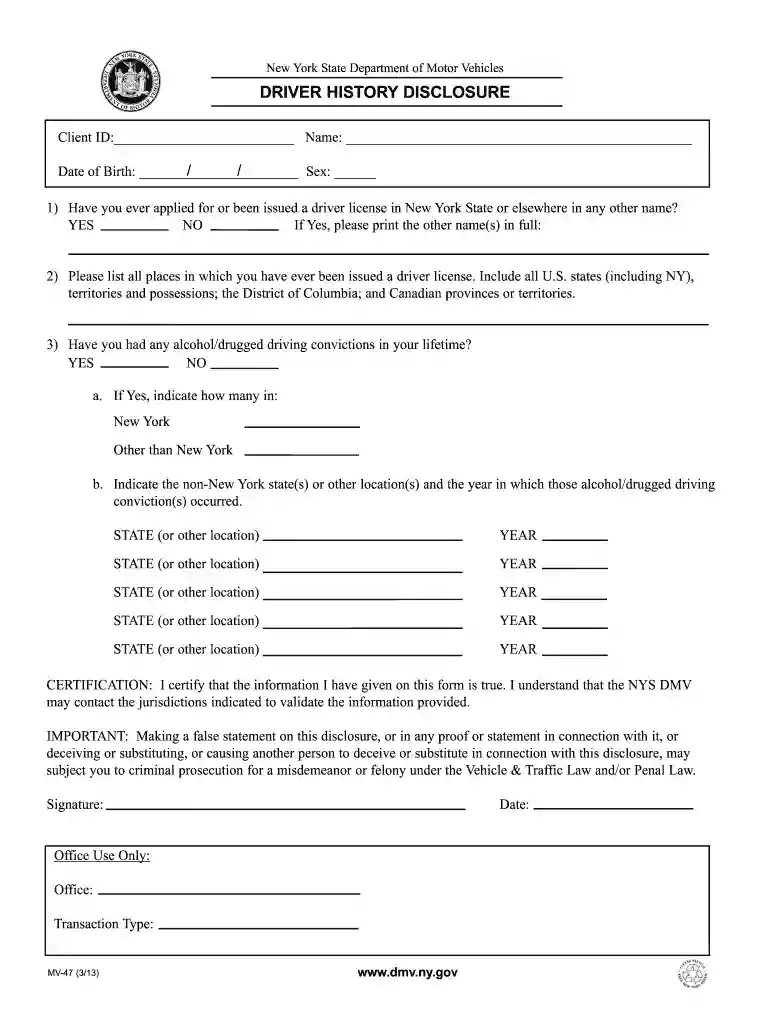
The MV-47 form, also known as the Driver History Disclosure form, is used in New York State to collect vital personal information from individuals seeking to disclose their driving history. This form plays a crucial role for various stakeholders including insurance companies, employers, and government agencies that require verification of an individual's driving record. The primary purpose of the MV-47 is to provide an official account of any incidents that may affect an individual's driving eligibility, such as past alcohol or drug-related convictions.
Key elements that the MV-47 form addresses include:
The legal implications tied to the information disclosed on the MV-47 form underline its significance, as providing false information can lead to criminal prosecution.
Filling out the MV-47 form involves several straightforward steps that ensure accurate completion. Individuals should follow the structured approach outlined below to avoid common pitfalls and ensure compliance with state mandates.
Gather Necessary Information: Before starting, individuals should compile relevant documents such as their driver license number, previous address history, and any records of past convictions.
Fill out Personal Details: The first section of the MV-47 form requires the applicant to enter their name, date of birth, and current address. It is important to ensure that all information is up-to-date and correctly entered.
Provide Driver History: The second section asks for information about previous driving licenses held, including the license numbers and issuing states. This section must accurately reflect the applicant's driving history to avoid discrepancies.
Disclose Convictions: Applicants must honestly answer questions regarding any past convictions related to driving, particularly those involving drugs or alcohol. This is critical as it influences the assessment of the individual's driving eligibility.
Certification and Signature: Finally, applicants must sign the form, certifying that all information provided is truthful. This section reinforces the legal accountability attached to the disclosures made.
Individuals should carefully review the completed form to ensure accuracy before submission.
The MV-47 contains several important sections, each serving a distinct purpose in the context of driver history disclosure. Understanding these elements is vital for effective completion and compliance.
Personal Identification: This includes full name, address, date of birth, and driver's license number. Accurate personal information is essential for proper identification.
Previous Licenses: Details of all previous licenses held, including license type and issuing authority. This helps create a comprehensive view of the individual’s driving history.
Conviction History: The applicant must report any drug or alcohol-related driving convictions. This critical information can significantly affect insurance rates and employment eligibility.
Verification Statement: The form includes a statement to verify that all provided information is correct. Falsifying information can lead to severe penalties, reinforcing the need for honesty.
Having a clear understanding of these sections ensures that applicants can navigate the form without confusion, thereby increasing the likelihood of a successful submission.
The legal ramifications associated with the MV-47 form are vital for applicants to understand. This form is not just a standard request for information; it carries legal weight and implications.
Legally Binding Disclosure: Providing a signature on the MV-47 form signifies that all information is accurate, which subjects the applicant to penalties for false information. Under the New York State Vehicle and Traffic Law, inaccurate or misleading disclosures can lead to criminal charges.
Regulatory Compliance: Entities such as employers and insurance companies often require the MV-47 to assess risk and liability. Utilizing this form ensures compliance with regulations while safeguarding against potential legal challenges.
Record Keeping: The completion of the MV-47 creates a documented account of disclosures that can be referenced in the event of disputes regarding driving history.
Understanding these legal considerations can help applicants make informed decisions regarding their disclosures and the potential consequences of their driving history.
Familiarity with specific terminology associated with the MV-47 form is crucial, as it aids in avoiding misunderstandings during the completion process.
Disclosure: Refers to the process of revealing pertinent information regarding one's driving history, including any past convictions.
Convictions: Legal judgments or sentences given for violations related to driving, particularly under the influence of drugs or alcohol.
Certification: The act of confirming that the information submitted is true and correct, which is legally binding once the form is signed.
Driver License Number: A unique identifier assigned to each driver that is critical for tracking and verifying personal driving histories.
Understanding these terms ensures that individuals engage with the MV-47 form knowledgeably, reducing the likelihood of errors that could lead to legal consequences.
We've got more versions of the mv 47 form ny form. Select the right mv 47 form ny version from the list and start editing it straight away!
| Versions | Form popularity | Fillable & printable |
|---|---|---|
| 2013 | 4.9 Satisfied (217 Votes) |
Yes, it is possible with DocHub. This secure and compliant online service has a phone-based signing option. When you log in to your DocHub account and add your mv47 to our editor, complete all empty fields and use the Sign feature on the upper barf. Click on Create your signature and choose Phone from the available choices. Here, you scan a QR code with your smartphone and draw your signature on your phone screen, as you usually do when approving physical papers. If you access DocHub right from your mobile device, you can eSign your form by drawing your eSignature, adding its image, or simply with a typed name.
When you edit your mv 47 with DocHub, you will not need to look for other applications or services to eSign it. An electronic signature is part of DocHub’s extensive editing toolset, which enables you to apply changes in your form without switching between platforms. Simply complete your form, double-check the correctness of your data and put your electronic signature at the end to make it submission-ready within minutes.
At DocHub, your data security is our priority. We follow HIPAA, SOC2, GDPR, and other standards, so you can work on your documents with confidence.





Some features are not available in certain regions. Due to product improvements, specifications and appearance are subject to change without notice.Read more
A non-domiciled CDL allows individuals to operate commercial motor vehicles. Who can apply for a non-domiciled CDL? IndividualsRead more
Food for Americas Future! Manufacturing baby food. Gerber, Fremont, MI. Concrete with the Bends! Testing concrete beams. Austin Co., Cleveland, OH.Read more


