Type text, add images, blackout confidential details, add comments, highlights and more.
02. Sign it in a few clicks
Draw your signature, type it, upload its image, or use your mobile device as a signature pad.
03. Share your form with others
Send it via email, link, or fax. You can also download it, export it or print it out.
How to use or fill out Office Lease Agreement - North Dakota with our platform
Ease of Setup
DocHub User Ratings on G2
Ease of Use
DocHub User Ratings on G2
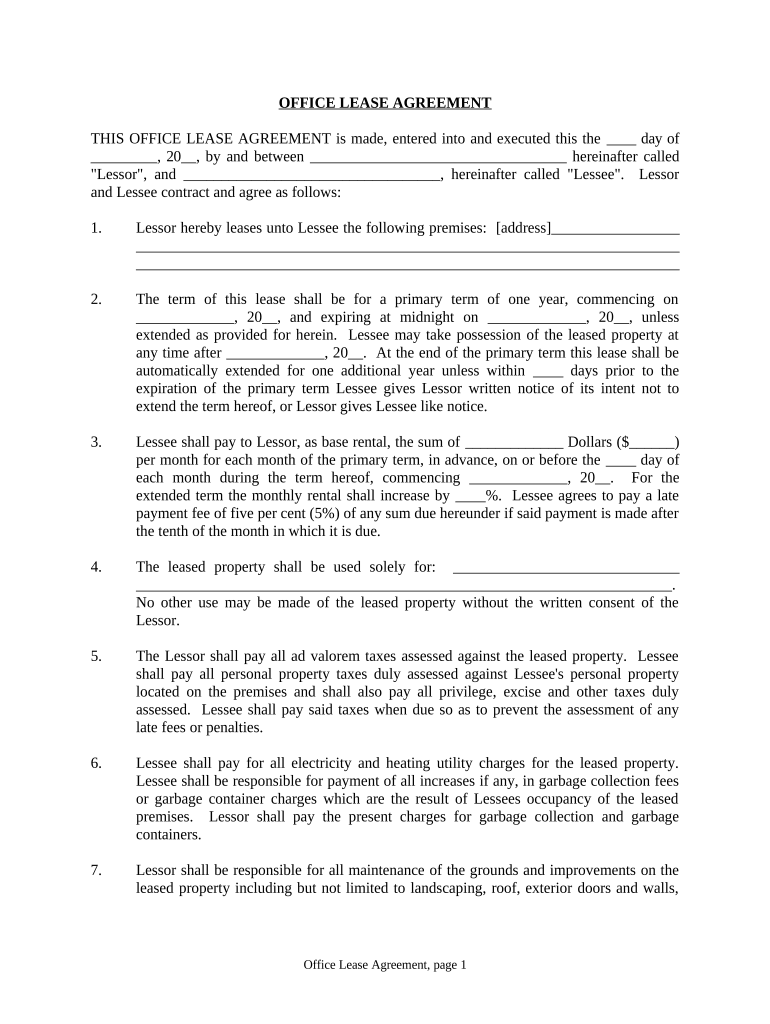
Click ‘Get Form’ to open the Office Lease Agreement in the editor.
Begin by filling in the date of execution at the top of the document. This is crucial for establishing the timeline of your lease.
In Section 1, enter the names of both parties involved: Lessor and Lessee. Ensure that all names are spelled correctly to avoid any legal issues.
Proceed to Section 2 and specify the address of the leased premises, along with the start and end dates of the lease term. Pay attention to any options for extension mentioned here.
In Section 3, input the monthly rental amount and due date. Be mindful of any late fees that may apply if payments are not made on time.
Continue through each section, ensuring you complete details regarding property use, maintenance responsibilities, and insurance obligations as outlined in Sections 4 through 14.
Finally, review all entries for accuracy before signing in the designated areas at the end of the document. This ensures both parties agree to all terms laid out in this agreement.
Start using our platform today to easily fill out your Office Lease Agreement for free!
Fill out Office Lease Agreement - North Dakota online It's free
Can you write your own tenancy agreement? Certainly. Unless youre an attorney, or have an attorney review it, you probably shouldnt, But you certainly can. If you fail to follow your state/local laws to-the-letter, the agreement may be invalid.
How do I lease out office space?
How To Lease Office Space in 8 Steps Become familiar with the leasing journey. Determine if you should hire a broker. Assess your space needs. Develop a budget. Select a location and a building. Negotiate with landlords. Build out space. Pack up and move (if applicable).
What type of lease typically is used for office leases?
Gross Lease Gross leases are most common for commercial properties such as offices and retail space. The tenant pays a single, flat amount that includes rent, taxes, utilities, and insurance. The landlord is responsible for paying taxes, utilities, and insurance from the rent fees.
What are the standard office lease terms?
Most office space leases stretch for 5-10 years, but some landlords prefer to set yearly renewals for leases. Its possible to have a break clause at the midpoint of the lease duration. This is only possible if the lease agreement states it as part of the terms.
How long are most office leases?
The duration of office leases can vary, but most range from 1 to 10 years. The average lease term for office space tends to be around 3 to 5 years. Factors influencing lease duration include the tenants business needs, industry standards, and negotiations between the landlord and tenant.
Related Searches
Simple office lease agreement north dakotaOffice lease agreement north dakota template freeOffice lease agreement north dakota pdfFree office lease agreement north dakota
Security and compliance
At DocHub, your data security is our priority. We follow HIPAA, SOC2, GDPR, and other standards, so you can work on your documents with confidence.
It is for this reason that commercial lease terms typically range from three to five years or longer. If improvements for a tenant need to be made to the space and the landlord is paying for them, the terms tend to be longer based on the cost of the improvements.
What is a typical lease term?
The proper real estate terminology depends on the state and local laws, but generally: Rental agreements are usually short-term or month-to-month. A standard lease is for more extended periods (six months or one year)
Related links
N.D. Admin Code 99-01.3-02-06 - Rental agreement
1. A rental agreement must be signed and dated by a lessor and organization. 2. An agreement must contain: 3. Rent must be a fixed dollar amount per month. 4
Cookie consent notice
This site uses cookies to enhance site navigation and personalize your experience.
By using this site you agree to our use of cookies as described in our Privacy Notice.
You can modify your selections by visiting our Cookie and Advertising Notice.