Letter from Tenant to Landlord about Landlord using Unlawful Self-Help to Gain Possession - North Dakota 2026

Get Form
squatters rights in north dakota Preview on Page 1

Here's how it works

01. Edit your squatters rights in north dakota online
Type text, add images, blackout confidential details, add comments, highlights and more.
02. Sign it in a few clicks
Draw your signature, type it, upload its image, or use your mobile device as a signature pad.
03. Share your form with others
Send north dakota squatters rights via email, link, or fax. You can also download it, export it or print it out.

How to use or fill out Letter from Tenant to Landlord about Landlord using Unlawful Self-Help to Gain Possession - North Dakota with our platform

Form edit decoration
9.5
Ease of Setup
DocHub User Ratings on G2
9.0
Ease of Use
DocHub User Ratings on G2
  1. Click ‘Get Form’ to open it in the editor.
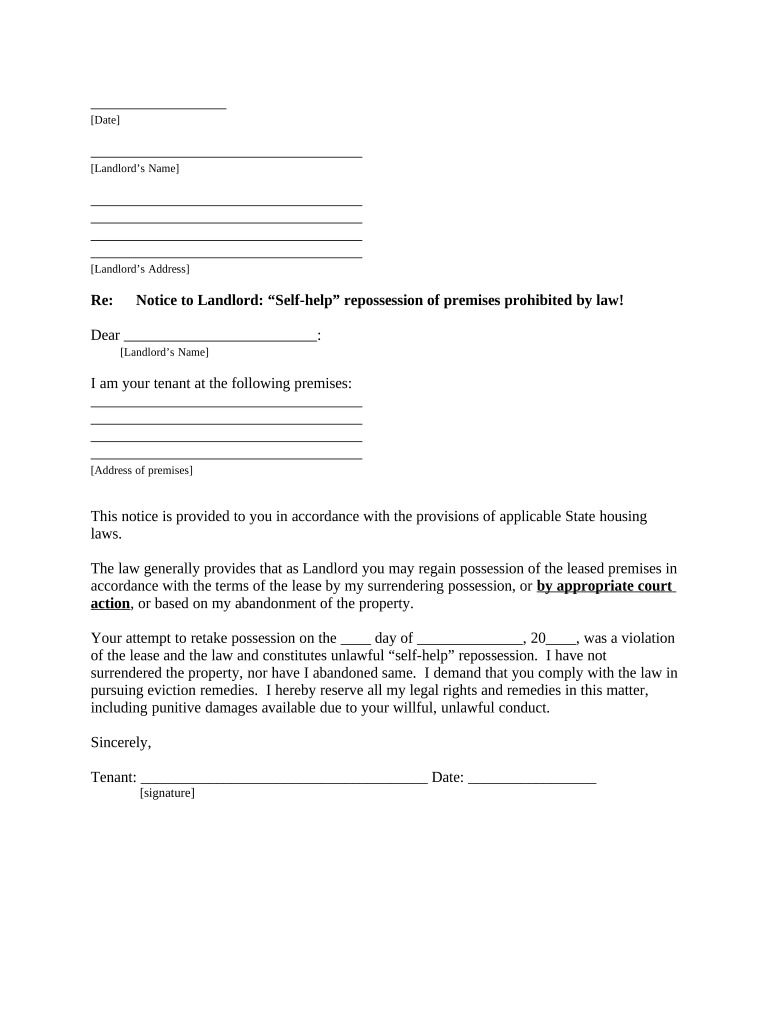
  2. Begin by entering the date at the top of the letter. This is important for record-keeping and legal purposes.
  3. Fill in the landlord’s name and address in the designated fields. Ensure accuracy to avoid any miscommunication.
  4. In the greeting, address your landlord directly by name, maintaining a professional tone.
  5. Provide your address as the tenant in the specified section. This confirms your identity and residence.
  6. Clearly state the date of the unlawful self-help repossession attempt. This is crucial for establishing a timeline of events.
  7. Sign and date at the bottom of the letter, ensuring that your signature matches any previous documents you’ve submitted.
  8. Complete the Proof of Delivery section by selecting how you delivered this notice to your landlord, signing, and dating it accordingly.

Start using our platform today to easily fill out and manage your important documents for free!

be ready to get more

Complete this form in 5 minutes or less

Get form

Got questions?

We have answers to the most popular questions from our customers. If you can't find an answer to your question, please contact us.
Contact us
What is holding over? Holding over is simply a tenant remaining in occupation of premises once the original term of their letting has come to an end. Holding over the risks. Holding over principally presents risks as a result of the lack of clarity on the legal position of the parties that it creates.
Yes, North Dakota is generally considered landlord-friendly. The state does not impose rent control, places no statutory cap on late fees, and offers broad flexibility in lease terms. However, landlords must still comply with federal fair housing laws and follow due process for evictions.
The eviction process can generally last two weeks to several months, depending on the situation.
A holdover tenant is a renter who remains in a property after the expiration of the lease. If the landlord continues to accept rent payments, the holdover tenant can continue to legally occupy the property, and state laws and court rulings determine the length of the holdover tenants new rental term.
In North Dakota, a holdover tenant is someone who remains in possession of a rental property after the lease has expired or been terminated. The status of a holdover tenant can be either a tenant at will or a tenant at sufferance, depending on the landlords consent.

Security and compliance

At DocHub, your data security is our priority. We follow HIPAA, SOC2, GDPR, and other standards, so you can work on your documents with confidence.

Learn more
ccpa2
pci-dss
gdpr-compliance
hipaa
soc-compliance

People also ask

If an attorney is representing the tenant, the attorney must electronically file the counterclaim. A counterclaim must include the same case name and case number as the landlords case. At the bottom the counterclaim should state how and when the counterclaim is being served on the landlord.
You may also hear the term tenancy at sufferance when talking about a tenant holdover. Simply put, this refers to the situation when the renter remains on the rented property after the lease expired, without the landlords consent and without signing a new lease.
In California, landlords must be aware of the proper protocol for disposing of a tenants belongings after eviction. Its illegal for landlords to simply discard or throw them away and a landlord must notify you in writing of these rights.

nd squatters rights