Letter from Tenant to Landlord about Fair Housing Reduction or Denial of services to Family with Children - Missouri 2026

Get Form
which of the following could potentially be exempt from the fair housing act Preview on Page 1

Here's how it works

01. Edit your which of the following could potentially be exempt from the fair housing act online
Type text, add images, blackout confidential details, add comments, highlights and more.
02. Sign it in a few clicks
Draw your signature, type it, upload its image, or use your mobile device as a signature pad.
03. Share your form with others
Send it via email, link, or fax. You can also download it, export it or print it out.

How to use or fill out Letter from Tenant to Landlord about Fair Housing Reduction or Denial of services to Family with Children - Missouri

Form edit decoration
9.5
Ease of Setup
DocHub User Ratings on G2
9.0
Ease of Use
DocHub User Ratings on G2
  1. Click ‘Get Form’ to open it in the editor.
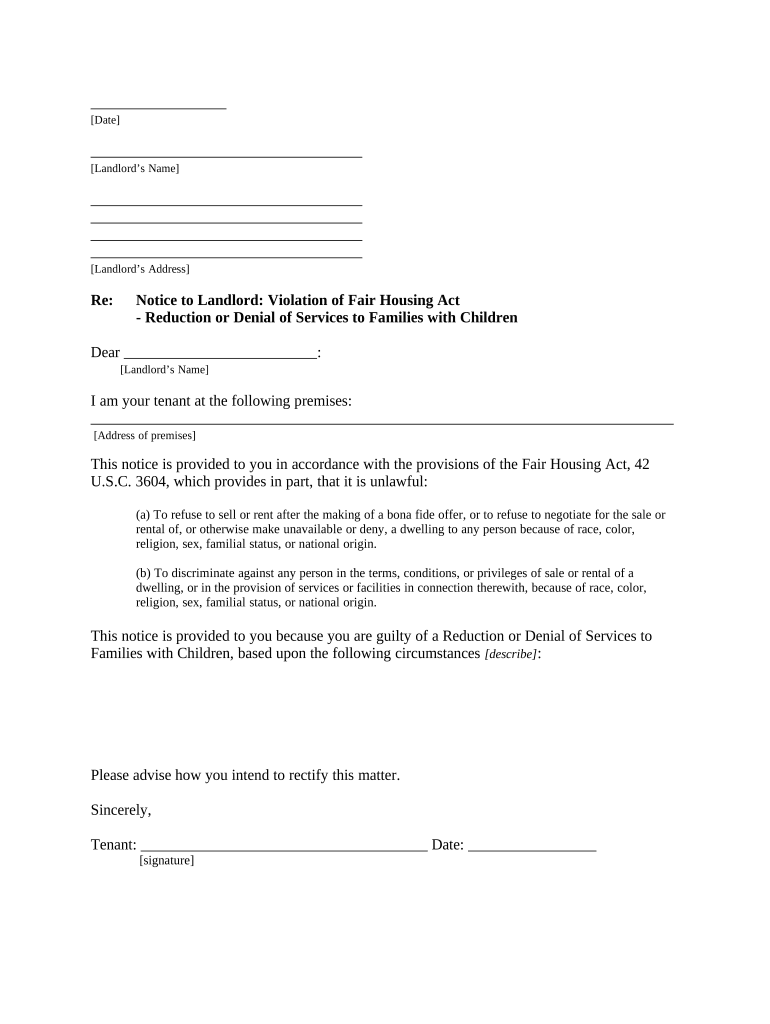
  2. Begin by entering the date at the top of the document. This is important for record-keeping.
  3. Fill in the landlord’s name and address in the designated fields. Ensure accuracy to avoid any miscommunication.
  4. In the greeting, address your landlord directly by name, maintaining a professional tone.
  5. Provide your address as the tenant in the specified section. This establishes your identity and residence.
  6. Clearly state the violation of the Fair Housing Act, referencing specific sections as needed for clarity.
  7. Describe the circumstances leading to this notice in detail, ensuring you provide enough context for your claims.
  8. Request a response from your landlord on how they plan to rectify this issue, promoting an open dialogue.
  9. Sign and date at the bottom of the letter where indicated, confirming that you are indeed sending this notice.
  10. Complete the proof of delivery section by selecting how you delivered this notice and signing it accordingly.

Start using our platform today to easily fill out and manage your documents online for free!

be ready to get more

Complete this form in 5 minutes or less

Get form

Got questions?

We have answers to the most popular questions from our customers. If you can't find an answer to your question, please contact us.
Contact us
As a renter in Missouri you have rights: a right to a safe, sanitary, and livable home; a right to not have your utilities shut-off by the landlord; a right to privacy and respect; and a right to not have your landlord retaliate against you for reporting housing code violations.
Familial status is about the presence of children under 18 in someones household. Sometimes housing providers try to avoid renting to anyone whos raising kids. Or theyll try to segregate them from other residents.
The Complainant must show that they are a member of a protected class. The protected classes under the federal Fair Housing Act are race, color, religion, national origin, sex, disability, and familial status. The complaint must show that they were qualified for the housing transaction.
The Federal Fair Housing Act and the Missouri Human Rights Act prohibit discrimination in housing rental, sales, and lending due to race, color, national origin, religion, physical or mental disability, sex, or having children in the household.
The Fair Housing Act protects people from discrimination when they are renting or buying a home, getting a mortgage, seeking housing assistance, or engaging in other housing-related activities.

Security and compliance

At DocHub, your data security is our priority. We follow HIPAA, SOC2, GDPR, and other standards, so you can work on your documents with confidence.

Learn more
ccpa2
pci-dss
gdpr-compliance
hipaa
soc-compliance

People also ask

Discriminatory Refusal to Rent or Sell Housing One of the most common fair housing violations involves landlords or property owners refusing to rent or sell housing based on a persons protected status. This type of discrimination can manifest in different ways and can docHubly restrict housing access.
The term mental or physical impairment may include conditions such as blindness, hearing impairment, mobility impairment, infection, mental retardation, alcoholism, drug addiction, chronic fatigue, learning disability, head injury, and mental illness.

Related links