




01. Edit your ysq s3 pdf online
Type text, add images, blackout confidential details, add comments, highlights and more.

Type text, add images, blackout confidential details, add comments, highlights and more.

Draw your signature, type it, upload its image, or use your mobile device as a signature pad.

Send young schema questionnaire via email, link, or fax. You can also download it, export it or print it out.
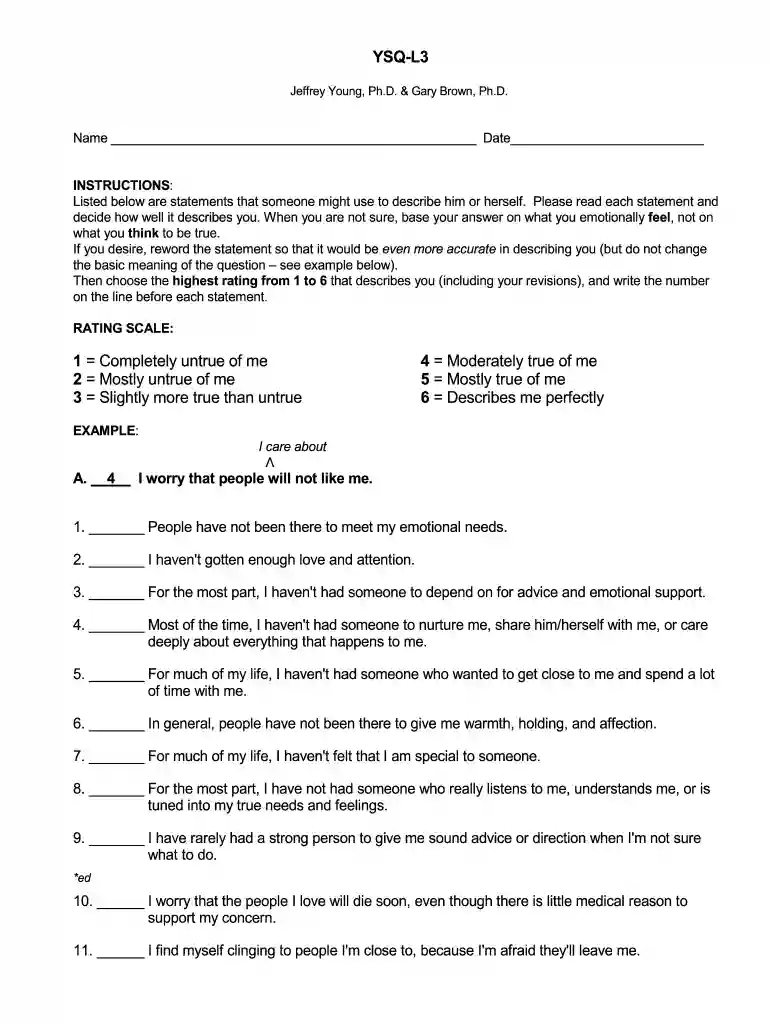
The Young Schema Questionnaire (YSQ) S3 Short Form is a psychological assessment tool that focuses on identifying maladaptive schemas and their impact on interpersonal relationships and emotional health. It is a streamlined version of the full YSQ, designed to assess foundational beliefs developed during childhood and adolescence. The short form is particularly useful in various settings, including clinical psychology, counseling, and research, due to its efficiency and comprehensiveness.
The YSQ S3 Short Form PDF consists of statements that respondents rate based on their agreement or disagreement. This format allows for the rapid identification of core schemas that may influence a person's behavior and emotional responses. The form is categorized into several bondable schema domains, which include:
By focusing on these areas, the YSQ S3 provides insights into an individual's emotional needs and relational patterns, which can guide therapeutic interventions.
The administration process for the YSQ S3 is straightforward, typically involving the following steps:
The scoring process for the YSQ S3 involves assigning numerical values to the responses given by the individual on the questionnaire. Each schema domain is then evaluated based on these scores. Key points include:
The YSQ S3 Short Form has undergone rigorous testing to establish its validity and reliability in measuring schema-related constructs. Key findings include:
The YSQ S3 is applicable in various contexts, including:
With its focused approach, the YSQ S3 Short Form PDF serves as an essential tool in psychology, aiding in the identification and understanding of personal schemas that affect emotional health and relationships.
At DocHub, your data security is our priority. We follow HIPAA, SOC2, GDPR, and other standards, so you can work on your documents with confidence.


by L Botter 2026 Download PDF icon Download PDF Young Schema Questionnaire Short Form Version 3 (YSQ‐S3): Preliminary Validation in Older Adults.Read more
The YSQ-S3 is a psychometrically valuable instrument for the assessment of Early Maladaptive Schemas in both clinical and research settings.Read more


