Authorization to Release Insurance Information - Minnesota 2026

Get Form
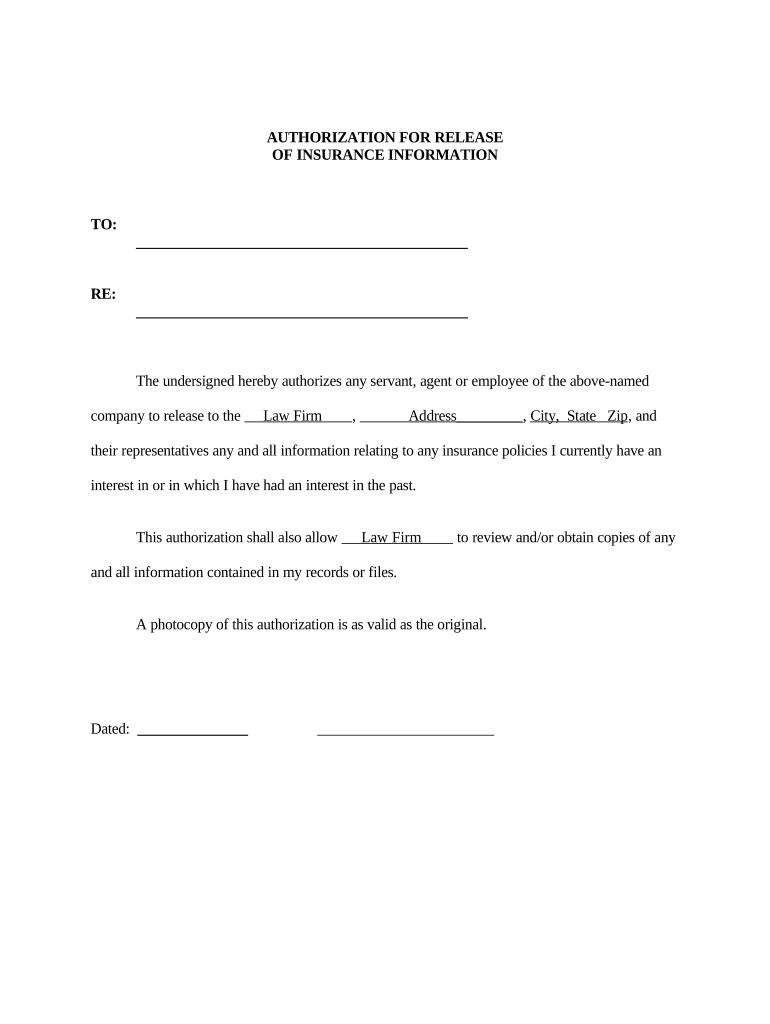
Authorization to Release Insurance Information - Minnesota Preview on Page 1

Here's how it works

01. Edit your form online
Type text, add images, blackout confidential details, add comments, highlights and more.
02. Sign it in a few clicks
Draw your signature, type it, upload its image, or use your mobile device as a signature pad.
03. Share your form with others
Send it via email, link, or fax. You can also download it, export it or print it out.

How to use or fill out Authorization to Release Insurance Information - Minnesota with our platform

Form edit decoration
9.5
Ease of Setup
DocHub User Ratings on G2
9.0
Ease of Use
DocHub User Ratings on G2
  1. Click ‘Get Form’ to open it in the editor.
  2. In the first section, enter the name of the company from which you are authorizing the release of information. This is crucial for identifying the source of your insurance details.
  3. Next, provide your name and any relevant details regarding your insurance policies in the designated fields. Be thorough to ensure all necessary information is captured.
  4. Fill in the law firm’s name and address where you want the information sent. This ensures that your authorization reaches the correct party.
  5. Date the document by entering today’s date in the specified field. This validates your authorization.
  6. Finally, sign your name at the bottom of the form. This signature confirms your consent for releasing insurance information.

Start using our platform today to easily complete and manage your Authorization to Release Insurance Information!

be ready to get more

Complete this form in 5 minutes or less

Get form

Got questions?

We have answers to the most popular questions from our customers. If you can't find an answer to your question, please contact us.
Contact us
Common scenarios where a signed release form is required include: Sharing medical records with a family member. A healthcare professional cant send test results to a spouse or parent unless the patient has given written permission. Sending records to an insurance company or attorney.
Under the HIPAA Privacy Rule, healthcare providers, health plans, business associates, and others involved in administration of healthcare, may not share a patients protected health information (PHI) without that patients written authorization.
The authorizations that most insurance companies will want you to sign are blanket authorizations that allow the company to obtain any and all of your medical records, even records that are completely unrelated to the injuries you suffered in the accident.
0:43 1:58 A description of the protected. Health information to be used and disclosed. The person authorizedMoreA description of the protected. Health information to be used and disclosed. The person authorized to make the use or disclosure. The person to whom the covered entity may make the disclosure.
A signed and dated patient consent is necessary for the records release. A consent is valid for one year, unless specified in the consent, or by law.

Security and compliance

At DocHub, your data security is our priority. We follow HIPAA, SOC2, GDPR, and other standards, so you can work on your documents with confidence.

Learn more
ccpa2
pci-dss
gdpr-compliance
hipaa
soc-compliance

People also ask

8 Key Elements of a Compliant Medical Records Release Form Patient Information. Purpose of Request. Dates of Service. Recipient Information. Valid Authorization Signature. Date of Signature. Restrictions or Limitations. Revocation Clause.
A consent to release medical information form will typically be requested when someone wants a copy of their own medical records or would like to have them sent to a third party. The request is made to the healthcare provider, therapist, or organization that has the patients records.
Authorization. A covered entity must obtain the individuals written authorization for any use or disclosure of protected health information that is not for treatment, payment or health care operations or otherwise permitted or required by the Privacy Rule.

Related links