Type text, add images, blackout confidential details, add comments, highlights and more.
02. Sign it in a few clicks
Draw your signature, type it, upload its image, or use your mobile device as a signature pad.
03. Share your form with others
Send it via email, link, or fax. You can also download it, export it or print it out.
How to use or fill out Interrogatories to Defendant for Motor Vehicle Accident - Minnesota
Ease of Setup
DocHub User Ratings on G2
Ease of Use
DocHub User Ratings on G2
Click ‘Get Form’ to open it in the editor.
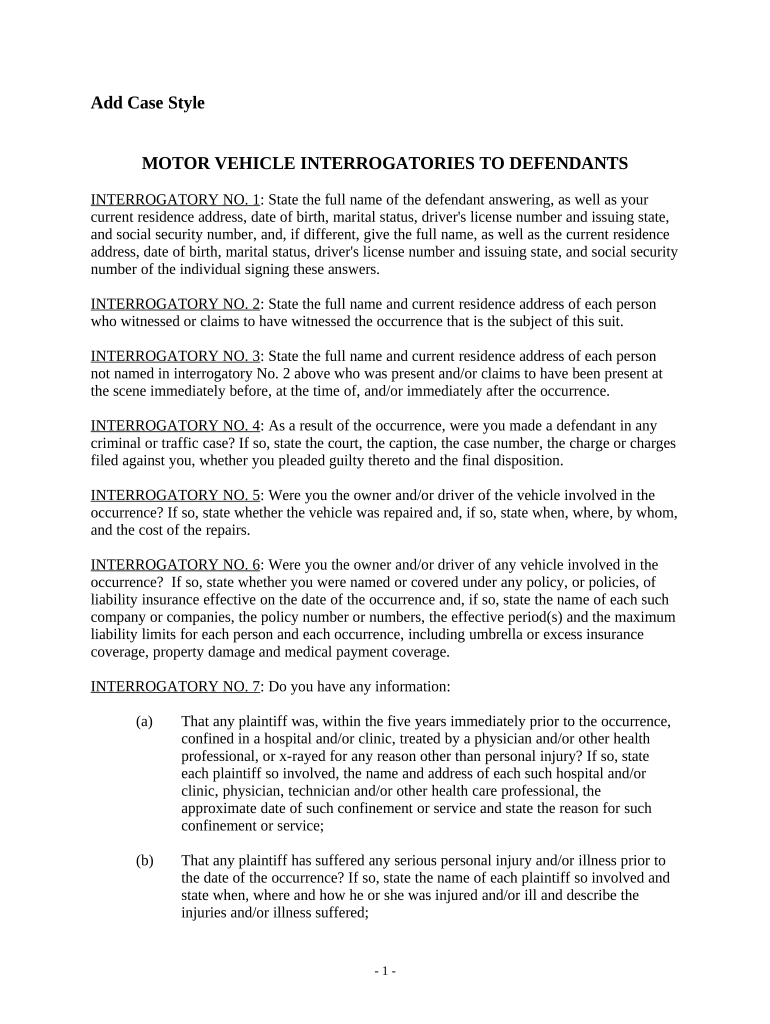
Begin with INTERROGATORY NO. 1, providing your full name, current residence address, date of birth, marital status, driver's license number and issuing state, and social security number. If someone else is signing the answers, include their details as well.
Proceed to INTERROGATORY NO. 2 by listing all witnesses who saw the incident. Ensure you provide their full names and addresses.
For INTERROGATORY NO. 3, identify any additional individuals present at the scene before, during, or after the accident.
Continue through each interrogatory systematically, ensuring that you answer questions regarding prior legal issues (INTERROGATORY NO. 4), vehicle ownership (INTERROGATORY NO. 5), insurance coverage (INTERROGATORY NO. 6), and any medical history relevant to the case (INTERROGATORY NO. 7).
Complete all remaining interrogatories by providing accurate information about conversations related to the incident (INTERROGATORY NO. 9) and any statements made by others (INTERROGATORY NO. 10).
Finally, review your responses for accuracy before saving or exporting your completed document.
Start using our platform today to fill out your Interrogatories efficiently and for free!
Fill out Interrogatories to Defendant for Motor Vehicle Accident - Minnesota online It's free
What is the statute of limitations on a car accident in Minnesota?
Under Minnesota law, the statute of limitations for filing a personal injury claim, including car accident cases, is typically six years from the date of the accident.
What are the tips for interrogatories?
Interrogatories should be brief, simple, particularized, unambiguous, and capable of being understood by jurors when read in conjunction with the answer. They should not be argumentative nor should they impose unreasonable burdens on the responding party.
What are the six basic questions to be answered in a report are called the interrogatories?
Rationale: Interrogatories are a formal set of written questions used in a legal proceeding. They are not related to the six basic questions to be answered in a report.
What to ask in interrogatories?
Interrogatories may also be useful to define what an adversarys claims or defenses are. To that end, a party may ask an opponent to identify each fact that supports its claims or each instance of misconduct that it alleges.
What is the statute of limitations on a slip and fall in Minnesota?
The Slip and Fall Statute of Limitations For most Minnesota slip and fall claims, you have two years from the date you were injured to sue. Different rules might apply when: youre hurt on government property. the injuries result in death.
Related Searches
Sample Interrogatories to Defendant car accidentSample interrogatory questions to PlaintiffSample interrogatories negligence to defendantPremises liability Interrogatories to DefendantSample interrogatories Civil casesSpecial interrogatories examplesSample Interrogatories to Defendant breach of contractMedical Malpractice Interrogatories to Plaintiff
Security and compliance
At DocHub, your data security is our priority. We follow HIPAA, SOC2, GDPR, and other standards, so you can work on your documents with confidence.
How long after a car accident can you file a claim in MN?
Some of the more common statutes of limitations under Minnesota law include: Six years: If your injury is caused by negligent conduct such as a car collision, trucking accident, or motorcycle accident, you typically have six years from the date of your injury to file your suit.
What can be asked in interrogatories?
Interrogatories are written questions sent by one party to another, which the responding party must answer under penalty of perjury. Interrogatories allow the parties to ask who, what, when, where and why questions, making them a good method for obtaining new information.
What is the best way to answer interrogatories?
When responding to interrogatories, simply stating I dont understand the question is insufficient. The proper approach is to specify which part is unclear and request clarification from the opposing party. Courts expect clear, complete, and truthful answers.
Related links
Chapter 9. Discovery Limitations
In Muller v. Rogers, the Minnesota Court of Appeals held that a defendant in a wrongful death action arising from an automobile accident waived his right to
Uniform interrogatories. (a) Uniform plaintiffs interrogatories to the defendant are as follows: PLAINTIFFS INTERROGATORIES TO DEFENDANT. INTERROGATORY NO
Cookie consent notice
This site uses cookies to enhance site navigation and personalize your experience.
By using this site you agree to our use of cookies as described in our Privacy Notice.
You can modify your selections by visiting our Cookie and Advertising Notice.