Partial Release of Property From Deed of Trust for Individual - North Carolina 2026

Get Form
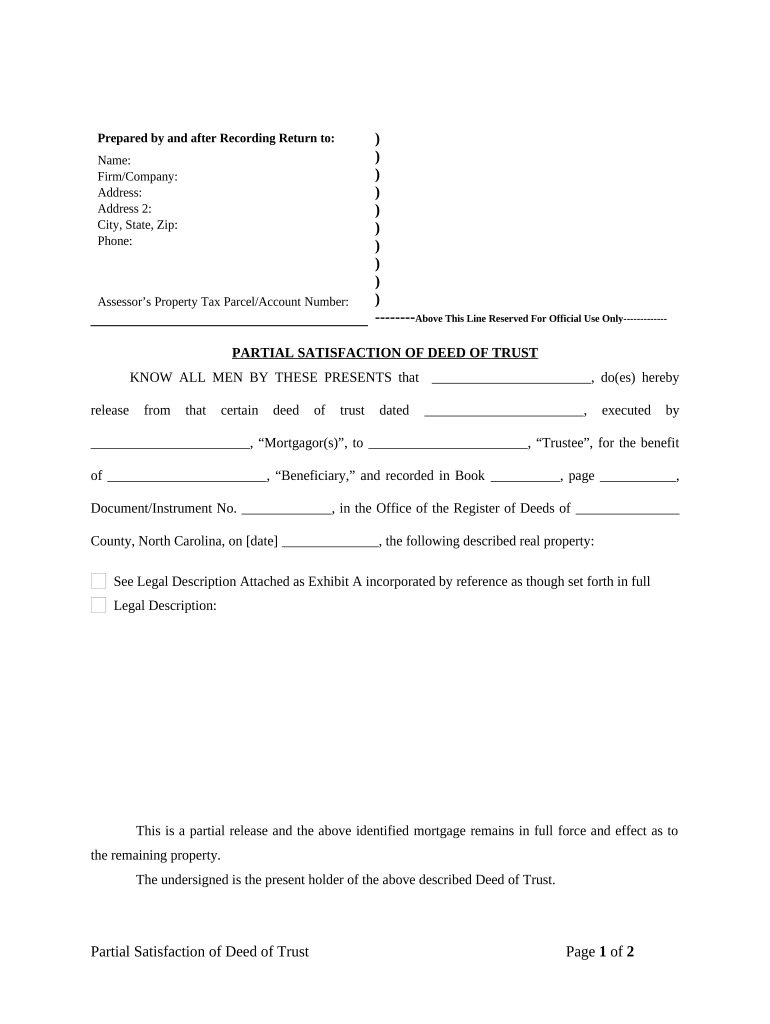
partial mortgage release form Preview on Page 1

Here's how it works

01. Edit your partial mortgage release form online
Type text, add images, blackout confidential details, add comments, highlights and more.
02. Sign it in a few clicks
Draw your signature, type it, upload its image, or use your mobile device as a signature pad.
03. Share your form with others
Send partial release of mortgage via email, link, or fax. You can also download it, export it or print it out.

How to use or fill out Partial Release of Property From Deed of Trust for Individual - North Carolina with our platform

Form edit decoration
9.5
Ease of Setup
DocHub User Ratings on G2
9.0
Ease of Use
DocHub User Ratings on G2
  1. Click ‘Get Form’ to open it in the editor.
  2. Begin by filling in the 'Prepared by and after Recording Return to' section. Enter your name, firm/company, address, city, state, zip code, and phone number.
  3. Next, locate the 'Assessor’s Property Tax Parcel/Account Number' field and input the relevant property tax information.
  4. In the 'Partial Satisfaction of Deed of Trust' section, clearly state the name(s) of the mortgagor(s) releasing the property from the deed of trust.
  5. Fill in the date of the original deed of trust and provide details about the trustee and beneficiary involved.
  6. Attach a legal description of the property as Exhibit A. Ensure this is accurately referenced in your document.
  7. Complete any applicable sections regarding assignments if necessary, including dates and recording information.
  8. Finally, sign and date the document. Ensure that a notary public certifies your signature where required.

Start using our platform today to easily complete your Partial Release of Property From Deed of Trust for free!

be ready to get more

Complete this form in 5 minutes or less

Get form

Got questions?

We have answers to the most popular questions from our customers. If you can't find an answer to your question, please contact us.
Contact us
A Release of Deed of Trust, sometimes called a Deed of Reconveyance, is a crucial document in real estate transactions. It signifies that the obligations under a deed of trust have been fulfilled, and the borrower is released from the security instruments obligations.
Instead of an agreement directly between a lender and a borrower, a trust deed places the title of a property in the hands of a third party, or trustee. Only after the borrower has satisfied the terms of their debt to the lender will the property be fully transferred to the borrower.
An instrument that transfers legal title in real property to a trustee to hold as security for a loan made by a lender to a borrower. The borrower retains equitable title to the real property.
Partial Release of Deed of Trust: In this case, only a portion of the property described in the legal description is released from the deed of trust. The remaining property continues to be subject to the lien until the obligations are fully satisfied.
The majority of the time a deed of trust is used in a real estate transaction in North Carolina, it will be a purchase money mortgage, or a mortgage issued to the borrower by the seller of the home as part of the purchase transaction, unlike a traditional mortgage which is obtained through a bank.

Security and compliance

At DocHub, your data security is our priority. We follow HIPAA, SOC2, GDPR, and other standards, so you can work on your documents with confidence.

Learn more
ccpa2
pci-dss
gdpr-compliance
hipaa
soc-compliance

People also ask

Every lender has different requirements for approving a partial release. Some may require additional payments to adjust the loan-to-value ratio, while others might need specific documentation or approvals. Always start by consulting your lender to understand their process.
A partial release allows the release of a portion of the collateral from a mortgage after the borrower has paid down a certain amount of the loan. Lenders require proof of payment, a survey map, an appraisal, and a letter outlining the reason for the partial release.

Related links