




01. Edit your patient registration form pdf online
Type text, add images, blackout confidential details, add comments, highlights and more.

Type text, add images, blackout confidential details, add comments, highlights and more.

Draw your signature, type it, upload its image, or use your mobile device as a signature pad.

Send patient registration form pdf free download via email, link, or fax. You can also download it, export it or print it out.
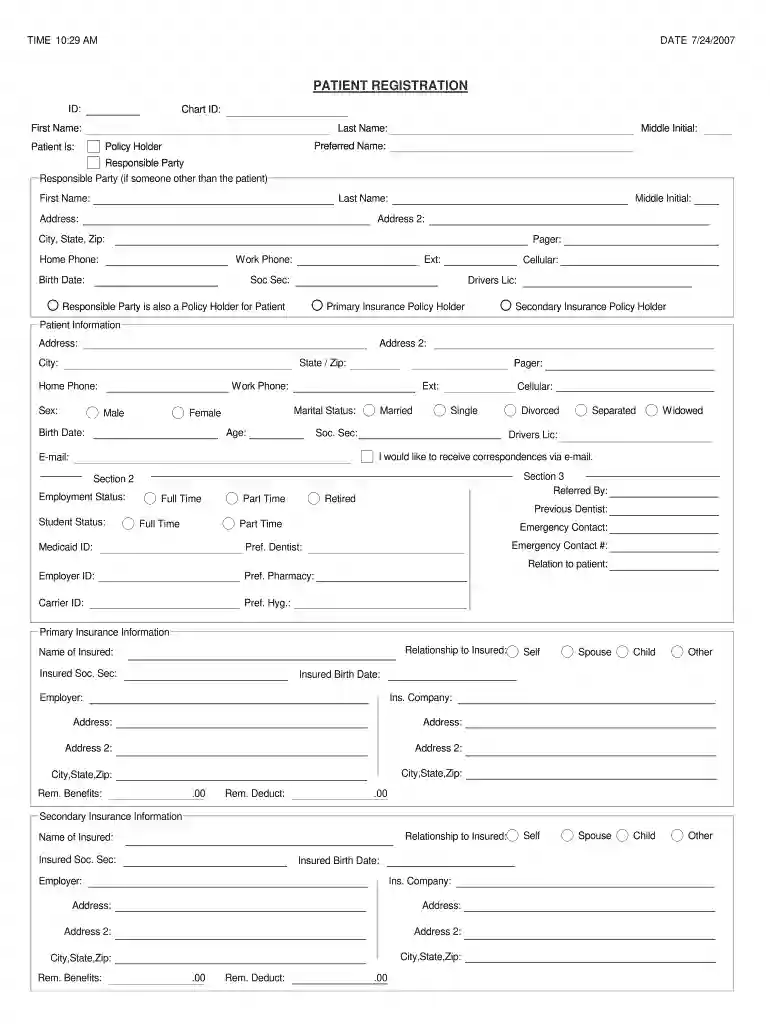
A Patient Registration Form is a crucial document used in healthcare settings to collect essential information about a patient. It typically gathers personal details, insurance information, and any relevant medical history. The primary aim is to create an efficient record that facilitates patient management and care delivery in medical environments.
Personal Details: This includes the patient's full name, address, date of birth, and contact information. It ensures that healthcare providers can communicate effectively with the patient and manage appointments.
Insurance Information: The form requires information about the patient's primary and secondary insurance providers. This helps verify coverage for medical services and streamlines the billing process.
Emergency Contact: Patients are asked to provide a contact person in case of emergencies. This is important for ensuring patient safety and facilitating timely communication.
Employment Status: Knowing a patient's employment status can assist healthcare providers in understanding potential health-related issues or coverage options.
Using the Patient Registration Form involves several straightforward steps. This ensures that all necessary information is collected accurately to provide optimal patient care.
Obtain the Form: The Patient Registration Form can be accessed as a PDF from various healthcare provider websites or downloaded through reputable sources.
Fill in Personal Information: Patients should begin by entering their full name, address, and contact details. Accuracy is vital to avoid miscommunication.
Insurance Details: Provide the names of the primary and secondary insurance providers along with policy numbers. This information helps in the billing process.
Medical History: Some forms may include questions about medical history, allergies, and current medications, which are critical for effective treatment planning.
Signature and Date: After completing the form, patients must sign and date it to confirm that the information provided is accurate and complete.
Completing the Patient Registration Form accurately helps medical staff provide tailored care. Incomplete information may lead to delays in services or complications in billing and insurance claims.
Accessing the Patient Registration Form is accessible and can be done through various channels to accommodate different preferences.
Online Download: Many healthcare facilities offer the option to download the form directly from their websites as a PDF. This provides convenience and immediate access.
In-Person Requests: Patients can visit their healthcare provider's office to request a physical copy. This is useful for those who prefer to complete the form on-site.
Email Request: Some providers allow patients to request the form via email, which can then be filled out and returned electronically.
By utilizing these methods, patients can ensure they have the correct and most recent version of the Patient Registration Form.
Understanding the terminology associated with the Patient Registration Form is vital for navigating healthcare processes effectively.
HIPAA: The Health Insurance Portability and Accountability Act protects patient privacy and ensures that personal health information is kept confidential.
Insurance Co-Payment: This is the amount a patient pays out-of-pocket for a covered healthcare service, with the remaining balance billed to the insurance provider.
Deductible: The amount a patient must pay for healthcare services before their insurance begins to pay.
Patient Portal: A secure online platform that allows patients to access personal health information, schedule appointments, and often complete registration forms electronically.
By familiarizing yourself with these terms, patients can better understand their rights and responsibilities related to their healthcare.
Legal considerations surrounding the use of the Patient Registration Form are critical to ensuring compliance with healthcare regulations and protecting patient rights.
Confidentiality: Under HIPAA, healthcare providers must ensure that information on the Patient Registration Form is kept confidential and used only for purposes related to healthcare provision.
Informed Consent: Patients must be informed about how their data will be used and the rights they have concerning their information.
Secure Storage: Healthcare providers must implement measures to securely store and protect the registration forms to prevent unauthorized access.
Understanding these legal aspects helps patients remain informed about their rights and the responsibilities of healthcare providers.
We've got more versions of the patient registration form pdf form. Select the right patient registration form pdf version from the list and start editing it straight away!
| Versions | Form popularity | Fillable & printable |
|---|---|---|
| 2007 | 4 Satisfied (24 Votes) |
At DocHub, your data security is our priority. We follow HIPAA, SOC2, GDPR, and other standards, so you can work on your documents with confidence.
Please complete this form as fully as possible prior to your first appointment which will help expedite the registration process and give us valuableRead more
ADD ADD a new patient. EPT EDIT a patients file. FAC Print a FACE SHEET. NON Enter NON-MANDATORY new patient information. NAM CORRECT the patients NAME.Read more


