




Here's how it works

01. Edit your form online
Type text, add images, blackout confidential details, add comments, highlights and more.

02. Sign it in a few clicks
Draw your signature, type it, upload its image, or use your mobile device as a signature pad.

03. Share your form with others
Send it via email, link, or fax. You can also download it, export it or print it out.
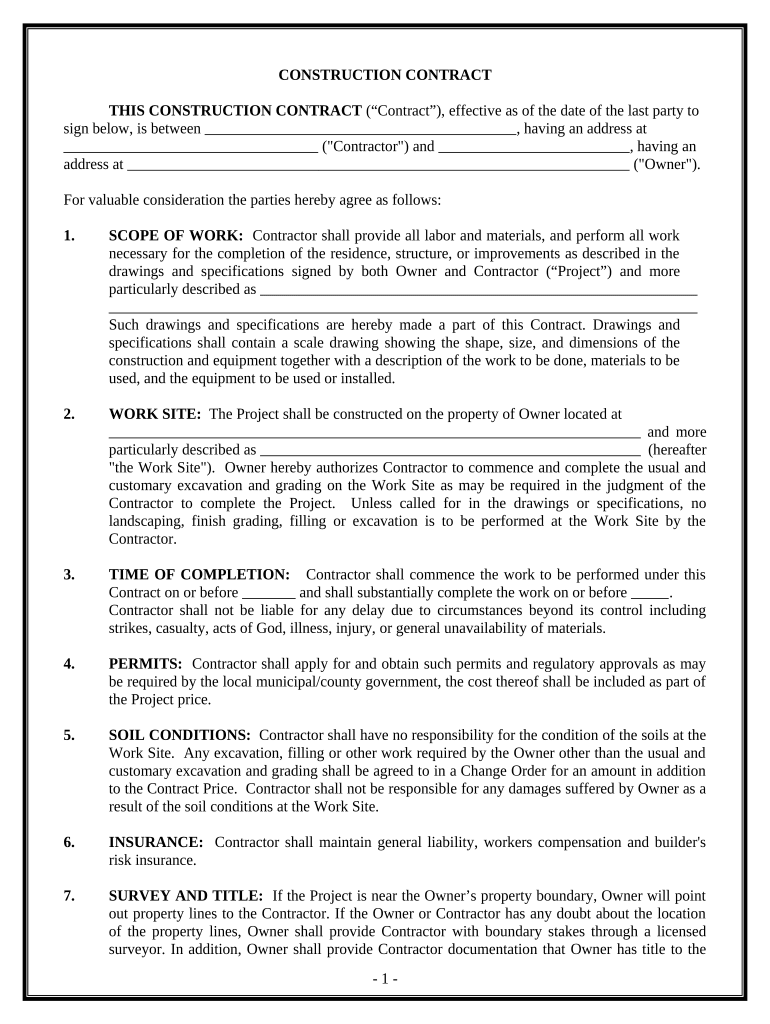
How to use or fill out Construction Contract Cost Plus or Fixed Fee - Montana

- Click ‘Get Form’ to open it in the editor.
- Begin by filling in the Contractor and Owner details, including names and addresses, in the designated fields.
- In the 'SCOPE OF WORK' section, clearly describe the project specifications and attach any necessary drawings.
- Specify the 'WORK SITE' address where the construction will take place.
- Indicate the 'TIME OF COMPLETION' by entering start and completion dates.
- Complete the 'CONTRACT PRICE' section by selecting either COST PLUS or FIXED FEE and entering the respective amounts.
- Review all sections for accuracy, ensuring that any changes are documented as Change Orders if necessary.
- Finally, both parties should sign and date the contract at the bottom of the document.
Start using our platform today to streamline your construction contract process for free!
Fill out Construction Contract Cost Plus or Fixed Fee - Montana online
It's free
It's free
Got questions?
We have answers to the most popular questions from our customers. If you can't find an answer to your question, please contact us.
Contact us
What is the percentage of cost-plus in construction contracts?
A CPPC contract is one that is structured to pay the contractor his actual costs incurred on the contract plus a fixed percent for profit or overhead (that is not audited/adjusted) and which is applied to actual costs incurred.
What are the advantages and disadvantages of cost-plus pricing?
It allows for easily calculating the minimum price that will cover all costs and ensure the desired profitability. However, despite its simplicity and clarity, the cost-plus pricing model has certain limitations, as it does not take into account changes in demand, competitor behavior, or customer price sensitivity.
When to use cost-plus fixed fee?
This contract is often used when the scope of the work cannot be precisely defined at the time of the agreement, and there are doubts about potential changes and variations in the course of the project. In a CPFF contract, the buyer agrees to reimburse the supplier for the allowable costs of the project.
How do you protect yourself in a cost-plus contract?
How Do You Protect Yourself in a Cost-Plus Contract? Set a Guaranteed Maximum Price (GMP): Limit total spending so that even if costs rise, they wont exceed a set maximum. Define Allowed Costs: Clearly specify which expenses will be reimbursed and which will not.
What are the disadvantages of a cost-plus fee contract?
What are the advantages and disadvantages of a cost-plus contract? Cost plus construction contracts offer advantages like transparency, flexibility, and reduced contractor risk. They also come with drawbacks, including uncertain pricing, a higher administrative workload, and a greater risk of disputes.
Security and compliance
At DocHub, your data security is our priority. We follow HIPAA, SOC2, GDPR, and other standards, so you can work on your documents with confidence.
Learn more


People also ask
What is a potential problem with a simple cost-plus contract?
One potential risk of a cost-plus contract is the potential for higher costs than initially anticipated. Since the total cost is determined by the contractors expenses, owners may end up paying more than expected, especially if there are unexpected or unplanned costs during the project.
What is the difference between a fixed price contract and a cost-plus contract?
A cost plus contract guarantees profit for the contractor. It is stated in the contract that the contractor will be reimbursed for all costs and still generate a profit. Conversely, a fixed price contract establishes a projects price beforehand.


