




01. Edit your annulment form online
Type text, add images, blackout confidential details, add comments, highlights and more.

Type text, add images, blackout confidential details, add comments, highlights and more.

Draw your signature, type it, upload its image, or use your mobile device as a signature pad.

Send annulment form in the philippines via email, link, or fax. You can also download it, export it or print it out.
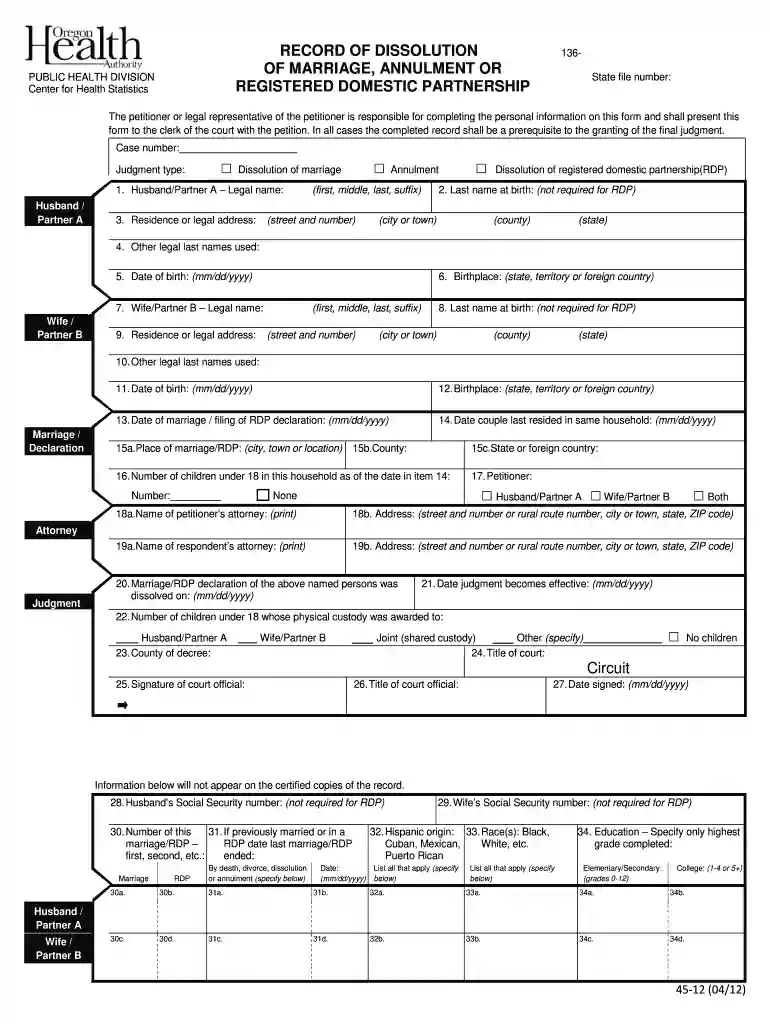
The annulment form, commonly utilized in the Philippines, serves as a crucial legal document that initiates the process of annulling a marriage or registered domestic partnership. Unlike divorce, which ends a valid marriage, annulment legally declares that the marriage was void or invalid from the start due to specific reasons, such as psychological incapacity or fraud. This form outlines necessary personal information and details regarding the marriage, serving as the foundation for a legal decree that formally dissolves the union.
The annulment form typically includes:
Each section must be filled out accurately, as this information will be assessed during the court proceedings to determine the case's validity.
Obtaining the annulment form PDF in the Philippines is an essential step for individuals seeking to initiate the annulment process. The form can typically be acquired from various official sources, ensuring that the document meets legal standards.
It is advisable to ensure that the form being completed is the latest version, as legal requirements and documentation may change over time.
Filling out the annulment form PDF accurately is crucial for a successful application. Following a structured approach can simplify the process and decrease the likelihood of errors.
Ensuring that each section is accurate and complete will facilitate smoother processing once submitted to the court.
Understanding legal terminology associated with the annulment form aids in navigating the complexities of the annulment process effectively.
Acquainting oneself with these terms can help demystify the process and ensure clarity throughout legal proceedings.
The annulment form must be used legally to dissolve a marriage or partnership within the Philippine judicial system. Understanding its proper utilization is essential for compliance with legal standards.
Failing to adhere to these legal guidelines could result in the annulment application being rejected or delayed.
Completing the annulment form involves submitting various supporting documents, all of which are vital for a successful application.
Submitting these documents alongside the annulment form ensures that all necessary information is available to the court during the review process.
Familiarizing oneself with the key elements of the annulment form is beneficial for understanding its structure and requirements.
Understanding these elements will aid applicants in accurately completing the form, aligning with legal expectations.
Different situations may lead individuals to utilize the annulment form in the Philippines, each with its unique set of circumstances.
By recognizing these scenarios, individuals can better understand their own situations and the potential for annulment proceedings.
We've got more versions of the annulment form form. Select the right annulment form version from the list and start editing it straight away!
At DocHub, your data security is our priority. We follow HIPAA, SOC2, GDPR, and other standards, so you can work on your documents with confidence.
In this present Petition, the Petitioner prays of this Honorable Court to declare as null and void her marriage to Respondent on the ground of the latters
Nonresponse Card, the Neighbor Information Form, the Screener Non-Interview Form, Consent Forms,. Authorization for Transportation Form, etc.). Corrections
It is noted that the Philippine Rule of. Declaration of Absolute Nullity of Void Marriages and Annulment of Voidable Marriages, A.M. No. 02-11-10-SC 2003-03-04,


