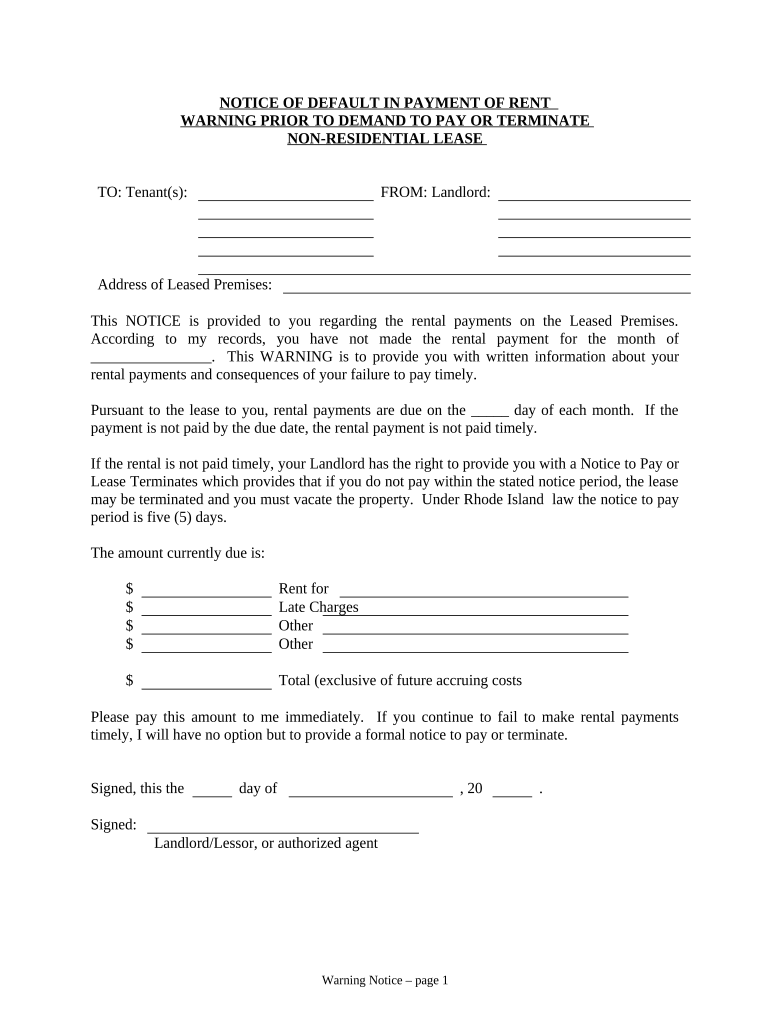
Notice of Default in Payment of Rent as Warning Prior to Demand to Pay or Terminate for Nonresidential or Commercial Property - Rhode Island 2026

Get Form
Notice of Default in Payment of Rent as Warning Prior to Demand to Pay or Terminate for Nonresidential or Commercial Property - Rhode Island Preview on Page 1

Here's how it works

01. Edit your form online
Type text, add images, blackout confidential details, add comments, highlights and more.
02. Sign it in a few clicks
Draw your signature, type it, upload its image, or use your mobile device as a signature pad.
03. Share your form with others
Send it via email, link, or fax. You can also download it, export it or print it out.

How to use or fill out Notice of Default in Payment of Rent as Warning Prior to Demand to Pay or Terminate for Nonresidential or Commercial Property - Rhode Island

Form edit decoration
9.5
Ease of Setup
DocHub User Ratings on G2
9.0
Ease of Use
DocHub User Ratings on G2
  1. Click ‘Get Form’ to open it in the editor.
  2. Begin by entering the tenant's name(s) in the designated 'TO' field. This ensures that the notice is directed appropriately.
  3. In the 'FROM' section, input your name as the landlord along with your contact information for clarity.
  4. Fill in the address of the leased premises where the tenant resides. This is crucial for legal documentation.
  5. Specify the month for which rent has not been paid in the blank space provided. This highlights the specific payment issue.
  6. Indicate the due date for rental payments according to your lease agreement. This establishes a timeline for payment expectations.
  7. List any amounts due, including rent, late charges, and other fees in their respective fields. Ensure accuracy to avoid disputes.
  8. Sign and date the notice at the bottom, confirming its authenticity and your intent to communicate formally with the tenant.
  9. Complete the proof of delivery section by selecting how you delivered this notice (hand, mail, or posting) and provide relevant details.

Start using our platform today to streamline your document editing and ensure timely communication with tenants!

be ready to get more

Complete this form in 5 minutes or less

Get form

Got questions?

We have answers to the most popular questions from our customers. If you can't find an answer to your question, please contact us.
Contact us
A Rhode Island 5-day notice to pay or quit is a document sent to a tenant who is more than 15 days late on their rent payment. The notice gives the tenant five additional days to pay the past-due rent or face eviction.
A landlord who wants to end a month-to-month tenancy, but does not have legal cause to evict the tenant, can give the tenant a written 30-day notice to move. This notice must explain to the tenant that the landlord is terminating the tenancy and that the tenant must move out of the rental unit by the end of 30 days.
A landlord must provide a tenant with a written notice 30 days or more prior to the effective date, for a rental increase for a residential tenancy that is on a weekly or monthly basis. With longer tenancies it is 30 days prior to expiration of the current rental agreement.
Subject: Demand for Payment of Overdue Rent This letter serves as formal notice that your rent payment for the property at [Property Address] is past due. According to the terms of your lease agreement dated [Lease Start Date], you agreed to pay $[Monthly Rent Amount] on or before the [Due Date] of each month.
A default notice to tenant is a formal letter that informs the tenant of their lease violation and outlines corrective actions. For example, if rent is overdue, the notice might include the amount owed, the deadline for payment, and the consequences of noncompliance.

Security and compliance

At DocHub, your data security is our priority. We follow HIPAA, SOC2, GDPR, and other standards, so you can work on your documents with confidence.

Learn more
ccpa2
pci-dss
gdpr-compliance
hipaa
soc-compliance

People also ask

A 5-day notice to quit form is a document that can be used to notify tenants that they need to remedy a violation of their lease agreement or leave the property. Once received, tenants have five days to respond in some way. If they do not take action, they can be evicted through the court system.

Related links