Letter from Tenant to Landlord for Failure of Landlord to return all prepaid and unearned rent and security recoverable by Tenant - Rhode Island 2026

Get Form
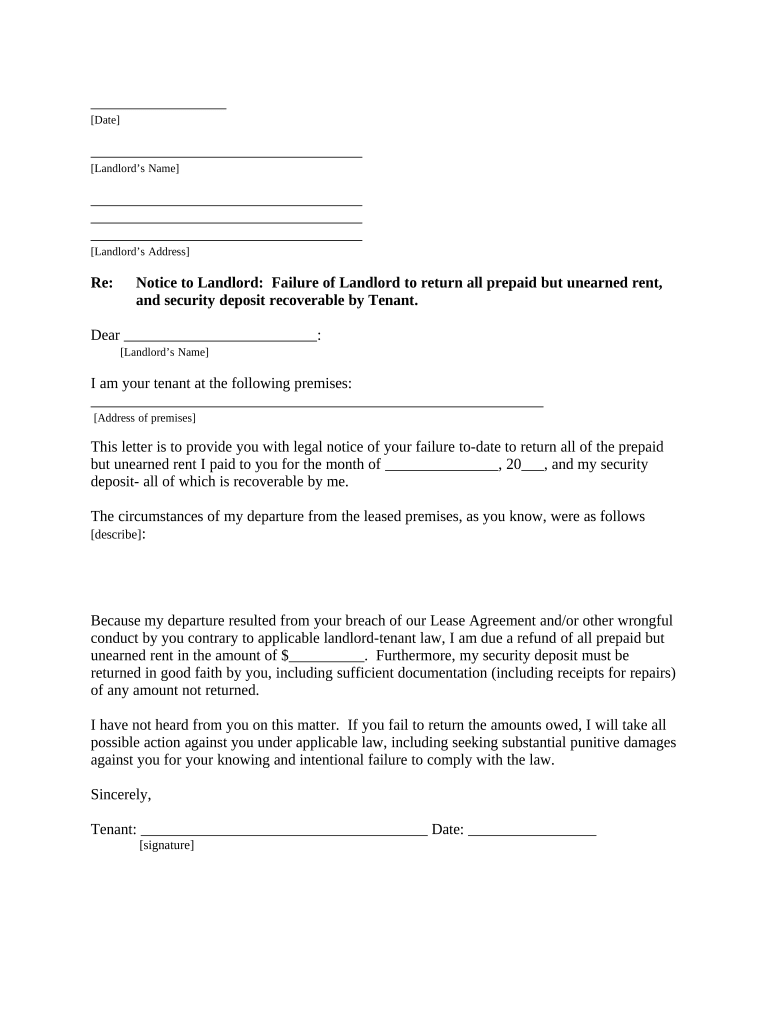
Letter from Tenant to Landlord for Failure of Landlord to return all prepaid and unearned rent and security recoverable by Tenant - Rhode Island Preview on Page 1

Here's how it works

01. Edit your form online
Type text, add images, blackout confidential details, add comments, highlights and more.
02. Sign it in a few clicks
Draw your signature, type it, upload its image, or use your mobile device as a signature pad.
03. Share your form with others
Send it via email, link, or fax. You can also download it, export it or print it out.

How to use or fill out Letter from Tenant to Landlord for Failure of Landlord to return all prepaid and unearned rent and security recoverable by Tenant - Rhode Island with our platform

Form edit decoration
9.5
Ease of Setup
DocHub User Ratings on G2
9.0
Ease of Use
DocHub User Ratings on G2
  1. Click ‘Get Form’ to open it in the editor.
  2. Begin by entering the date at the top of the letter. This is important for record-keeping purposes.
  3. Fill in the landlord’s name and address in the designated fields. Ensure accuracy to avoid any delivery issues.
  4. In the greeting, address your landlord directly using their name. This personal touch can help convey your seriousness.
  5. Provide your address as the tenant in the specified section. This clarifies your identity and residence.
  6. Clearly state the month and year for which you are claiming unearned rent in the appropriate field.
  7. Describe the circumstances surrounding your departure from the leased premises in detail, ensuring clarity on why you believe you are owed a refund.
  8. Insert the amount of prepaid but unearned rent you are requesting back, along with any relevant details about your security deposit.
  9. Complete the proof of delivery section by selecting how you will deliver this notice to your landlord, ensuring compliance with any lease agreements.
  10. Finally, sign and date the letter at the bottom before sending it off through your chosen method.

Start using our platform today to easily fill out and send your tenant letters for free!

be ready to get more

Complete this form in 5 minutes or less

Get form

Got questions?

We have answers to the most popular questions from our customers. If you can't find an answer to your question, please contact us.
Contact us
Your deposit must be returned as soon as possible when the tenancy ends, unless the landlord has a legal reason to keep it. It does not have to be returned on the day you move out. The landlord may need time to inspect the property.
The landlord must return the security deposit or a listing of damages and the remaining amount (if any) within 20 days after the tenant moves, returns the key, and leaves a forwarding address.
Typical Hardship Letters outline your situation before the hardship occurred, and then describes your current financial situation and why you are unable to meet the payments due. Some common reasons for writing a Hardship Letter include injury, loss of job, economic downturn, an illness to you or a family member, etc.
A landlord can try to charge you for anything. Whether theyre successful is another matter. They can still charge you for cleaning if its needed, they just cant require you to pay for cleaning as a matter of course.
Tell the scheme if the landlord or agent do not reply or refund your deposit within 10 days of you writing to ask for it back. The scheme will contact your landlord. They will tell them to pay the money into an account until the dispute is resolved and offer dispute resolution to you both.
be ready to get more

Complete this form in 5 minutes or less

Get form

People also ask

If they do not, you may be able to withhold rent or even break your lease and move out. If the issue is minor, on the other hand, the landlord has more breathing room. You cannot withhold rent or break the lease without repercussions if the landlord fails to fix a minor repair.
34-18-19. Security deposits. (a) A landlord may not demand or receive a security deposit, however denominated, in an amount or value in excess of one months periodic rent.
A landlord can take a security deposit from a tenant at the beginning of a new rental term but it cannot exceed one months rent.

Related links