Pa provisions 2026

Get Form
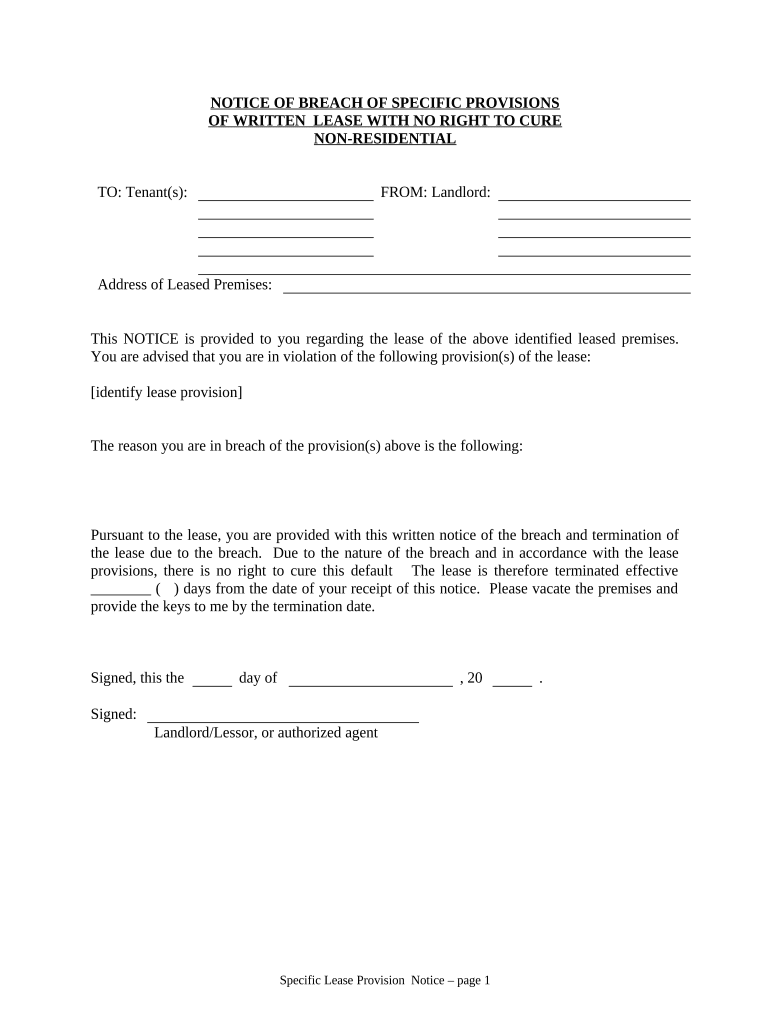
pa provisions Preview on Page 1

Here's how it works

01. Edit your form online
Type text, add images, blackout confidential details, add comments, highlights and more.
02. Sign it in a few clicks
Draw your signature, type it, upload its image, or use your mobile device as a signature pad.
03. Share your form with others
Send it via email, link, or fax. You can also download it, export it or print it out.

How to use or fill out pa provisions with our platform

Form edit decoration
9.5
Ease of Setup
DocHub User Ratings on G2
9.0
Ease of Use
DocHub User Ratings on G2
  1. Click ‘Get Form’ to open the pa provisions document in the editor.
  2. Begin by entering the Tenant(s) name and the Landlord's name in the designated fields. This ensures that both parties are clearly identified.
  3. Fill in the Address of Leased Premises accurately to specify where the lease pertains.
  4. Identify the specific lease provision(s) you are notifying the tenant about. Clearly state these in the provided section.
  5. In the reason for breach section, detail why the tenant is in violation of the lease provisions. Be concise yet thorough.
  6. Indicate the termination date by filling in how many days from receipt this notice takes effect, ensuring compliance with lease terms.
  7. Sign and date the document at the bottom, confirming your authority as Landlord/Lessor or authorized agent.
  8. Complete the Proof of Delivery section by selecting how you delivered this notice to ensure proper documentation.

Start using our platform today to streamline your document editing and signing process for free!

be ready to get more

Complete this form in 5 minutes or less

Get form

Got questions?

We have answers to the most popular questions from our customers. If you can't find an answer to your question, please contact us.
Contact us
Pennsylvania took the first step toward protecting farmland when it adopted an Agricultural Security Area law (PA Act 43) in 1981. Local municipalities create ASAs in cooperation with individual landowners, who agree to collectively place at least 250 acres in an agricultural security area.
At the state level, the constitutions of the states of California, Colorado, Florida, Georgia, Illinois, Iowa, Kansas, Kentucky, Louisiana, Maine, Massachusetts, Michigan, Minnesota, New Jersey, New Mexico, Nevada, Pennsylvania, Texas, Wisconsin, and Washington, and the U.S. territory Puerto Rico, make a reference to
Article I, section 21 of the Pennsylvania State Constitution states: The right of the citizens to bear arms in defense of themselves and the State shall not be questioned.
Pennsylvania law holds an individual or company in possession of the land responsible for certain injuries suffered by people who are on the property. Owners of businesses and owners of private property have a duty to keep their premises in a safe and hazard free condition.
The Constitutions first three articles embody the doctrine of the separation of powers, in which the federal government is divided into three branches: the legislative, consisting of the bicameral Congress (Article I); the executive, consisting of the president and subordinate officers (Article II); and the judicial,

Security and compliance

At DocHub, your data security is our priority. We follow HIPAA, SOC2, GDPR, and other standards, so you can work on your documents with confidence.

Learn more
ccpa2
pci-dss
gdpr-compliance
hipaa
soc-compliance

People also ask

27. Natural resources and the public estate. The people have a right to clean air, pure water, and to the preservation of the natural, scenic, historic and esthetic values of the environment. Pennsylvanias public natural resources are the common property of all the people, including generations yet to come.
All men have a natural and indefeasible right to worship Almighty God ing to the dictates of their own consciences; no man can of right be compelled to attend, or support any place of worship, or to maintain any ministry against his consent; no human authority can, in any case whatever, control or interfere
While the U.S. Constitution does not mention God, nearly all state constitutions reference either God or the divine, ing to a 2017 analysis. God also appears in the Declaration of Independence, the Pledge of Allegiance and on U.S. currency.

Related links