

Oregon elective 2026

Get Form
oregon elective Preview on Page 1

Here's how it works

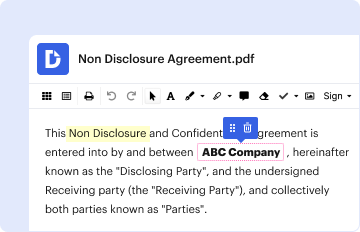
01. Edit your form online
Type text, add images, blackout confidential details, add comments, highlights and more.
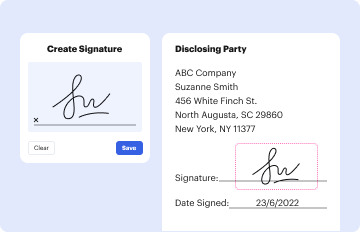
02. Sign it in a few clicks
Draw your signature, type it, upload its image, or use your mobile device as a signature pad.
03. Share your form with others
Send it via email, link, or fax. You can also download it, export it or print it out.

How to use or fill out oregon elective with our platform

Form edit decoration
9.5
Ease of Setup
DocHub User Ratings on G2
9.0
Ease of Use
DocHub User Ratings on G2
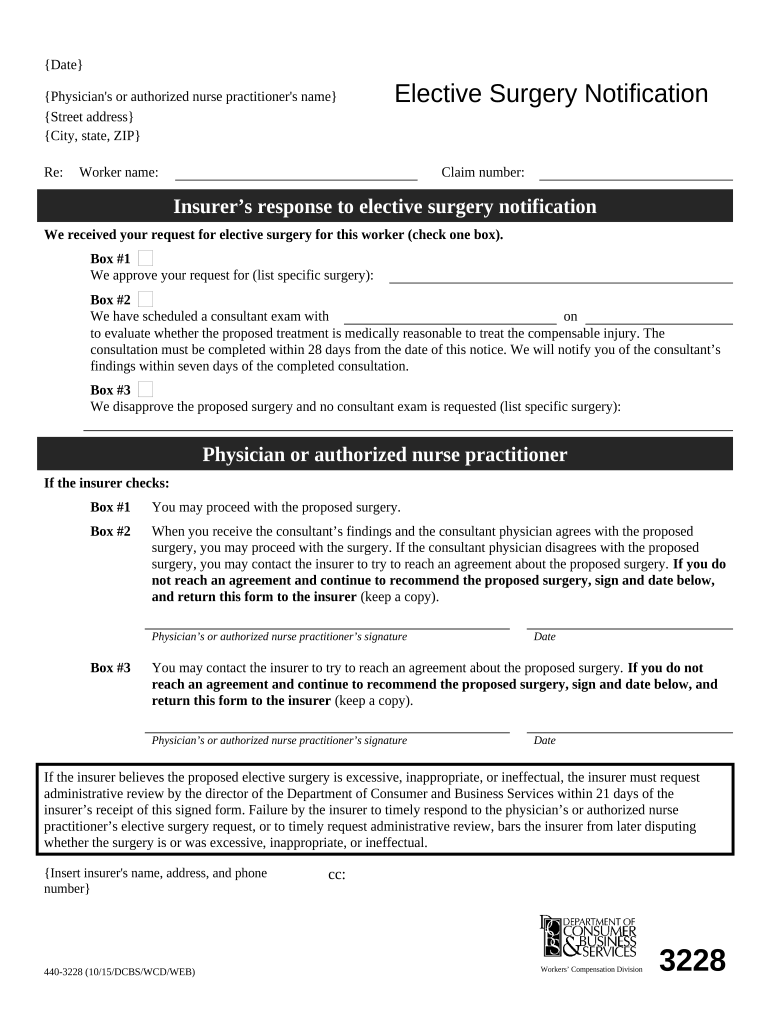
  1. Click ‘Get Form’ to open the Oregon Elective Surgery Notification in the editor.
  2. Begin by entering the date at the top of the form. This is essential for tracking purposes.
  3. Fill in the physician's or authorized nurse practitioner's name, followed by their street address, city, state, and ZIP code.
  4. In the 'Worker name' section, input the name of the worker requiring surgery along with their claim number.
  5. Review the insurer’s response options. Check one box that corresponds to your situation: approval, scheduled consultation, or disapproval of surgery.
  6. If applicable, list specific surgery details next to the approved option or provide reasons for disapproval if necessary.
  7. Ensure that the physician or authorized nurse practitioner signs and dates at the bottom of the form before submission.

Start using our platform today to streamline your document editing and ensure a smooth process for your Oregon elective!

be ready to get more

Complete this form in 5 minutes or less

Get form

Got questions?

We have answers to the most popular questions from our customers. If you can't find an answer to your question, please contact us.
Contact us
what is the pte tax election? The pass-through entity (PTE) tax allows certain California pass-through entities to pay state income tax at the PTE level. In return, qualified owners can get a nonrefundable tax credit for their share of the entity level state tax, which reduces their personal income tax for California.
Are refunds from the PTET subject to federal tax? For federal tax purposes, state tax refunds are often treated as taxable since they are deemed an accession of wealth. While specific IRS guidance has not been issued, there is a likelihood that PTET refunds are on par with other state tax refunds.
Oregons elective share statute provides that a surviving spouse is entitled to 25% of the net probate estate of a deceased spouse regardless of the provisions of the deceased spouses will. The purpose of elective share statutes is to protect a surviving spouse from disinheritance by his or her decedent spouse.
About the tax For tax years beginning on or after January 1, 2022, entities taxed as S corporations and partnerships may elect annually to be subject to the PTE-E tax at a rate of 9 percent tax on the first $250,000 of distributive proceeds and 9.9 percent tax on any amount exceeding $250,000.
Top 10 colleges in Oregon with the lowest acceptance rates Reed College acceptance rate. Concordia University Portland Oregon acceptance rate. University of Portland acceptance rate. Warner Pacific College acceptance rate. Lewis and Clark College acceptance rate. Southern Oregon University acceptance rate.

Security and compliance

At DocHub, your data security is our priority. We follow HIPAA, SOC2, GDPR, and other standards, so you can work on your documents with confidence.

Learn more
ccpa2
pci-dss
gdpr-compliance
hipaa
soc-compliance

People also ask

The PTE elective tax is 9.3% of the entitys qualified net income, which is the sum of the pro rata or distributive share and guaranteed payments of each qualified taxpayers income subject to California personal income tax.
In July 2021, Oregon created a new tax called the Pass-Through Entity Elective (PTE-E) Tax, a business alternative income tax. This tax was made in response to the $10,000 cap on the federal State and Local Tax (SALT) deduction in the 2017 federal Tax Cuts and Jobs Act.
Alaska, Delaware, Montana, New Hampshire and Oregon are the five U.S. states that do not levy a statewide sales tax. Individual municipalities may charge local sales tax in some areas, and property and income taxes may be higher in these states to offset the revenue loss.

Related links