Notice of Default in Payment of Rent as Warning Prior to Demand to Pay or Terminate for Nonresidential or Commercial Property - Oregon 2026

Get Form
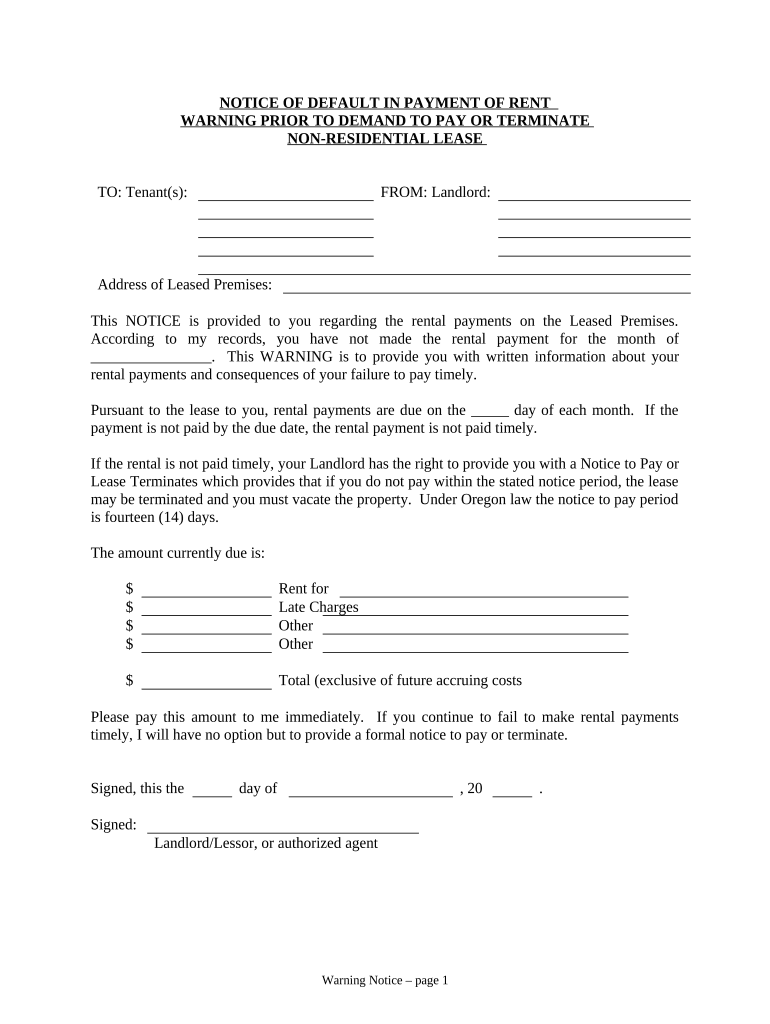
Notice of Default in Payment of Rent as Warning Prior to Demand to Pay or Terminate for Nonresidential or Commercial Property - Oregon Preview on Page 1

Here's how it works

01. Edit your form online
Type text, add images, blackout confidential details, add comments, highlights and more.
02. Sign it in a few clicks
Draw your signature, type it, upload its image, or use your mobile device as a signature pad.
03. Share your form with others
Send it via email, link, or fax. You can also download it, export it or print it out.

How to use or fill out Notice of Default in Payment of Rent as Warning Prior to Demand to Pay or Terminate for Nonresidential or Commercial Property - Oregon

Form edit decoration
9.5
Ease of Setup
DocHub User Ratings on G2
9.0
Ease of Use
DocHub User Ratings on G2
  1. Click ‘Get Form’ to open it in the editor.
  2. Begin by entering the tenant's name(s) in the designated 'TO' field. This ensures that the notice is correctly addressed.
  3. In the 'FROM' section, input your name as the landlord along with any authorized agent details if applicable.
  4. Fill in the address of the leased premises where the tenant resides. This is crucial for clarity and legal purposes.
  5. Specify the month for which rent has not been paid in the blank space provided. This highlights the specific payment issue.
  6. Indicate the due date for rental payments according to your lease agreement. This establishes a timeline for payment expectations.
  7. List all amounts due, including rent, late charges, and any other fees in their respective fields. Ensure accuracy to avoid disputes.
  8. Sign and date the notice at the bottom, confirming its authenticity and your intent to communicate formally with your tenant.
  9. Complete the proof of delivery section by selecting how you delivered this notice (by hand or mail) and signing it accordingly.

Start using our platform today to streamline your document editing and ensure timely communication with tenants!

be ready to get more

Complete this form in 5 minutes or less

Get form

Got questions?

We have answers to the most popular questions from our customers. If you can't find an answer to your question, please contact us.
Contact us
Lease Terms. In Oregon, there are no statutes or regulations that dictate commercial lease terms. While a new business may prefer a one- or two-year lease to start, a typical short-term lease will range from three to 15 years and will often include an option to renew.
Tenants who want to break a lease in Oregon must comply with the states notice requirements if they want to avoid penalties or other legal consequences. Generally speaking, these are the two notice requirements needed, depending on the type of lease: Yearly Leases with No End Date: At least 60 days of notice.
Your landlord can give you a 10-day notice to move out; You do not have another chance to fix the problem; and. If you do not move out by the 10-day deadline, your landlord can start an eviction case.
Many commercial leases do not have pre-negotiated early termination rights. However, when lease termination clauses are negotiated, its common for the landlord to require the tenant to pay three to six months of rent obligation, plus unamortized lease up costs.
Oregon law allows tenants to end a lease early without penalty if a landlord does not provide a habitable living environment, as outlined in Oregon statute 90.320. The law states that a landlord is required by law to provide: Functioning locks on windows and doors. Smoke alarms.

Security and compliance

At DocHub, your data security is our priority. We follow HIPAA, SOC2, GDPR, and other standards, so you can work on your documents with confidence.

Learn more
ccpa2
pci-dss
gdpr-compliance
hipaa
soc-compliance

People also ask

Notice Period: 10 days (when rent is 8 or more days late) or 13 days (when rent is 5-8 days late). Rent Grace Period: 4 days. Maximum Late Fee: 5% of the periodic rent or an otherwise reasonable amount for that rental market.

Related links