




01. Edit your letter informing death of husband online
Type text, add images, blackout confidential details, add comments, highlights and more.

Type text, add images, blackout confidential details, add comments, highlights and more.

Draw your signature, type it, upload its image, or use your mobile device as a signature pad.

Send sample letter informing death of husband via email, link, or fax. You can also download it, export it or print it out.
A letter notifying death serves as a formal communication to inform relevant parties about the passing of an individual. This document plays a crucial role in various contexts—ranging from legal notifications to notifying membership programs or workplaces. By providing essential details about the deceased, the letter ensures that necessary actions can be taken, such as canceling accounts or processing benefits.
To ensure clarity and completeness, a letter notifying death should encompass specific, essential components. Each element provides vital information that helps the recipient understand the context and implications of the notification.
Effectively utilizing a letter notifying death requires a clear understanding of your target audience and their specific requirements.
Writing a letter notifying death involves several important steps that help ensure its effectiveness and appropriateness.
Providing practical examples of a letter notifying death can help clarify the format and tone required for different situations.
Sample Letter Informing Death to an Employer:
[Your Name]
[Your Address]
[City, State, ZIP Code]
[Email Address]
[Phone Number]
[Date][Employer's Name]
[Company Name]
[Company Address]
[City, State, ZIP Code]Dear [Employer's Name],
I am writing to inform you of the passing of my husband, [Husband's Name]. He passed away on [Date of Death]. We appreciate any support or insight you can provide regarding his benefits and any necessary paperwork we need to address. Please find enclosed a copy of his death certificate.
Thank you for your understanding during this difficult time.
Sincerely,
[Your Name]
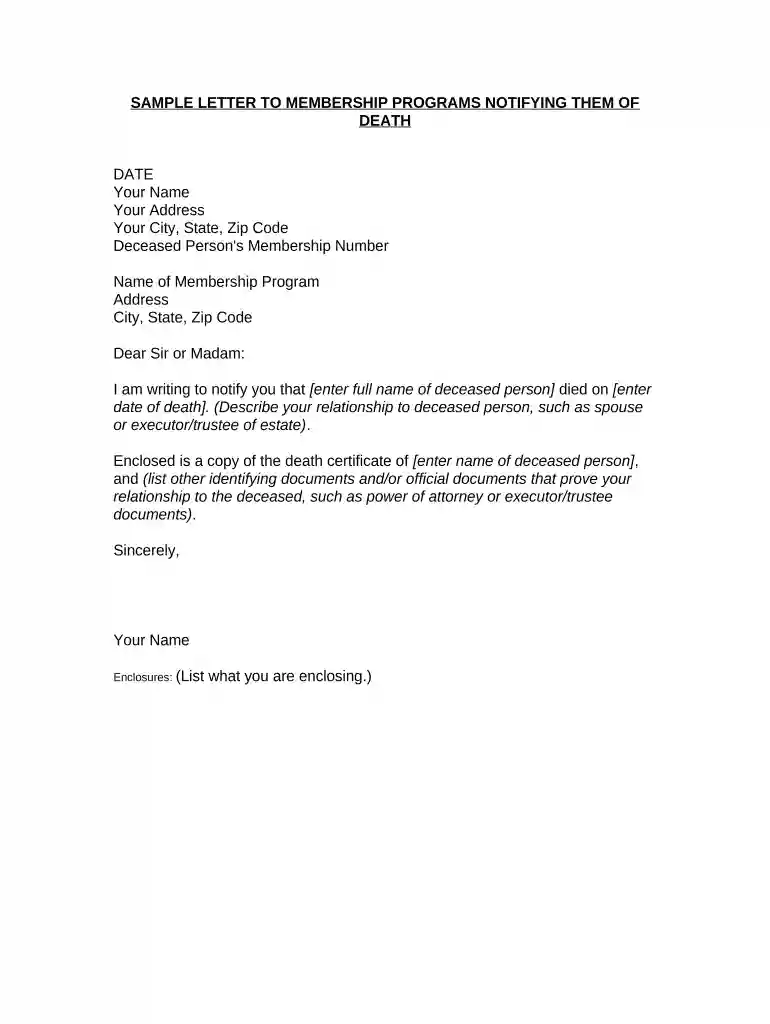
Sample Letter to Inform a Membership Organization:
[Your Name]
[Your Address]
[City, State, ZIP Code]
[Email Address]
[Phone Number]
[Date][Membership Organization Name]
[Organization Address]
[City, State, ZIP Code]Dear [Recipient's Name],
I am writing to notify you of the death of [Deceased's Name] who was a member of your organization. [He/She/They] passed away on [Date of Death]. Please let us know the next steps regarding any memberships or dues that may need cancellation or handling.
Enclosed is a copy of the death certificate for your records. Thank you for your assistance in this matter.
Sincerely,
[Your Name]
These examples illustrate the clarity and simple structure necessary in a letter notifying death, making it easier for recipients to process the information appropriately.
At DocHub, your data security is our priority. We follow HIPAA, SOC2, GDPR, and other standards, so you can work on your documents with confidence.





These messages communicate how the entity died, and some are intended to be humorous. Some death messages are harder to get than others, and are thereforeRead more
1. Request copies of the death certificate. 2. Draft a notification letter. Utilize SCDCAs sample letter for notifying the credit bureaus of the death a. Your
It is with deep sadness and heavy hearts that we inform you of the death of our colleague and friend, (name), who passed away on (date).Read more


