




01. Edit your form online
Type text, add images, blackout confidential details, add comments, highlights and more.

Type text, add images, blackout confidential details, add comments, highlights and more.

Draw your signature, type it, upload its image, or use your mobile device as a signature pad.

Send it via email, link, or fax. You can also download it, export it or print it out.
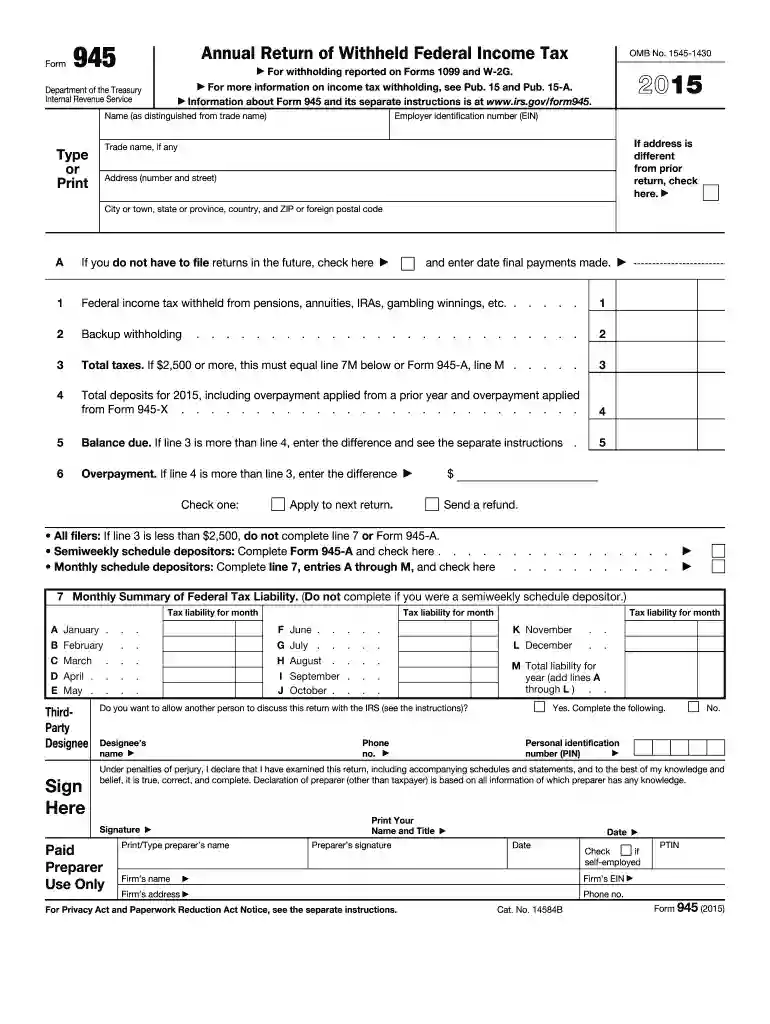
The 2015 Form 945 is a tax document utilized by businesses to report federal income tax withheld from non-payroll payments. These payments include pensions, annuities, gambling winnings, and IRAs. The form ensures compliance with IRS regulations by accurately reporting the amount withheld from various income sources, distinct from payroll withholding captured on other forms like W-2.
The form includes critical sections that users must complete to provide necessary information to the IRS. Key elements include:
Completing the form involves a structured approach:
The IRS provides comprehensive guidelines for filers, detailing how and when the form should be submitted.
Failing to file a correct 2015 Form 945 can result in penalties such as:
Entities most likely to use this form include those handling non-payroll payments:


The form can be accessed in several ways to facilitate taxpayer convenience.
Choosing between filing digitally or on paper can impact the process.
Certain businesses find particular utility in the form:
Ensuring businesses and their clients meet tax obligations accurately can prevent complications with the IRS. Regular updates and compliance checks are advisable to remain in good standing.
A detailed understanding of the form’s legal context ensures correct usage.
A thorough grasp of these concepts is essential for proper reporting and avoiding potential disputes or audits. Understanding each term within the legal framework ensures compliance and facilitates smoother operations concerning tax obligations.
We've got more versions of the 2015 form 945 form. Select the right 2015 form 945 version from the list and start editing it straight away!
| Versions | Form popularity | Fillable & printable |
|---|---|---|
| 2025 | 4.5 Satisfied (32 Votes) | |
| 2024 | 4.1 Satisfied (33 Votes) | |
| 2023 | 4.8 Satisfied (54 Votes) | |
| 2022 | 4.6 Satisfied (49 Votes) | |
| 2021 | 4.8 Satisfied (84 Votes) | |
| 2020 | 4.4 Satisfied (192 Votes) | |
| 2019 | 4.4 Satisfied (124 Votes) | |
| 2018 | 4.4 Satisfied (173 Votes) | |
| 2017 | 4.3 Satisfied (164 Votes) | |
| 2016 | 4.4 Satisfied (639 Votes) | |
| 2015 | 4 Satisfied (34 Votes) | |
| 2014 | 4 Satisfied (28 Votes) |
At DocHub, your data security is our priority. We follow HIPAA, SOC2, GDPR, and other standards, so you can work on your documents with confidence.
Form 945. Current Year (2017). Prior Year (2015 2016). Form 990PF balance due and amended returns. 2018 2019 (Jan. Dec.) Form 990PF estimated taxes. 2018 2019 (Read more
Enclose your check or money order made payable to. United States Treasury. Be sure to enter your EIN,. Form 945, and 2015 on your check or money order.Read more
May 2, 2017 Employers must report the compensation paid and any backup withholding on Forms 1099-MISC and Form 945, Annual Return of. Withheld FederalRead more


