




01. Edit your schedule c form instructions online
Type text, add images, blackout confidential details, add comments, highlights and more.

Type text, add images, blackout confidential details, add comments, highlights and more.

Draw your signature, type it, upload its image, or use your mobile device as a signature pad.

Send form 1065 schedule c via email, link, or fax. You can also download it, export it or print it out.
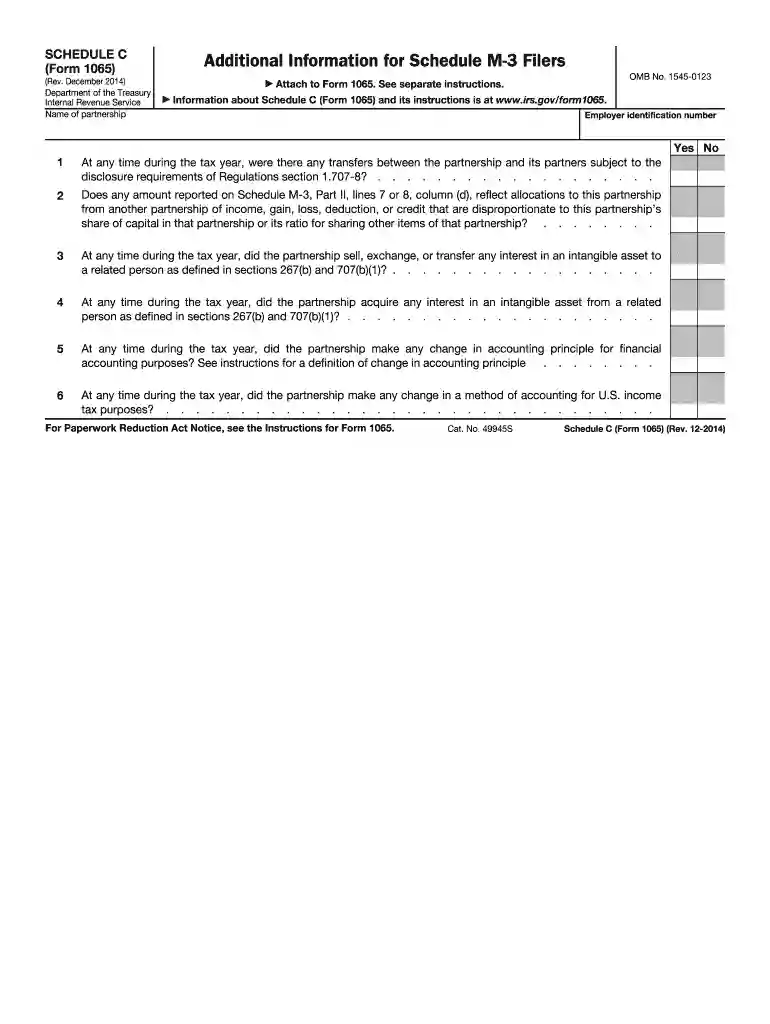
Schedule C (Form 1065) is an essential component of the tax documentation required for partnerships in the United States. It provides detailed information for partnerships that are filing Schedule M-3, which is necessary for reporting certain financial transactions. The form addresses key areas such as transfers between partners, allocations from other partnerships, and any changes in accounting methods or principles during the tax year. This schedule helps ensure that all financial activities are accurately reported to the IRS, promoting transparency and compliance in partnership taxation.
Obtaining IRS Form 1065 Schedule C is a straightforward process. The form can be downloaded directly from the IRS website, where it is available in PDF format. Additionally, many tax preparation software programs include access to this form as part of their package for business taxes. For those who prefer paper copies, the form can be requested by contacting the IRS directly. Once obtained, it is important to ensure that you are using the latest version of the form to comply with current tax regulations.
Filling out IRS Form 1065 Schedule C requires careful attention to detail. Here are the steps to complete this form:
Gather Necessary Information: Collect all relevant financial documents, including records of partner transactions, financial statements, and changes in accounting methods.
Fill Out Partner Transaction Details: Provide detailed information about any transfers or allocations between partners during the tax year.
Disclose Changes in Accounting: If there were any changes in accounting principles or methods, these must be clearly documented and explained.
Ensure Accuracy: Double-check all entries for accuracy to avoid potential audits or penalties.
Consult IRS Guidelines: Always refer to the most recent IRS instructions for any updates or changes in filing requirements.
IRS Form 1065 Schedule C is primarily used by partnerships, including general partnerships, limited partnerships, and limited liability partnerships. These entities often engage in various transactions that require thorough documentation. While filling out Schedule C, partnerships aim to disclose all relevant financial activities to the IRS. Some partnerships might also need to file this form if they are part of a larger corporate structure or have complex financial dealings with other entities.
The IRS requires partnerships to submit Form 1065 and associated schedules, including Schedule C, by the 15th day of the 3rd month following the end of the partnership’s tax year. For partnerships operating on a calendar year, the deadline is typically March 15. It is crucial for partnerships to adhere to these deadlines to avoid late penalties. However, if an extension is needed, partnerships can file Form 7004 to request additional time to complete their filing.
Failing to comply with IRS filing requirements for Form 1065 Schedule C can result in significant penalties. Partnerships that do not file on time, or that submit incomplete or inaccurate information, may be subject to fines. These penalties can be costly, emphasizing the importance of timely and accurate filing. Furthermore, the partnership could face increased scrutiny from the IRS, leading to audits or additional compliance checks.
Partnerships can leverage various tax software solutions to assist with filing Form 1065 and Schedule C. Popular platforms such as TurboTax and QuickBooks are equipped to handle the complexities of partnership tax filings, including the integration of financial data directly from accounting software. These tools provide step-by-step assistance to ensure accuracy and compliance with IRS regulations, reducing the likelihood of errors in filing.
We've got more versions of the schedule c form instructions form. Select the right schedule c form instructions version from the list and start editing it straight away!
At DocHub, your data security is our priority. We follow HIPAA, SOC2, GDPR, and other standards, so you can work on your documents with confidence.
Next, if you are filing Schedule C, C-EZ, F, or SE, or you received a Schedule K-1 (Form 1065 or Form. 1065-B), go to line 2a. Otherwise, skip lines 2aRead more
c Schedules K-1 are filed with the return and furnished to the partners on or before the due date (including extensions) for the partnership return. d TheRead more
Jan 23, 2026 Schedule C (Form 1065), Additional Information for Schedule M-3 Filers Schedule C (Form 1065) to provide answers to additional questions.Read more


