




01. Edit your 14157 form online
Type text, add images, blackout confidential details, add comments, highlights and more.

Type text, add images, blackout confidential details, add comments, highlights and more.

Draw your signature, type it, upload its image, or use your mobile device as a signature pad.

Send 14817 form via email, link, or fax. You can also download it, export it or print it out.
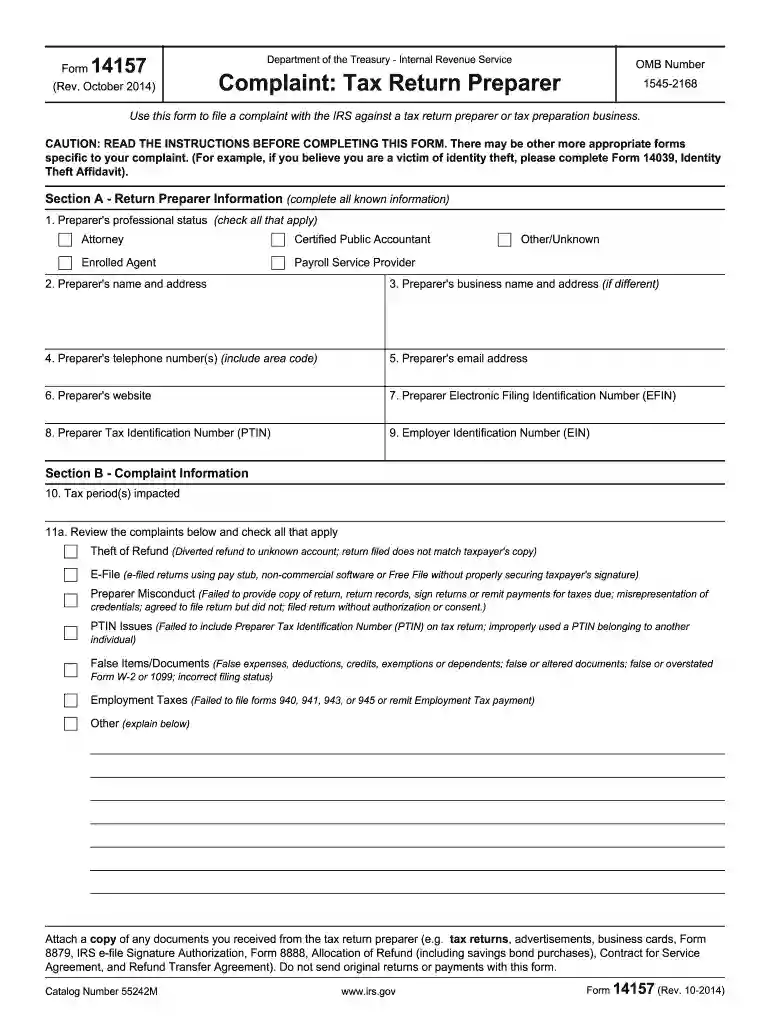
Form 14157, established in 2014, serves as a formal avenue for filing complaints with the IRS against tax return preparers or tax preparation firms. It is an essential tool for taxpayers seeking to report misconduct or malpractice in tax preparation services. The form specifically addresses potential violations of tax laws, fostering compliance among tax preparers. By documenting grievances, this form aids the IRS in investigating and enforcing regulations to maintain the integrity of tax administration.
Form 14157 comprises several critical sections designed to capture comprehensive information:
Understanding these elements is crucial for effectively completing and submitting the form to ensure the IRS receives the necessary information for investigation.
Publishing a complaint using Form 14157 involves several key steps:
This process emphasizes transparency and accuracy to facilitate proper handling and resolution of complaints.
Filing Form 14157 requires meticulous attention to detail:
Section One – Preparer’s Information:
Section Two – Complaint Details:
Section Three – Your Information:
Section Four – Evidence Submission:
Verification and Signature:
Following these steps ensures that your complaint is precise and complete, allowing for effective IRS intervention.
Form 14157 is primarily utilized by:
This form empowers these groups to hold tax professionals accountable for their actions, contributing to a fairer tax system.
The legal foundation of Form 14157 lies in its alignment with IRS regulatory standards:
These guidelines are critical for maintaining trust and integrity within the tax filing landscape.
While Form 14157 itself does not have an explicit deadline, timely submission is advisable to expedite the resolution process. Taxpayers should aim to file as soon as a discrepancy is identified. Key tax season dates, such as filing deadlines, can impact the processing time and should be taken into consideration when filing a complaint to the IRS.
Filing Form 14157 is an essential step in addressing tax preparer misconduct, as failure to report such issues can lead to the perpetuation of errors:
These outcomes underscore the importance of using Form 14157 to correct preparer misconduct and protect taxpayer interests.
Form 14157 can be submitted using various methods:
Each method has distinct benefits, with digital submissions providing faster delivery and simplified tracking of form status.
We've got more versions of the 14157 form form. Select the right 14157 form version from the list and start editing it straight away!
At DocHub, your data security is our priority. We follow HIPAA, SOC2, GDPR, and other standards, so you can work on your documents with confidence.


