Liability customer 2026

Get Form
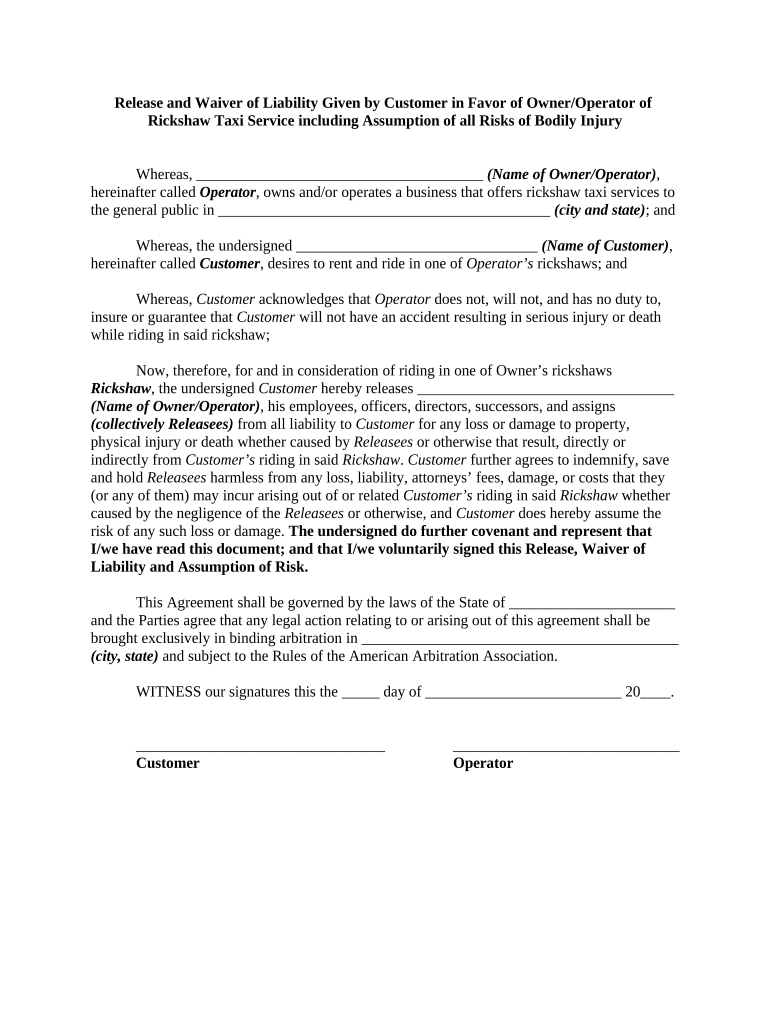
liability customer Preview on Page 1

Here's how it works

01. Edit your form online
Type text, add images, blackout confidential details, add comments, highlights and more.
02. Sign it in a few clicks
Draw your signature, type it, upload its image, or use your mobile device as a signature pad.
03. Share your form with others
Send it via email, link, or fax. You can also download it, export it or print it out.

How to use or fill out liability customer with our platform

Form edit decoration
9.5
Ease of Setup
DocHub User Ratings on G2
9.0
Ease of Use
DocHub User Ratings on G2
  1. Click ‘Get Form’ to open the liability customer document in the editor.
  2. Begin by entering the name of the Owner/Operator in the designated field. This identifies who is providing the rickshaw service.
  3. Next, fill in the city and state where the rickshaw service operates. This provides context for the agreement.
  4. In the section for Customer's name, input your full name as it appears on your identification. This confirms your identity as a participant.
  5. Review the waiver statement carefully. Ensure you understand that you are releasing liability from the Operator and their associates.
  6. Indicate your understanding and acceptance of risks by signing at the bottom of the form. Make sure to date your signature appropriately.
  7. Finally, if required, fill in any additional information regarding arbitration location and laws governing this agreement.

Start using our platform today to complete your liability customer form easily and for free!

be ready to get more

Complete this form in 5 minutes or less

Get form

Got questions?

We have answers to the most popular questions from our customers. If you can't find an answer to your question, please contact us.
Contact us
Liability for a bank is anything that it owes to the outsiders. Examples of liabilities for a bank include distribution payments to customers from stock, interest paid to customers for savings and fixed deposits. The most common bank liabilities are: Loans taken from the central bank. Deposits made by the bank
The Customer Acceptance Policy (CAP) of the Bank is a document that defines the basis on which the Bank enters into relationships with its customers. An inadequate CAP or the inadequate implementation of the CAP can expose the Bank to serious compliance risk as well as legal and reputational risks.
So, are customer deposits current liabilities or assets? Under the rules of double-entry accounting, they would qualify as a current liability. Although youve received money, its not really yours until youve provided the finished product or service.
It follows the accounting principle; the deposit is a current liability that is debited and sales revenue credited. A customer deposit could also be the amount of money deposited in a bank. Since there are no cash earnings, the money is debit to the bank and credit to the customers deposit account.
Consumer liability places accountability on consumers to prevent negligence in their consumption activities. Policies that determine the level of consumer liability are written into companies contracts and are a way of protecting them from any liability as a result of potential consumer negligence.

Security and compliance

At DocHub, your data security is our priority. We follow HIPAA, SOC2, GDPR, and other standards, so you can work on your documents with confidence.

Learn more
ccpa2
pci-dss
gdpr-compliance
hipaa
soc-compliance

People also ask

Acceptance Liabilities means, at any time of calculation, the sum of (i) the amount of all outstanding Acceptances (without regard to whether any conditions to payment thereunder can then be met), plus (ii) the aggregate unpaid amount of all reimbursement obligations under Section 3.02 in respect of previous
Liabilities of Customers under Acceptances means contingent liabilities of customers whose bills are accepted by commercial banks and other acceptances of the same nature for which the commercial banks are obligated to make payment due under the acceptances given.

Related links