Wrongful information 2025

Get Form
wrongful information Preview on Page 1

Here's how it works

01. Edit your form online
Type text, add images, blackout confidential details, add comments, highlights and more.
02. Sign it in a few clicks
Draw your signature, type it, upload its image, or use your mobile device as a signature pad.
03. Share your form with others
Send it via email, link, or fax. You can also download it, export it or print it out.

How to Use or Fill Out Wrongful Information with Our Platform

Form edit decoration
9.5
Ease of Setup
DocHub User Ratings on G2
9.0
Ease of Use
DocHub User Ratings on G2
  1. Click ‘Get Form’ to open it in the editor.
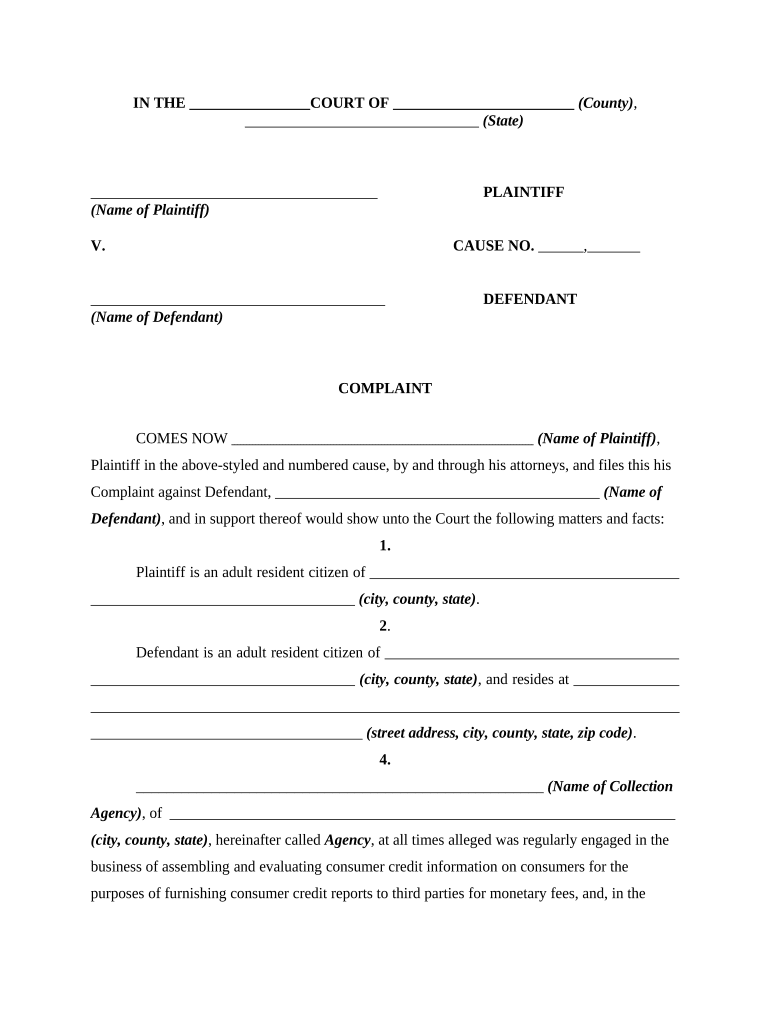
  2. Begin by entering the court name and county in the designated fields at the top of the form. This sets the context for your complaint.
  3. Fill in the names of both the plaintiff and defendant, ensuring accuracy as these are critical identifiers in your case.
  4. In section 1, provide your residency details, including city, county, and state. This establishes your legal standing.
  5. For section 2, input the defendant's residency information similarly to confirm their jurisdiction.
  6. Detail any collection agency involved in section 4, including their location. This is important for establishing connections to your claim.
  7. In section 5, describe how the defendant wrongfully accessed your credit information. Be specific about dates and actions taken.
  8. Outline damages suffered in section 6. Clearly articulate how you were harmed due to this wrongful action.
  9. Finally, complete the request for judgment against the defendant by specifying compensatory damages and other relief sought.

Start editing your document today for free on our platform!

be ready to get more

Complete this form in 5 minutes or less

Get form

Got questions?

We have answers to the most popular questions from our customers. If you can't find an answer to your question, please contact us.
Contact us
Elizabeth F. Loftus (born 1944) is an American psychologist who is best known in relation to the misinformation effect, false memory and criticism of recovered memory therapies.
The misinformation effect is the tendency for the information you learned after an event to interfere with your original memory of what happened. Research has shown that introducing even relatively subtle new information later on can dramatically affect how people remember events they have seen or experienced.
What is the misinformation effect? Creation of fictitious memories by providing misleading information about an event after it takes place.
The Misinformation Effect A well-known experiment demonstrated that participants recollections of a car crash changed based on the words used to describe the accident (e.g., smashed vs. hit). Such subtle influences can create false memories or alter actual details.
To find you guilty of an offence of providing false or misleading information, the Police must prove, beyond reasonable doubt, that you:- Gave information to another person; Knowing that that information was, either: False or misleading; or. Omitted any matter or thing without which the statement is misleading; and.
be ready to get more

Complete this form in 5 minutes or less

Get form

People also ask

525. Subsection (1) states that a person convicted of providing false and misleading information could be subject to an unlimited fine or up to two years imprisonment, or both.

Related links