Holdover tenant letter 2026

Get Form
the hold over Preview on Page 1

Here's how it works

01. Edit your the hold over online
Type text, add images, blackout confidential details, add comments, highlights and more.
02. Sign it in a few clicks
Draw your signature, type it, upload its image, or use your mobile device as a signature pad.
03. Share your form with others
Send holdover letter via email, link, or fax. You can also download it, export it or print it out.

How to use or fill out holdover tenant letter with our platform

Form edit decoration
9.5
Ease of Setup
DocHub User Ratings on G2
9.0
Ease of Use
DocHub User Ratings on G2
  1. Click ‘Get Form’ to open the holdover tenant letter in the editor.
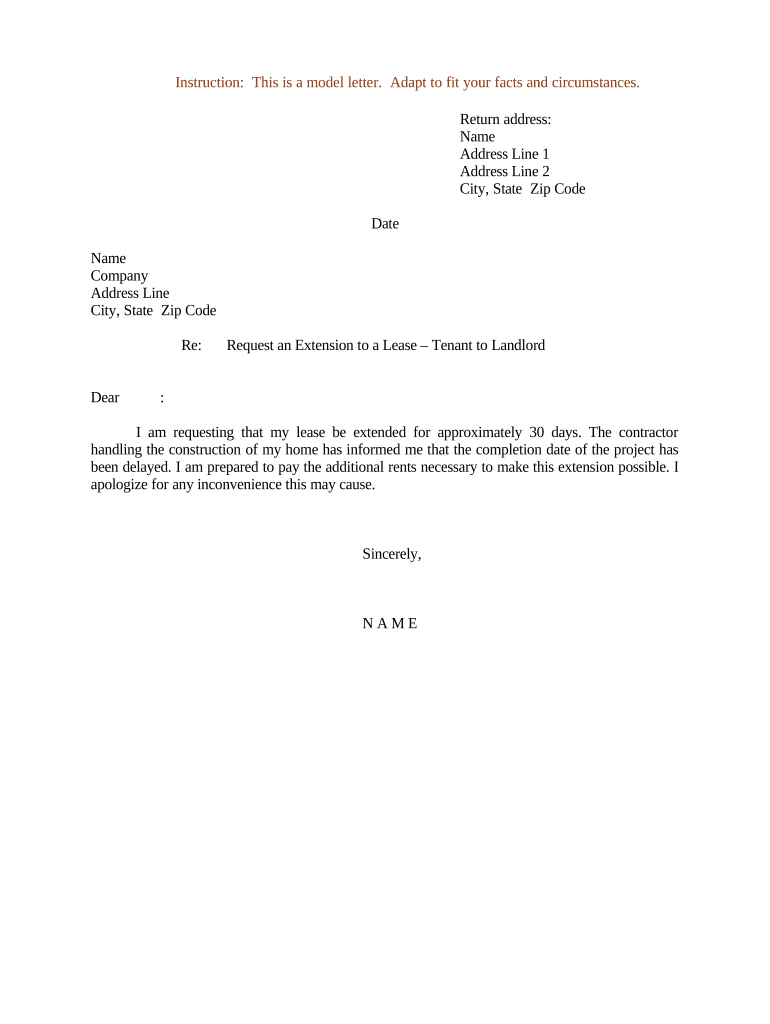
  2. Begin by entering your return address at the top of the letter. Fill in your name, address line 1, address line 2 (if applicable), city, state, and zip code.
  3. Next, input the date on which you are writing the letter. This is important for record-keeping.
  4. In the recipient section, enter the landlord's name and company (if applicable), followed by their address details.
  5. Proceed to the body of the letter. Clearly state your request for a lease extension and provide a brief explanation regarding the delay in construction of your new home.
  6. Conclude with a polite apology for any inconvenience caused and sign off with your name at the bottom of the letter.

Start using our platform today to easily fill out and manage your holdover tenant letter for free!

be ready to get more

Complete this form in 5 minutes or less

Get form

Got questions?

We have answers to the most popular questions from our customers. If you can't find an answer to your question, please contact us.
Contact us
A Holding Company clause defines the role and status of a holding company within a contractual or corporate structure. Typically, it clarifies that the holding company owns controlling interests in one or more subsidiary companies but does not engage directly in their day-to-day operations.
A holdover case is brought to evict a tenant or a person in the apartment who is not a tenant for reasons other than simple nonpayment of rent. A holdover case is much more complicated than a nonpayment case. A holdover proceeding can have many variations.
What is a holdover clause? When a tenant stays past the end of the lease, without renewing or extending the term, the tenant is a holdover tenant. In that situation, the existence of a holdover clause in a lease contract helps protect the landlords rights, and potentially those of a successor occupant.
Dear [Tenants Name], This letter serves as formal notice that your lease agreement for [property address] will terminate on [termination date]. This notice complies with the [state-required notice period]-day requirement specified in our lease agreement.
Example: Resident shall surrender possession of the Premises to Owner upon the effective date of any termination of this Agreement, and in the event Resident fails to do so Resident shall pay Owner rent (at month-to-month rates determined by Owner) for each day of such holdover, plus expenses or damages suffered by

Security and compliance

At DocHub, your data security is our priority. We follow HIPAA, SOC2, GDPR, and other standards, so you can work on your documents with confidence.

Learn more
ccpa2
pci-dss
gdpr-compliance
hipaa
soc-compliance

People also ask

Example of a Holdover Clause If the Tenant remains in possession of the Premises after the expiration of the Lease Term, such possession shall be deemed a month-to-month tenancy terminable upon thirty (30) days written notice by either party.
A holdover clause is designed to protect the brokerage, and there is no minimum or set time for a holdover period. If your agreement includes a holdover clause, make sure you agree to the length of the holdover period before you sign it.
What is holding over? Holding over is simply a tenant remaining in occupation of premises once the original term of their letting has come to an end. Holding over the risks. Holding over principally presents risks as a result of the lack of clarity on the legal position of the parties that it creates.

Related links