Payment pursuant 2026

Get Form
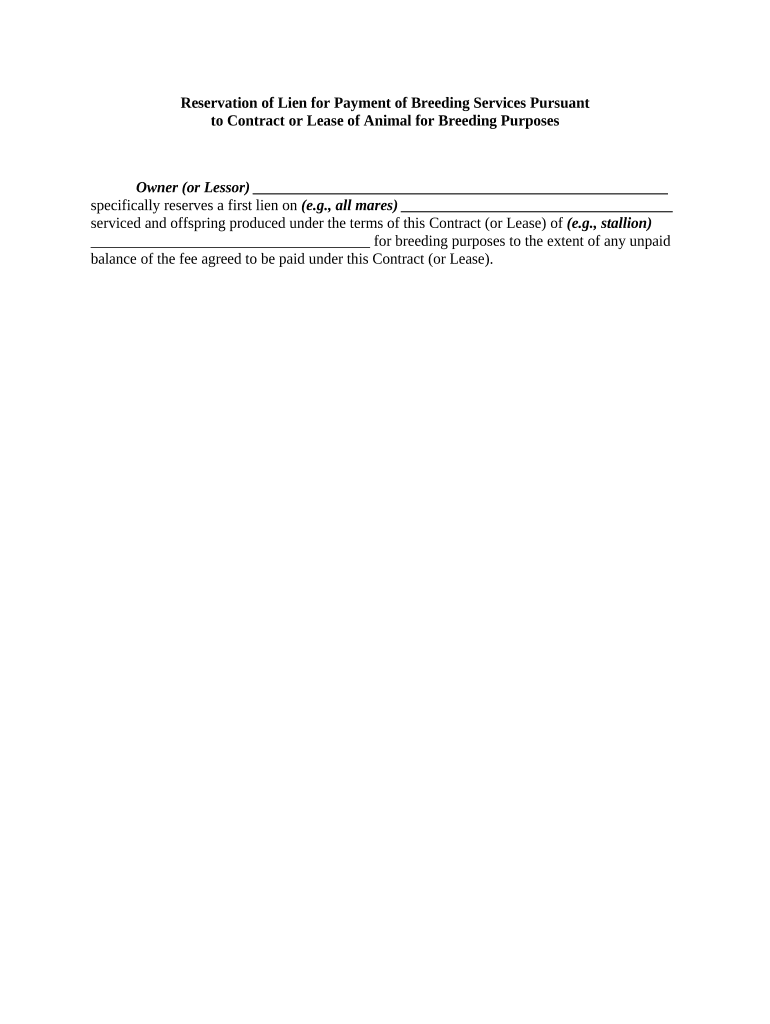
payment pursuant Preview on Page 1

Here's how it works

01. Edit your form online
Type text, add images, blackout confidential details, add comments, highlights and more.
02. Sign it in a few clicks
Draw your signature, type it, upload its image, or use your mobile device as a signature pad.
03. Share your form with others
Send it via email, link, or fax. You can also download it, export it or print it out.

How to use or fill out payment pursuant with our platform

Form edit decoration
9.5
Ease of Setup
DocHub User Ratings on G2
9.0
Ease of Use
DocHub User Ratings on G2
  1. Click ‘Get Form’ to open the payment pursuant document in the editor.
  2. Begin by entering the Owner (or Lessor) name in the designated field. This identifies who is reserving the lien.
  3. In the next section, specify what is being reserved by filling in details such as 'all mares' or any other relevant animals serviced under this contract.
  4. Next, indicate the stallion's name or any animal involved in breeding purposes. This ensures clarity on which animal is associated with the lien.
  5. Finally, review all entered information for accuracy before saving or signing your document. Ensure that all fields are completed to avoid any issues with unpaid balances.

Start using our platform today to streamline your document editing and signing process for free!

be ready to get more

Complete this form in 5 minutes or less

Get form

Got questions?

We have answers to the most popular questions from our customers. If you can't find an answer to your question, please contact us.
Contact us
The 50, 25, 25 payment terms mean the client pays 50% upfront, 25% at a project milestone or midway, and 25% upon completion. Its commonly used in construction, freelancing, and large projects.
Payment terms are agreed-upon conditions between two parties that specify how, where, and when the agreed price is to be paid. In addition to the payment amount, the time of payment, and the currency, payments terms include the type of payment, i.e., the means of payment or the payment method.
Proof of payment is a document that provides evidence of a bank transfer. The most common documents used and accepted are receipts, invoices, and bank statements. Ideally, the information that needs to be included in the document is: Personal Details - Your name, the name of your bank, and your account number.
A term of payment, also sometimes called payment term, is documentation that details how and when your customers pay for your goods or services. Terms of payment set your businesss expectations for payment, including when clients pay and what penalties they may receive for missed payments.
Payment terms refer to agreements that set payment options and expectations for payments. To ensure that they receive prompt payments, business owners set payment terms. The more common payment terms are net 30 and net 60. Net 30 means that the business owner expects payment within 30 days from the invoice date.

Security and compliance

At DocHub, your data security is our priority. We follow HIPAA, SOC2, GDPR, and other standards, so you can work on your documents with confidence.

Learn more
ccpa2
pci-dss
gdpr-compliance
hipaa
soc-compliance

People also ask

Essential Elements in Payment Terms and Conditions Payment Method: Specify acceptable forms of payment (bank transfer, credit card, etc.). Payment Due Date: Clearly state when payment is due (upon receipt, 30 days after invoice date, etc.). Late Payment Penalties: Detail any interest or fees for late payments.
Payment terms can include cash in advance (CIA), cash with order (CWO), cash before shipment (CBS), cash on delivery (COD), cash next delivery (CND), barter terms, or specified payment terms for purchases on account that are payable after receiving the goods or services.
Paragraph 37 states that, to have an enforceable right to payment, at all times throughout the duration of the contract, the entity must be entitled to an amount that at least compensates the entity for performance completed to date if the contract is terminated by the customer or another party for reasons other than

Related links