Conditional obligation 2026

Get Form
resolutory condition example Preview on Page 1

Here's how it works

01. Edit your resolutory condition example online
Type text, add images, blackout confidential details, add comments, highlights and more.
02. Sign it in a few clicks
Draw your signature, type it, upload its image, or use your mobile device as a signature pad.
03. Share your form with others
Send pure obligation example via email, link, or fax. You can also download it, export it or print it out.

How to use or fill out conditional obligation with our platform

Form edit decoration
9.5
Ease of Setup
DocHub User Ratings on G2
9.0
Ease of Use
DocHub User Ratings on G2
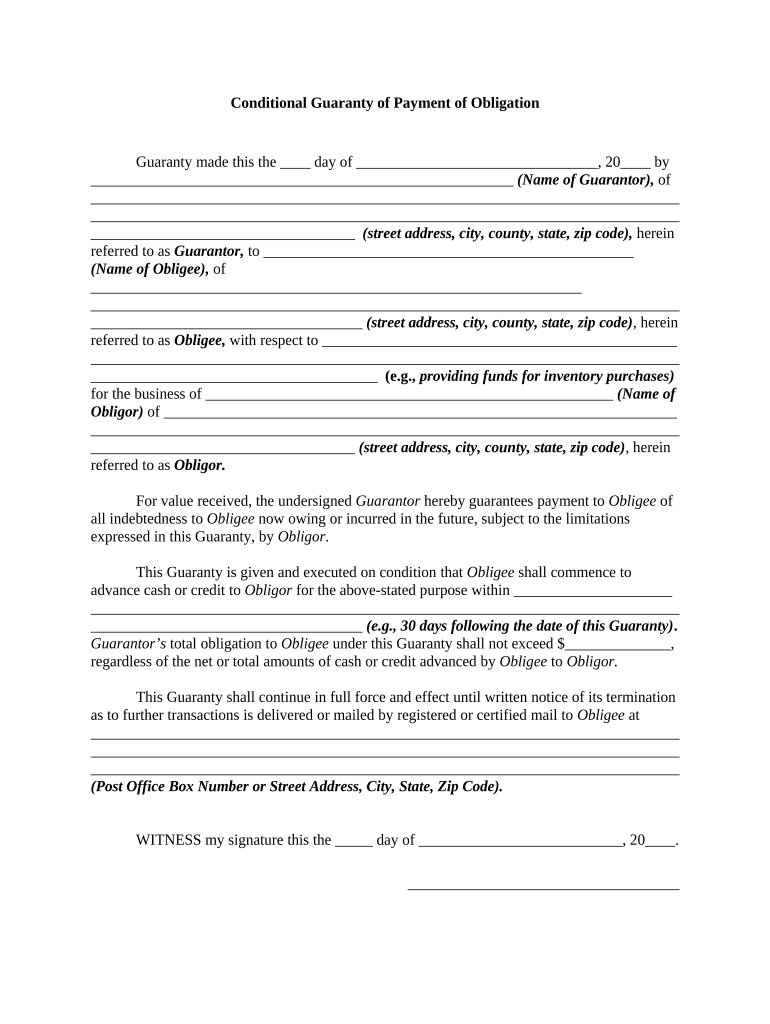
  1. Click ‘Get Form’ to open the Conditional Guaranty of Payment of Obligation in the editor.
  2. Begin by entering the date at the top of the form. This is crucial for establishing the timeline of the agreement.
  3. Fill in the name and address of the Guarantor, ensuring all details are accurate to avoid any legal complications.
  4. Next, provide the name and address of the Obligee. This identifies who will benefit from this guaranty.
  5. Specify what obligation is being guaranteed, such as 'providing funds for inventory purchases.'
  6. Enter the name and address of the Obligor, who is responsible for fulfilling the obligation.
  7. Indicate any conditions regarding when cash or credit will be advanced to Obligor, such as '30 days following this Guaranty.'
  8. Set a limit on Guarantor’s total obligation by filling in an amount that does not exceed your financial capacity.
  9. Finally, provide a termination notice address where written notifications can be sent if needed.
  10. Sign and date at the bottom to finalize your commitment under this agreement.

Start using our platform today to easily complete your Conditional Guaranty form online for free!

be ready to get more

Complete this form in 5 minutes or less

Get form

Got questions?

We have answers to the most popular questions from our customers. If you can't find an answer to your question, please contact us.
Contact us
Terms and conditions are legally enforceable agreements between a business and its users that define the rules for using a product, service, or website. They establish a framework of expectations, limitations, and responsibilities that both parties must adhere to during their relationship.
Absolute obligation involves unconditional terms, while contractual obligation stems from agreements between parties. Express obligation specifically states duties in an agreement, whereas moral obligation is based on right or wrong standards but isnt legally enforced.
A guarantee obligation is an example of a contingent obligation. Under the terms of the guarantee, the guarantor assumes liability for all guaranteed obligations, but its liability to make payments is conditional.
Kinds of Conditions in Conditional Obligations Effect: When the condition occurs, the obligation arises, and the parties are bound to perform their respective duties under the contract. Examples: A contract to sell a piece of land if the buyer secures a loan has a suspensive condition.
Examples of Conditional Contracts in Practice Real Estate: A buyer agrees to purchase a property contingent on receiving mortgage approval or planning permission. Business Transactions: A business acquisition might be conditional upon regulatory approval or satisfactory due diligence.

Security and compliance

At DocHub, your data security is our priority. We follow HIPAA, SOC2, GDPR, and other standards, so you can work on your documents with confidence.

Learn more
ccpa2
pci-dss
gdpr-compliance
hipaa
soc-compliance

People also ask

A conditional obligation is one dependent on an uncertain event. If the obligation may not be enforced until the uncertain event occurs, the condition is suspensive. If the obligation may be immediately enforced but will come to an end when the uncertain event occurs, the condition is resolutory.
Kinds of Conditions in Conditional Obligations Examples: A contract to sell a piece of land if the buyer secures a loan has a suspensive condition. If the buyer fails to secure a loan, the sale does not proceed.
Obligations can be pure or conditional. Pure obligations are demandable at once without conditions, while conditional obligations only become demandable upon the fulfillment of a condition.

Related links