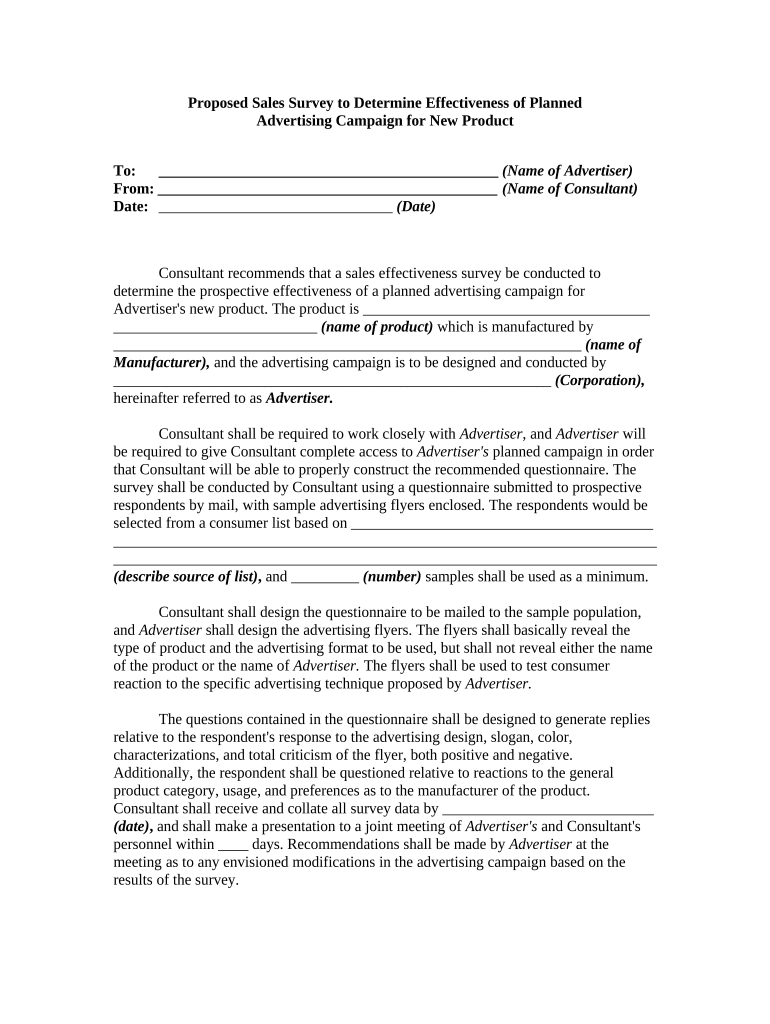
Proposed Sales Survey to Determine Effectiveness of Planned Advertising Campaign for New Product 2026

Get Form
Proposed Sales Survey to Determine Effectiveness of Planned Advertising Campaign for New Product Preview on Page 1

Here's how it works

01. Edit your form online
Type text, add images, blackout confidential details, add comments, highlights and more.
02. Sign it in a few clicks
Draw your signature, type it, upload its image, or use your mobile device as a signature pad.
03. Share your form with others
Send it via email, link, or fax. You can also download it, export it or print it out.

How to use or fill out Proposed Sales Survey to Determine Effectiveness of Planned Advertising Campaign for New Product with DocHub

Form edit decoration
9.5
Ease of Setup
DocHub User Ratings on G2
9.0
Ease of Use
DocHub User Ratings on G2
  1. Click ‘Get Form’ to open the Proposed Sales Survey in our editor.
  2. Begin by entering the name of the advertiser in the designated field. This is crucial for identifying who the survey pertains to.
  3. Next, fill in your name as the consultant and the date of completion. This information establishes accountability and a timeline for the survey.
  4. In the section regarding the product, specify its name and manufacturer. This helps contextualize the advertising campaign being evaluated.
  5. Describe how you will select respondents from your consumer list. Clearly outline your methodology to ensure transparency.
  6. Design your questionnaire within our platform, ensuring it includes questions about consumer reactions to advertising elements like design and color.
  7. Finally, set a deadline for data collection and presentation of results. Use our tools to track progress efficiently.

Start using our platform today to streamline your survey process for free!

be ready to get more

Complete this form in 5 minutes or less

Get form

Got questions?

We have answers to the most popular questions from our customers. If you can't find an answer to your question, please contact us.
Contact us
How to measure advertising effectiveness? Use survey data to identify the real docHub of your marketing campaign. Find the frequency sweet spot. Evaluate the true impact of your campaign against your goals. Measure ROI with confidence. Identify which campaign metrics need improvement.
These seven steps can help you develop a solid approach for how to measure marketing campaign effectiveness. Set Clear Goals. Define KPIs. Set a Campaign Time Frame. Create a Measurement Schedule. Choose the Right Marketing Tools. Create Benchmarks. Build a Dashboard to Present Results.
Advertising effectiveness relates to measuring and evaluating how a specific advertising campaign meets the goals outlined by customers. There are multiple ways in which businesses can measure the success of an advertising campaign, either through sales, the impact on the brand, or awareness of the company.
Clickthrough Rate (CTR) CTR is the ratio of users who click on your ad to the number of total impressions. A higher CTR indicates that your ad is engaging and relevant to your audience, prompting them to take action. This metric helps you assess the effectiveness of your ad copy, design, and placement.
Final Answer: The effectiveness of the advertising campaign can be analyzed through various methods including observing changes in purchase behavior, identifying associations with brand loyalty, interviewing consumers, and analyzing competitors strategies.

Security and compliance

At DocHub, your data security is our priority. We follow HIPAA, SOC2, GDPR, and other standards, so you can work on your documents with confidence.

Learn more
ccpa2
pci-dss
gdpr-compliance
hipaa
soc-compliance

People also ask

Click-through rate (CTR) Metrics impact: CTR measures the effectiveness of your ad in capturing attention and driving traffic to your landing page.
Market research survey best practices Define the problem. Market research is often a long-term and ongoing process. Establish research objectives. Target the right audience. Decide on your margin of error. Set timelines. Use resources and tools to help you. Use the right tools to start collecting and analyzing data.

Related links