Is USMCA still in effect?
Yes, the United States-Mexico-Canada Agreement (USMCA) is still in effect, having replaced NAFTA in July 2020, and governs North American trade, but it faces a critical six-year review in July 2026 where all three nations must agree to extend it for another 16 years or face annual reviews and potential termination in 2036. Key Details In Force Since: July 1, 2020. Replaced: North American Free Trade Agreement (NAFTA). Purpose: To facilitate trade, investment, and jobs across North America. Next Major Step: A mandated joint review in July 2026, where the three countries decide on renewal. What Happens at the 2026 Review? Renewal: If all parties agree, the USMCA continues for another 16 years, with a new review in 2032. No Renewal: If they dont agree, the pact enters annual reviews, with a potential end date of 2036 if issues remain unresolved. Current Status The agreement is active, but its future beyond 2026 is subject to the upcoming review, with discussions ongoing about potential changes to address concerns like labor standards, dairy trade, and Chinas influence in the region. AI can make mistakes, so double-check responsesUSMCA Review 2026 - CSISAug 18, 2025 In 2020, the USMCA replaced the North American Free Trade Agreement (NAFTA), which had governed trade between the threCSIS | Center for Strategic and International StudiesTrump and the Future of the USMCA - Council on Foreign RelationsJan 17, 2025 By * Shannon K. * The United States-Mexico-Canada Agreement (USMCA), which underpins North Americas economic intCouncil on Foreign Relations
Does NAFTA still apply?
No, NAFTA (North American Free Trade Agreement) is no longer in effect; it was officially terminated on June 30, 2020, and replaced by the United States-Mexico-Canada Agreement (USMCA), which took effect on July 1, 2020. The USMCA modernized and updated the original NAFTA, creating a more balanced free trade zone for North American workers, farmers, and businesses with updated rules for automobiles, digital trade, and intellectual property. Key Points: NAFTAs History: Signed in 1992, NAFTA established a free-trade zone, eliminating most tariffs between the U.S., Canada, and Mexico from 1994 to 2020. USMCAs Role: The USMCA (also known as CUSMA in Canada and T-MEC in Mexico) serves as the current trade agreement, incorporating changes for the digital age and stronger labor/environmental standards. Key USMCA Changes: Includes stricter rules of origin for autos, better dairy market access for U.S. farmers, new digital trade rules, and provisions on currency manipulation. AI can make mistakes, so double-check responsesUnited States-Mexico-Canada AgreementUSTRNorth American Free Trade AgreementDisclaimer. The North American Free Trade Agreement (NAFTA) terminated on June 30, 2020 and was replaced on July 1, 2020 by the UnU.S. Customs and Border Protection (.gov)
What is NAFTA paperwork?
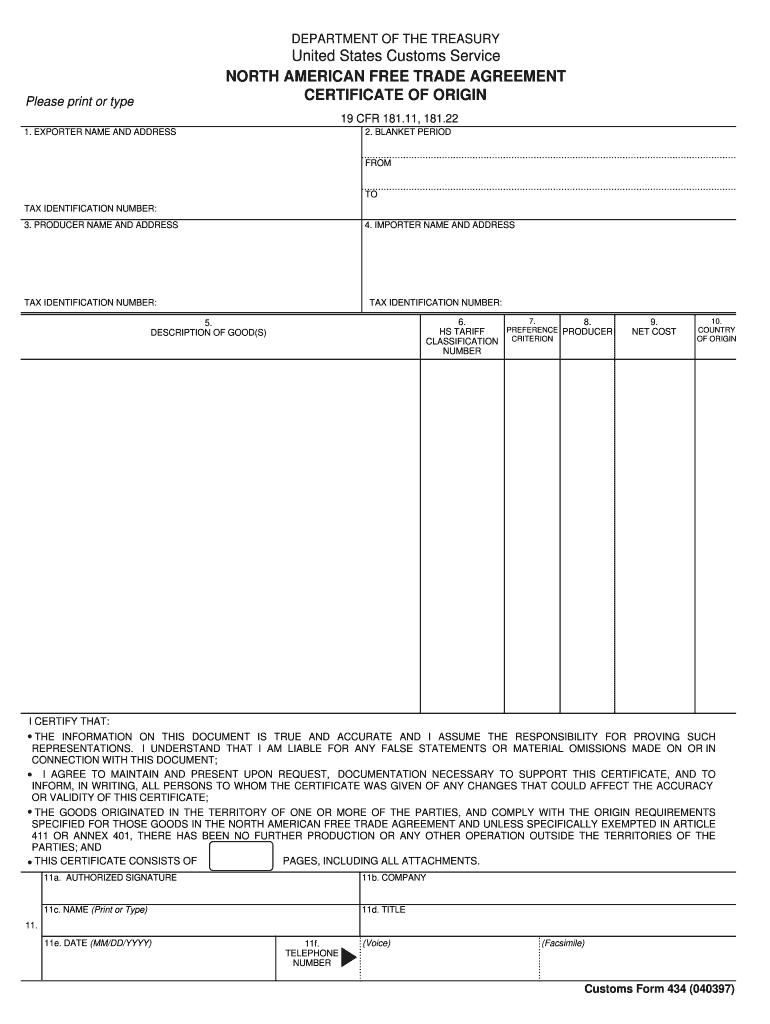
The NAFTA Certificate of Origin is used by the United States, Canada, and Mexico to determine if imported goods are eligible to receive reduced or eliminated duty as specified by the NAFTA.
What type of agreement is NAFTA?
The North American Free Trade Agreement (Spanish: Tratado de Libre Comercio de Amrica del Norte, TLCAN; French: de libre-change nord-amricain, ALNA), referred to colloquially in the Anglosphere as NAFTA, (/ˈnftə/ NAF-tə) was an agreement signed by Canada, Mexico, and the United States that created a
How to fill out a NAFTA form?
A Guide for Reviewing and Completing NAFTA Certificates. of Origin. Generally: Field 1: Exporter Name and Address. Field 2: Blanket Period. Field 3: Producer Name and Address. Field 4: Importer Name and Address. Field 5: Description of the Goods. Field 6: HS Tariff Classification.