Qualified personal 2026

Get Form
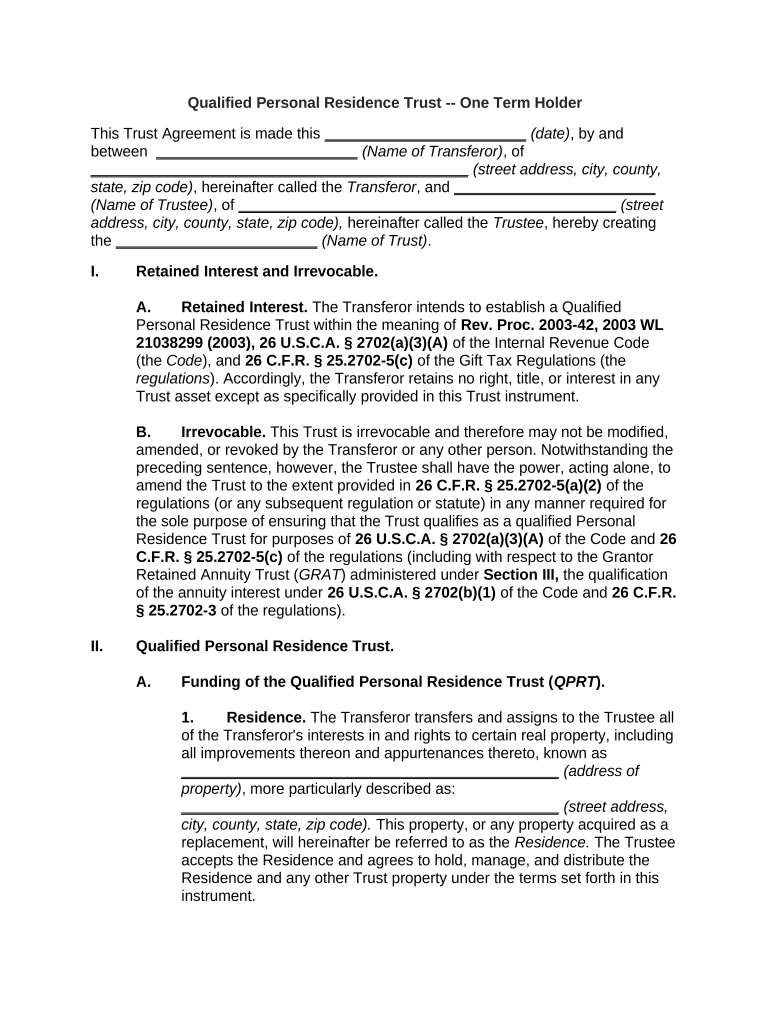
qualified personal Preview on Page 1

Here's how it works

01. Edit your form online
Type text, add images, blackout confidential details, add comments, highlights and more.
02. Sign it in a few clicks
Draw your signature, type it, upload its image, or use your mobile device as a signature pad.
03. Share your form with others
Send it via email, link, or fax. You can also download it, export it or print it out.

How to use or fill out qualified personal with our platform

Form edit decoration
9.5
Ease of Setup
DocHub User Ratings on G2
9.0
Ease of Use
DocHub User Ratings on G2
  1. Click ‘Get Form’ to open the Qualified Personal Residence Trust in the editor.
  2. Begin by entering the date of the agreement in the designated field. This is crucial for establishing the timeline of the trust.
  3. Fill in the names and addresses of both the Transferor and Trustee. Ensure accuracy as this information identifies all parties involved.
  4. Specify the name of the Trust in the provided space. This will be used throughout the document to refer to your trust.
  5. In Section I, clearly indicate that this Trust is irrevocable, ensuring you understand that modifications cannot be made once established.
  6. Proceed to Section II, where you will detail the residence being transferred into the trust. Include complete address information and any relevant descriptions.
  7. Complete all sections regarding funding, management, and termination of trust as outlined in Sections II and III, ensuring compliance with regulations.

Start using our platform today for free to streamline your document editing and signing process!

be ready to get more

Complete this form in 5 minutes or less

Get form

Got questions?

We have answers to the most popular questions from our customers. If you can't find an answer to your question, please contact us.
Contact us
How Long Can the Term on a QPRT be? There is no set limit on the term of a QPRT. Setting the term length is one of the most important aspects of the Trust. It should be set up such that it expires before you pass away.
Sale of Home in a QPRT If this happens, the trustee has to distribute the sale proceeds back to you or convert the trust to a Grantor Retained Annuity Trust (GRAT) within 30 days. If you do decide to sell the home, the trustee will transfer title to the purchaser and will purchase a new home in the name of the QPRT.
By making the rental payments to the trust rather than the beneficiaries directly, the grantor, not the beneficiaries, would be subject to income taxes on the rental payments.
Key Takeaways: C-corps providing professional services where the services are performed substantially by employees owning at least 95% of the stock are qualified PSCs. Unlike other C-corps, qualified PSCs might be subject to the passive loss rules if they dont participate materially in an activity.
For example, a young adult may set up a personal trust to pay for a graduate school program or professional education down the line.

Security and compliance

At DocHub, your data security is our priority. We follow HIPAA, SOC2, GDPR, and other standards, so you can work on your documents with confidence.

Learn more
ccpa2
pci-dss
gdpr-compliance
hipaa
soc-compliance

People also ask

A QPRT Example: Jill transfers her vacation home, worth $1 million, to a QPRT. She retains the right to occupy the home for 10 years, after which the home will pass to her son. Assuming a discount rate of 5.6%, Jills gift can be discounted by $420,090.
Qualified personal residence trust (QPRT) refers to a type of trust used to minimize estate and gift taxes by moving personal residences into a trust.

Related links