Claim against estate file 2026

Get Form
claim against estate file Preview on Page 1

Here's how it works

01. Edit your form online
Type text, add images, blackout confidential details, add comments, highlights and more.
02. Sign it in a few clicks
Draw your signature, type it, upload its image, or use your mobile device as a signature pad.
03. Share your form with others
Send it via email, link, or fax. You can also download it, export it or print it out.

How to use or fill out claim against estate file with our platform

Form edit decoration
9.5
Ease of Setup
DocHub User Ratings on G2
9.0
Ease of Use
DocHub User Ratings on G2
  1. Click ‘Get Form’ to open the claim against estate file in the editor.
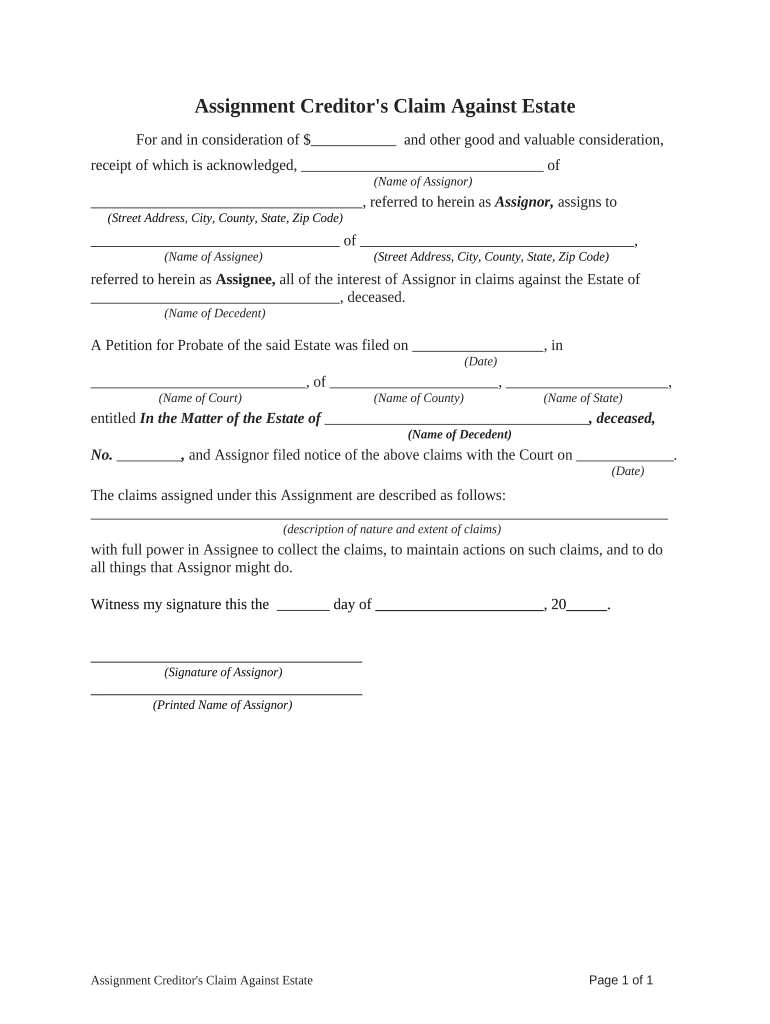
  2. Begin by entering the consideration amount in the designated field, ensuring accuracy for legal purposes.
  3. Fill in the name of the Assignor and their complete address, including street, city, county, state, and zip code.
  4. Next, input the name of the Assignee along with their full address details in the corresponding fields.
  5. Provide the name of the deceased (Decedent) and ensure you include all relevant dates related to probate filings and claims notifications.
  6. In the section describing claims, clearly outline the nature and extent of claims being assigned. This is crucial for clarity and legal validity.
  7. Finally, sign and print your name as Assignor at the bottom of the form. Ensure that all information is accurate before submission.

Start using our platform today to easily fill out your claim against estate file for free!

be ready to get more

Complete this form in 5 minutes or less

Get form

Got questions?

We have answers to the most popular questions from our customers. If you can't find an answer to your question, please contact us.
Contact us

Of course, electronically drawing your signature is acceptable, but only if you use a tool that complies with industry laws and regulations. Consider DocHub, which guarantees eSignature validity under ESIGN and UETA requirements. All you need to eSign your claim against estate file is an account with DocHub and an internet connection. After you open your document in our editor, click Sign and select the Draw tool.

If you go for analog methods of completing your claim against estate file, it is simple to download your file for printing. Search DocHub’s Forms & Templates catalog to find the exact document template you require and open it for editing or download it on your gadget in the format of your choice. It is possible to complete your form electronically and put your handwritten signature on it right after printing or eSign your document with DocHub.

Legal Heirs: In the absence of a will, legal heirs (often immediate family members) can lay claim according to intestacy laws. Creditors: If the deceased owed you money, you might claim against their estate to recover this debt.
Why are claims against an estate put into an order of priority? To determine which claims are to be paid if funds are insufficient to pay all claims.
One crucial point that people often miss is that only certain people can make claims against an estate, although it is important to note that the people who can make claims against an estate are not limited to family members. The starting point is that you must have an interest in making a claim.

Security and compliance

At DocHub, your data security is our priority. We follow HIPAA, SOC2, GDPR, and other standards, so you can work on your documents with confidence.

Learn more
ccpa2
pci-dss
gdpr-compliance
hipaa
soc-compliance
be ready to get more

Complete this form in 5 minutes or less

Get form

People also ask

A claim against an estate can be made if the deceaseds will didnt make reasonable financial provision for the claimant. What amounts to reasonable financial provision depends on the size of the estate and other factors, such as other potential dependants of the deceased.
Claims against the estate are demands for payment made by creditors who believe they are owed money by the deceased person.
When someone dies, they usually leave a will and name someone as executor. This is the person who is responsible for dealing with the deceaseds estate and defending against any will disputes or contests.

Related links