Letter destruction 2026

Get Form
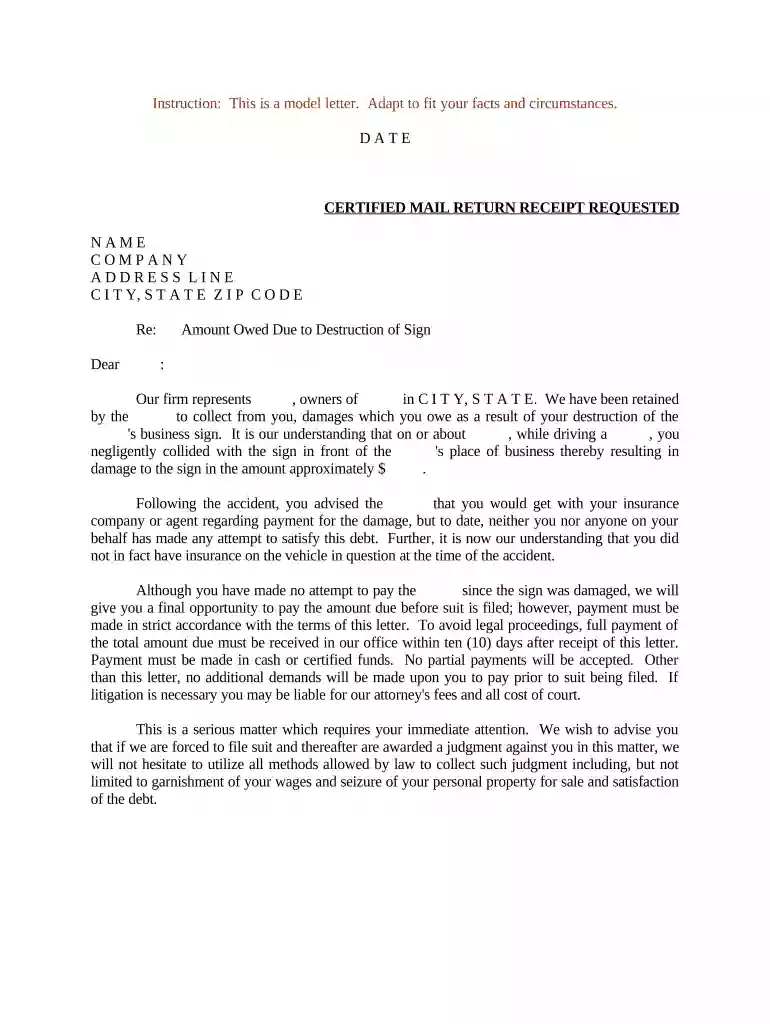
letter of destruction example Preview on Page 1

Here's how it works

01. Edit your letter of destruction example online
Type text, add images, blackout confidential details, add comments, highlights and more.

02. Sign it in a few clicks
Draw your signature, type it, upload its image, or use your mobile device as a signature pad.

03. Share your form with others
Send letter of destruction via email, link, or fax. You can also download it, export it or print it out.

Definition and Meaning of a Letter of Destruction

A letter of destruction is a formal document used to formally announce and record the disposal or destruction of sensitive materials, such as business documents, contracts, and personal information. It serves as evidence that specific items have been securely destroyed to ensure compliance with privacy laws and organizational policies. The primary purpose is the protection of sensitive data and to mitigate risks associated with data breaches. This letter typically includes details such as the type of document, the method of destruction, and the date of destruction.

Key Elements of a Letter of Destruction

  • Sender and Recipient Information: Clearly state the names and addresses of both parties.
  • Description of Documents: Detail the documents being destroyed, including types and quantities.
  • Method of Destruction: Specify how the destruction will be conducted (shredding, burning, etc.).
  • Date of Destruction: Indicate when the destruction will take place or has occurred.
  • Acknowledgment Line: A section for the recipient's signature to confirm their awareness of the destruction.

Including these elements ensures the letter is comprehensive and legally sound.

Importance of a Letter of Destruction in Compliance

Letters of destruction play a crucial role in legal and regulatory compliance. Many industries, particularly those dealing with personal or sensitive information, are required by law to maintain strict data protection practices.

Legal Requirements

  • Data Protection Laws: Regulations such as HIPAA, GDPR, and CCPA impose stringent rules regarding the handling of personal information.
  • Record Retention Policies: Organizations must adhere to internal policies that dictate how long certain documents should be kept before they can be destroyed.
  • Audit Trails: These letters provide a documented trail of compliance, helpful during audits or legal investigations.

Ensuring compliance through a letter of destruction not only protects an organization from potential penalties but also reinforces trust with clients and stakeholders.

Sample Letter of Destruction

When crafting a letter of destruction, it is helpful to follow a structured format. Below is an example:


[Your Company Letterhead]
[Date]

[Recipient's Name]
[Recipient's Title]
[Recipient's Company]
[Recipient's Address]

Dear [Recipient's Name],

This letter is to formally notify you that the following documents have been destroyed in compliance with our data retention policies and applicable laws:

  • Document Type: [e.g., Client Contracts]
  • Quantity: [e.g., 100 files]
  • Method of Destruction: [e.g., Shredding]
  • Date of Destruction: [e.g., October 15, 2023]

We acknowledge the importance of safeguarding sensitive information and confirm that all steps were taken to ensure secure destruction. Please sign below to acknowledge receipt of this notification.

Sincerely,

[Your Name]
[Your Title]
[Your Company]

Acknowledgment of Receipt


[Recipient's Signature]
[Date]


This sample serves as a solid template for organizations needing to document the destruction process formally.

Real-World Scenarios for Using a Letter of Destruction

In practice, letters of destruction may be utilized in various scenarios, such as:

  1. Business Document Disposal: A company may regularly destroy outdated contracts or financial records.
  2. Patient Records Management: Medical facilities must securely dispose of outdated patient records to comply with HIPAA regulations.
  3. End-of-Life Products: Manufacturers may need to destroy defective or recalled products to prevent misuse.

In each scenario, the letter serves as a record that can be referenced for compliance and auditing purposes.

Best Practices for Creating a Destruction Letter

When composing a letter of destruction, several best practices can enhance its effectiveness:

  • Clarity and Precision: Use straightforward language to avoid misunderstandings.
  • Documentation: Keep a file of all letters for internal record-keeping and compliance.
  • Review: Have legal counsel review templates to ensure they comply with local laws and regulations.
  • Recipient Confirmation: Ensure acknowledgment is obtained from all parties involved to certify awareness of the document destruction.

By following these best practices, organizations can ensure their destruction letters are both effective and compliant.

Variants and Alternatives to Letters of Destruction

While the letter of destruction serves its specific purpose, various alternative documents may be applicable depending on the context and content type. These include:

  • Certificate of Destruction: This document often provides proof of destruction from a third-party service.
  • Destruction Memo: A less formal notice that may be used internally within a company.
  • Data Disposal Policy: More comprehensive documents that outline organizational procedures for data destruction.

Each variant serves its distinct function, and organizations must choose the one that best fits their specific needs for data protection and compliance.

be ready to get more

Complete this form in 5 minutes or less

Get form

Got questions?

We have answers to the most popular questions from our customers. If you can't find an answer to your question, please contact us.
Contact us
The document is a necessity for businesses and services that work under laws and regulations governing the privacy of personal records, hazardous waste disposal, and the like. Having the certificate provides proof of due diligence in the face of an audit, investigation, or other legal issues.
A Certificate of Destruction (COD) is a document containing confirmation that your sensitive and confidential data stored on paper or hard drives has been destroyed.
This designation typically means the vehicle was considered non-repairable or that its value is below a minimum threshold, which often applies to rental vehicles or vehicles with water or structural damage. Even if the vehicle appears to be in good condition, the COD is usually an irreversible status.
What does disposal of documents mean? Disposal means the destruction of information in its entirety and forever (discarding, shredding, burning, deleting electronically etc.).
A certificate of destruction (CoD) ensures that no data breach incident or lapse has happened, as the document ensures complete, secure, and permanent data destruction. The CoD acts as a liability protection document during episodes of legal disputes or data breaches.

Security and compliance

At DocHub, your data security is our priority. We follow HIPAA, SOC2, GDPR, and other standards, so you can work on your documents with confidence.
Learn more
ccpa2
pci-dss
gdpr-compliance
hipaa
soc-compliance
be ready to get more

Complete this form in 5 minutes or less

Get form

People also ask

CarTitles.com confirms that when an insurance company pays the claim for a damaged vehicle and becomes the rightful owner, it has the legal right to issue a certificate of destruction, meaning the vehicle will never be registered for use on a public road again and is scheduled for destruction.
A Certificate of Destruction serves as legal proof that you transferred that responsibility to the shredding company for the purpose of having it destroyed, logging what was destroyed, when, and by whom.
If the restaurant purchases its fish from a supplier, a letter must be provided which states that the fish provided by the supplier is frozen for parasite destruction ing to the Food Code requirements above.

parasite destruction letter