






Definition and Key Concepts of Assignment of Accounts Receivable
An assignment of accounts receivable is a financial arrangement that involves the transfer of a business's outstanding invoices from one party, known as the Assignor, to another, the Assignee. This process allows businesses to secure immediate cash flow by allowing the Assignee to collect payments on those receivables directly. The assignment is documented in a formal agreement, outlining the rights and obligations of both parties.
Key Terminology
- Assignor: The party transferring the accounts receivable.
- Assignee: The party receiving the accounts receivable.
- Receivables: Outstanding invoices or amounts owed by customers.
Common Scenarios for Use
- A business facing liquidity issues may assign its receivables to a financial institution for quicker access to cash.
- A seller may use such an assignment to provide collateral for a loan, effectively leveraging outstanding invoices for immediate funding.
Components of an Assignment of Accounts Receivable Agreement
A comprehensive assignment of accounts receivable agreement outlines several critical components to protect both the Assignor and Assignee. These sections include:
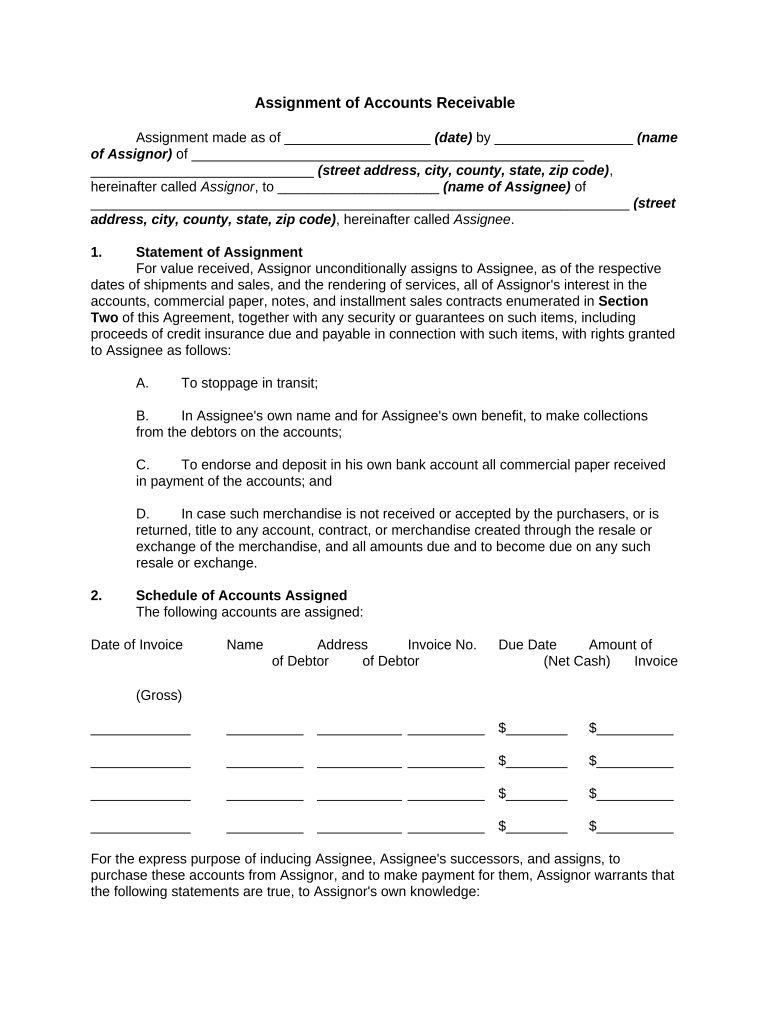
Assignment Statement
This section clearly states the intention of the Assignor to convey rights regarding the designated accounts to the Assignee. It includes specific details about which receivables are being assigned.
Schedule of Assigned Accounts
In this crucial area, a list of all included accounts is provided. Each account's value and related invoices should be itemized, offering clarity on the scope of the assignment.
Warranties and Representations
This part of the agreement offers assurances from the Assignor. Key warranties include:
- The validity of the accounts assigned.
- Confirmation that the accounts are free from prior claims or encumbrances.
- A guarantee that the accounts are collectible.
Legal Considerations for Assignment Transactions
Assigning accounts receivable has specific legal implications that both parties must be aware of to ensure compliance and enforceability.
Compliance with State Laws
Different states may have varying laws governing the assignment of receivables. Thus, it is essential to:
- Review relevant statutes before finalizing the assignment.
- Ensure the assignment complies with the Uniform Commercial Code (UCC), which governs such transactions in many jurisdictions.
Notification of Assignment
While not always legally required, it is advisable for the Assignor to notify debtors about the assignment. This can help prevent disputes regarding payments due on the receivables.
Practical Examples of Accounts Receivable Assignments
Understanding practical examples can provide clarity on how an assignment of accounts receivable functions.
Example One: Immediate Cash Flow Solution
A small business, facing unexpected expenses, decides to assign $50,000 in outstanding invoices to a factoring agency. The agency provides 80% of the invoice value upfront, enabling the business to cover its urgent costs. The agency then collects payments directly from the customers.
Example Two: Securing Financing
A manufacturer wanting to expand may assign its accounts receivable to a bank as collateral for a loan. The bank, upon receiving a notice of assignment, can validate the receivables and provide financing based on expected incoming cash flows.
Steps for Executing an Assignment of Accounts Receivable
Executing the assignment involves several key steps that both parties must follow to ensure a seamless process.
- Draft the Agreement: Both parties should collaborate to create a clear, detailed agreement that includes all essential components.
- Identify Accounts: The Assignor must compile a thorough list of all receivables being assigned.
- Obtain Necessary Consents: If applicable, secure any needed permissions from third parties, such as debtors.
- Execute the Agreement: Both parties should sign the agreement, making the assignment officially binding.
Important Considerations
- Ensure that the assignment agreement is notarized if required in your state, enhancing its legal enforceability.
- Keep detailed records of all communications and agreements related to the assignment process for future reference.
Advantages and Disadvantages of Assigning Accounts Receivable
Evaluating the benefits and potential drawbacks of this financial transaction is essential for any business owner considering an assignment.
Advantages
- Immediate Liquidity: The most significant benefit is access to cash flow without waiting for standard payment timelines.
- Reducing Credit Risk: Transitioning the responsibility for collections to the Assignee can help manage credit risk.
Disadvantages
- Cost: Assigning accounts may involve fees or decreased revenue due to discounts offered to the Assignee.
- Dependency on Assignee: The Assignor may become reliant on the Assignee for timely cash flow, potentially impacting business operations if issues arise.
In summary, the assignment of accounts receivable is a valuable financial tool for organizations aiming to strengthen their cash flow and manage their financial responsibilities effectively. Understanding its components, legal implications, and practical execution steps is critical for businesses looking to utilize this financial strategy efficiently.