Condominium association agreement 2026

Get Form
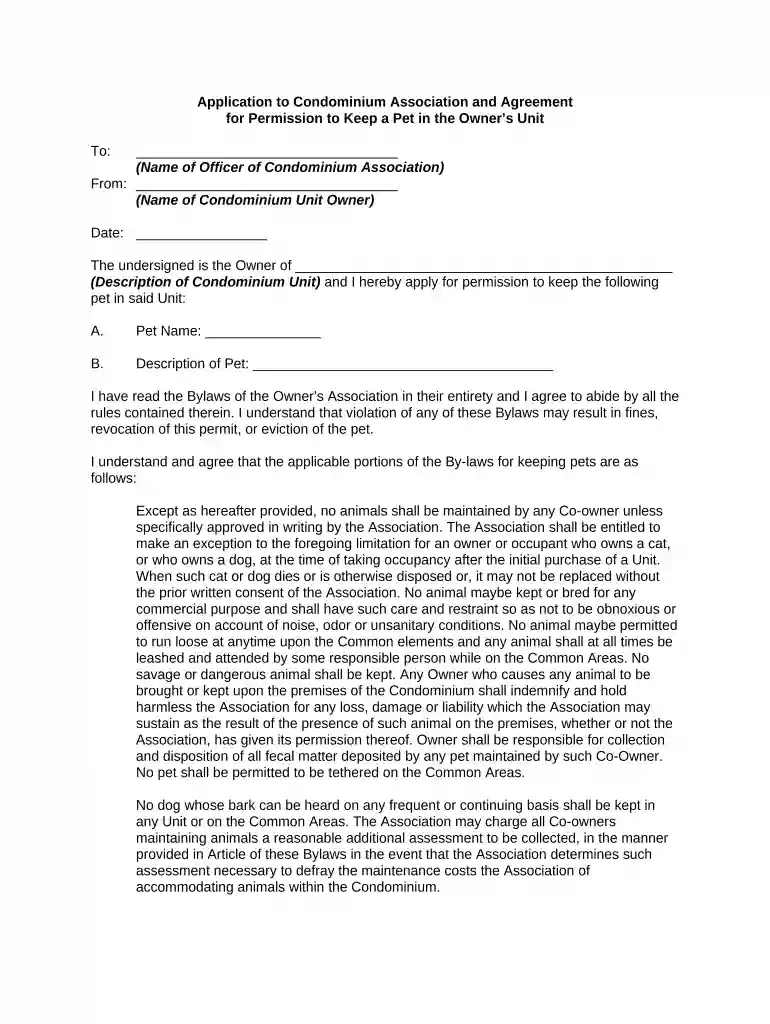
condo association agreement Preview on Page 1

Here's how it works

01. Edit your condo association agreement online
Type text, add images, blackout confidential details, add comments, highlights and more.

02. Sign it in a few clicks
Draw your signature, type it, upload its image, or use your mobile device as a signature pad.

03. Share your form with others
Send it via email, link, or fax. You can also download it, export it or print it out.

How to use or fill out condominium association agreement with our platform

Form edit decoration
9.5
Ease of Setup
DocHub User Ratings on G2
9.0
Ease of Use
DocHub User Ratings on G2
  1. Click ‘Get Form’ to open the condominium association agreement in the editor.
  2. Begin by entering the name of the officer of the condominium association in the designated field at the top of the form.
  3. Next, fill in your name as the condominium unit owner and include the date of application.
  4. Provide a detailed description of your condominium unit in the specified section to ensure clarity.
  5. In section A, enter your pet's name, followed by a thorough description of your pet in section B.
  6. Review and acknowledge that you have read and agree to abide by all bylaws by checking any required boxes or signing where indicated.
  7. Finally, sign and print your name at the bottom of the form to complete your application.

Start using our platform today for free to streamline your document editing and signing process!

be ready to get more

Complete this form in 5 minutes or less

Get form

Got questions?

We have answers to the most popular questions from our customers. If you can't find an answer to your question, please contact us.
Contact us
Condo associations have rules that the owners of a condo building must follow. These rules usually are explained in a restrictive covenant, sometimes called CCRs (covenants, conditions, and restrictions), which is a clause in the property deed that limits how an owner can use their property.
In a homeowners association (HOA), the association owns common areas, such as lobbies, pools, and gyms, and all owners are members of that association. In a condominium association, the individual owners own a percentage of all shared propertythe association doesnt have ownership of any real estate.
In an HOA, residents own their property, but the association owns and maintains common areas, such as lobbies, pools, clubhouses, and gyms. Conversely, in a COA, owners own their individual units and a percentage of all shared property, like tennis courts, pickleball courts, sidewalks, and parking lots.
0:00 1:22 And regulations of the association. And they should have all rights to use any of the facilities.MoreAnd regulations of the association. And they should have all rights to use any of the facilities. Common areas and have any other privileges of the community unless otherwise stated in the agreement.
A condo association is responsible for maintaining the common areas and elements of a condo development. That includes managing the associations finances and hiring vendors to clean, repair, and maintain the community. This enhances the quality of life for the residents and helps keep condo unit values high.

Security and compliance

At DocHub, your data security is our priority. We follow HIPAA, SOC2, GDPR, and other standards, so you can work on your documents with confidence.
Learn more
ccpa2
pci-dss
gdpr-compliance
hipaa
soc-compliance

People also ask

To structure these, every association has three types of governing documents: Covenants, Conditions Restrictions (called CCRs), Bylaws, and Rules Regulations.
What Exactly Are Association Dues? A recurring monthly share in the cost of utilities, security, janitorial, insurance, salaries, taxes on common areas, and management fees.

Related links