Letter accounting client 2026

Get Form
letter accounting client Preview on Page 1

Here's how it works

01. Edit your form online
Type text, add images, blackout confidential details, add comments, highlights and more.

02. Sign it in a few clicks
Draw your signature, type it, upload its image, or use your mobile device as a signature pad.

03. Share your form with others
Send it via email, link, or fax. You can also download it, export it or print it out.

How to use or fill out letter accounting client with our platform

Form edit decoration
9.5
Ease of Setup
DocHub User Ratings on G2
9.0
Ease of Use
DocHub User Ratings on G2
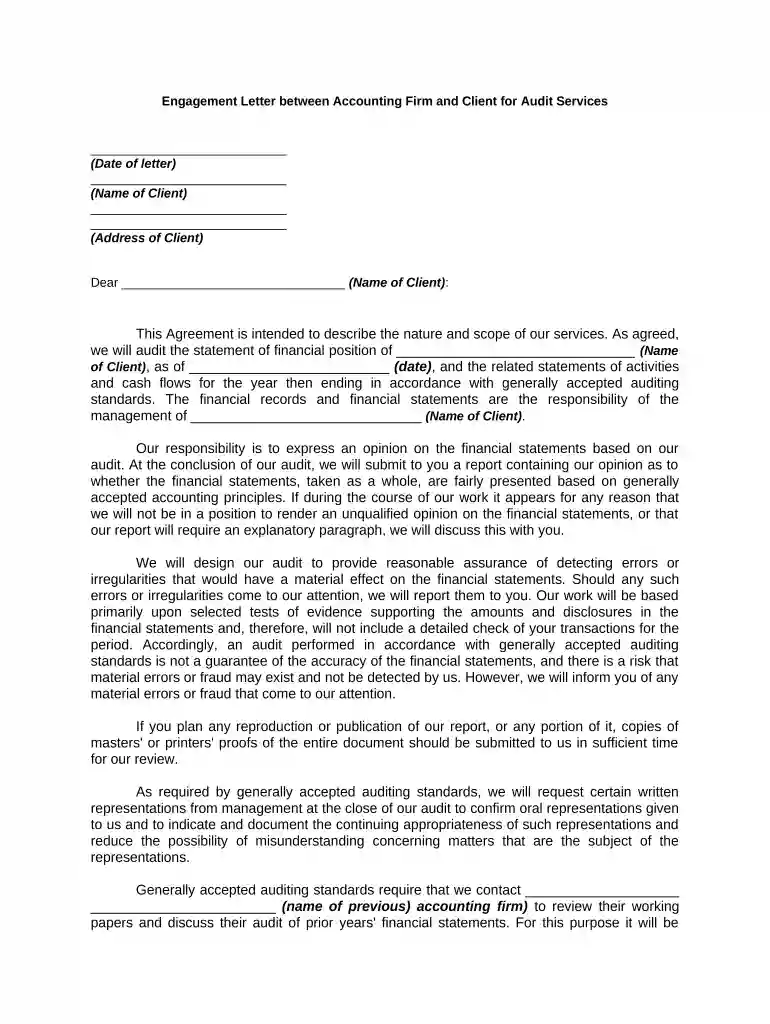
  1. Click ‘Get Form’ to open the letter accounting client in the editor.
  2. Begin by entering the date of the letter at the top of the document. This sets a clear timeline for your agreement.
  3. Fill in the name and address of the client in the designated fields. Ensure accuracy as this identifies who is involved in the agreement.
  4. In the body of the letter, specify the scope of services being provided, including details about the audit and any relevant dates.
  5. Complete sections regarding responsibilities, ensuring you clarify both parties' obligations concerning financial records and reporting.
  6. Review and fill out any additional fields related to fees, cooperation requirements, and dispute resolution processes.
  7. Finally, ensure that both parties sign where indicated to formalize the agreement. Use our platform’s signature feature for convenience.

Start using our platform today to streamline your document editing and signing process for free!

be ready to get more

Complete this form in 5 minutes or less

Get form

Got questions?

We have answers to the most popular questions from our customers. If you can't find an answer to your question, please contact us.
Contact us
Letters to clients are documents written by business professionals to current or potential customers. Many marketing and sales professionals write letters to clients for many reasons, like promoting a product or service, launching a new business, or responding to client complaints.
To write an effective accountant cover letter, follow these steps: Research the company. Address the recipient by name. State the job you are applying for. Talk about your qualifications. Explain why you are an ideal candidate. Conclude the letter. Re-read your cover letter.
An accountants letter is a docHub document that provides a professional verification of financial information. It is widely used in financial assessments by lenders, investors, and legal entities. For the subject of the letter, its a demonstration of transparency and credibility.
Essential Elements of an Accounting Engagement Letter Client and accountant identification. Effective date and engagement period. Scope of services to be provided. Fee structure and billing arrangements. Client responsibilities and obligations. Confidentiality and privacy considerations. Termination terms and conditions.
Best Practices for Writing an Accounting Engagement Letter Make sure to state in clear language what your duties are to the client, what you expect from them, the services youll provide, how youll charge them, and the start and end date for the engagement.

Security and compliance

At DocHub, your data security is our priority. We follow HIPAA, SOC2, GDPR, and other standards, so you can work on your documents with confidence.
Learn more
ccpa2
pci-dss
gdpr-compliance
hipaa
soc-compliance

People also ask

Client Accounting Services (CAS) are a variety of accounting services provided by CPAs to clients that range from basic bookkeeping to advanced management reporting, advisory and guidance services to businesses of all sizes.
An accountants letter is a document that has been signed by a fully qualified accountant. The accountant verifies that a borrowers self-declared income is correct and honest. In some instances the borrower is not required to self declare their income, instead the accountants letter alone is used to approve the loan.
Client advice letters have a similar structure to legal memoranda. They typically include (A) an introduction, (B) a statement of facts, (C) an analysis section, and (D) a concluding paragraph. 23 Each subsection below describes what to write in each component, as well as specific tips and examples.

Related links