







Definition and Purpose of the Telephone Screening Form
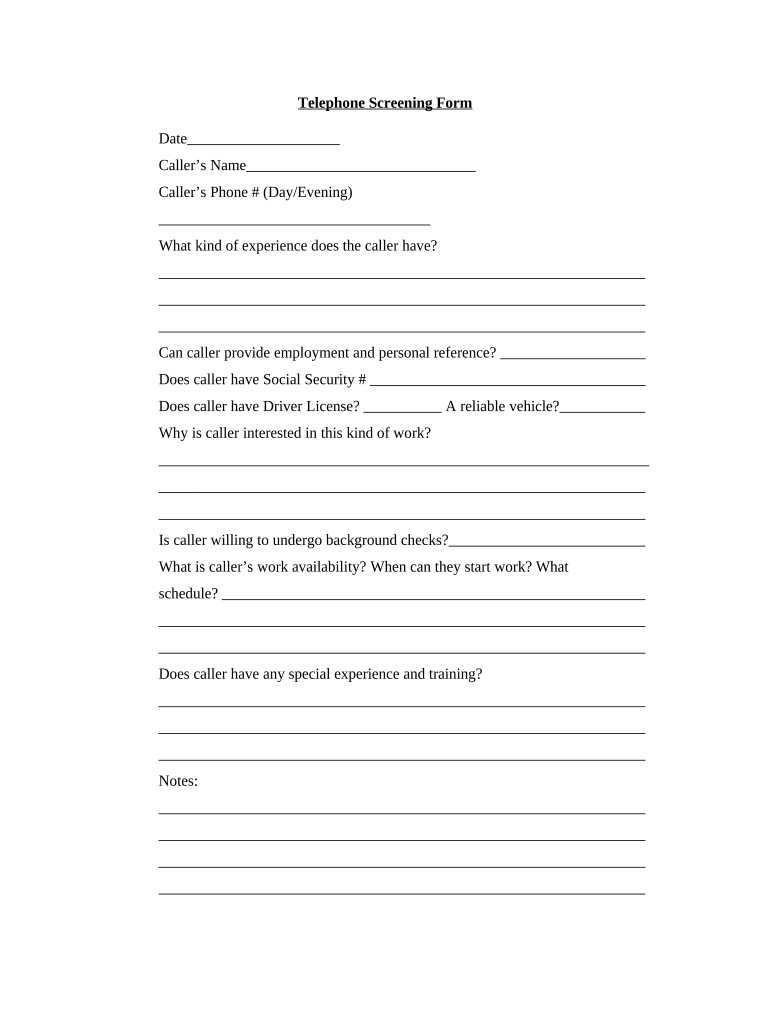
The Telephone Screening Form serves as a crucial tool in the recruitment process, designed to collect essential information from candidates prior to in-person interviews. This preliminary form helps employers gauge a candidate's qualifications, work experience, and overall fit for the role. By using this form, organizations can streamline the hiring process and make more informed decisions about moving forward with potential hires.
Key Features of the Telephone Screening Form
- Information Gathering: It includes questions that cover job-related qualifications, work history, and personal interests.
- Standardization: It ensures uniformity in candidate evaluation, allowing recruiters to easily compare responses.
- Time Efficiency: By conducting an initial screening over the phone, employers save time that would otherwise be spent interviewing candidates who may not meet the basic requirements.
Typical Entries in the Form
- Work Experience: Candidates are asked to describe their previous job responsibilities and achievements.
- Availability: Questions regarding when candidates can start and their preferred working hours help align expectations.
- Qualifications: The form may request information about certifications and training pertinent to the job role.
How to Use the Telephone Screening Form
To effectively utilize the Telephone Screening Form, recruiters should follow a structured approach. This involves preparing questions based on the job description and ensuring they are clear and concise. Here’s how to implement the form in a recruitment setting.
Preparing for the Screening Call
- Review the Job Description: Understand the required skills and qualifications to formulate relevant questions.
- Customize Your Form: Tailor the Telephone Screening Form to align with specific job roles, incorporating questions that target critical competencies.
- Schedule Calls: Contact candidates to schedule a time for the screening. Provide a brief overview of the process to ease their nerves.
Conducting the Screening
- Introduce Yourself: Start with a brief introduction and explain the purpose of the call.
- Ask Open-Ended Questions: Encourage candidates to elaborate on their experiences and skills. For instance, “Can you tell me about a time you overcame a challenge at work?”
- Take Detailed Notes: Document candidates' responses for later evaluation.
Post-Screening Analysis
After each screening, consolidate notes and impressions of each candidate. Compare responses to those of other candidates, focusing on qualifications and overall fit for the position.
Steps to Complete the Telephone Screening Form
Completing the Telephone Screening Form can be straightforward for both recruiters and candidates when following a systematic approach. This process can enhance the quality of information gathered during the screening.
Step-by-Step Completion Guide
- Initiate the Call: Start by greeting the candidate and explaining how the call will proceed.
- Fill in Candidate Details: Record the candidate’s name, contact information, and position applied for at the onset of the form to maintain an organized record.
- Ask Screening Questions: Pose a mix of situational, behavioral, and job-specific questions designed to elicit detailed responses.
- Document Responses: As responses are given, ensure that all pertinent details are accurately filled out on the form for future review.
- Clarify Any Points: If any responses are unclear, ask follow-up questions to ensure all necessary information is captured.
Key Elements of the Telephone Screening Form
The Telephone Screening Form is structured to cover critical areas that help in evaluating a candidate's suitability. Understanding these key elements can aid recruiters in crafting effective screening forms.
Essential Components
- Contact Information: This includes the candidate’s name, phone number, and email address.
- Position Specific Questions: Tailored questions are essential to discern a candidate's fit for the role based on their experience and skills.
- Behavioral Questions: These questions aim to uncover how a candidate has handled past scenarios, providing insight into their problem-solving and interpersonal skills.
- Open-Ended Statements: Sections inviting candidates to elaborate on their experience can offer a qualitative aspect to their capabilities.
Importance of Using the Telephone Screening Form
Utilizing the Telephone Screening Form conveys numerous advantages in improving the recruitment process. By formalizing the preliminary assessment of candidates, employers can significantly enhance their efficiency and hiring quality.
Benefits of Implementation
- Streamlined Interview Process: A well-structured form reduces the time spent on interviewing unsuitable candidates.
- Informed Decision Making: Recruiters can make preliminary decisions based on documented evidence of candidates' qualifications.
- Improved Candidate Experience: By establishing a clear process, candidates may feel more informed and engaged throughout the hiring process.
Scenarios Demonstrating Effectiveness
- High Volume Recruitment: In cases where many candidates apply, the Telephone Screening Form assists in quickly identifying top prospects.
- Specialized Positions: For roles requiring specific skills, the form helps ensure that candidates meet baseline qualifications before moving to more in-depth interviews.
Examples of Using the Telephone Screening Form
Integrating real-world examples can illustrate how the Telephone Screening Form is applied effectively in recruitment scenarios.
Case Study: A Technology Startup
A technology startup implemented a Telephone Screening Form to enhance its hiring process, which was previously inefficient. They designed their form to include specific questions regarding technical skills, leading to a more focused selection of candidates for further interviews. As a result, they saved over thirty hours per month in the screening phase.
Use in Various Industries
- Healthcare: Hospitals use a Telephone Screening Form to assess candidates for healthcare roles, focusing on certifications and patient care experience.
- Retail: Retail companies often inquire about customer service background and availability, which helps filter in enthusiastic candidates.
In each scenario, employing the Telephone Screening Form helped streamline the recruitment workflow, allowing hiring teams to concentrate on candidates who were a better match for their organizational needs.




