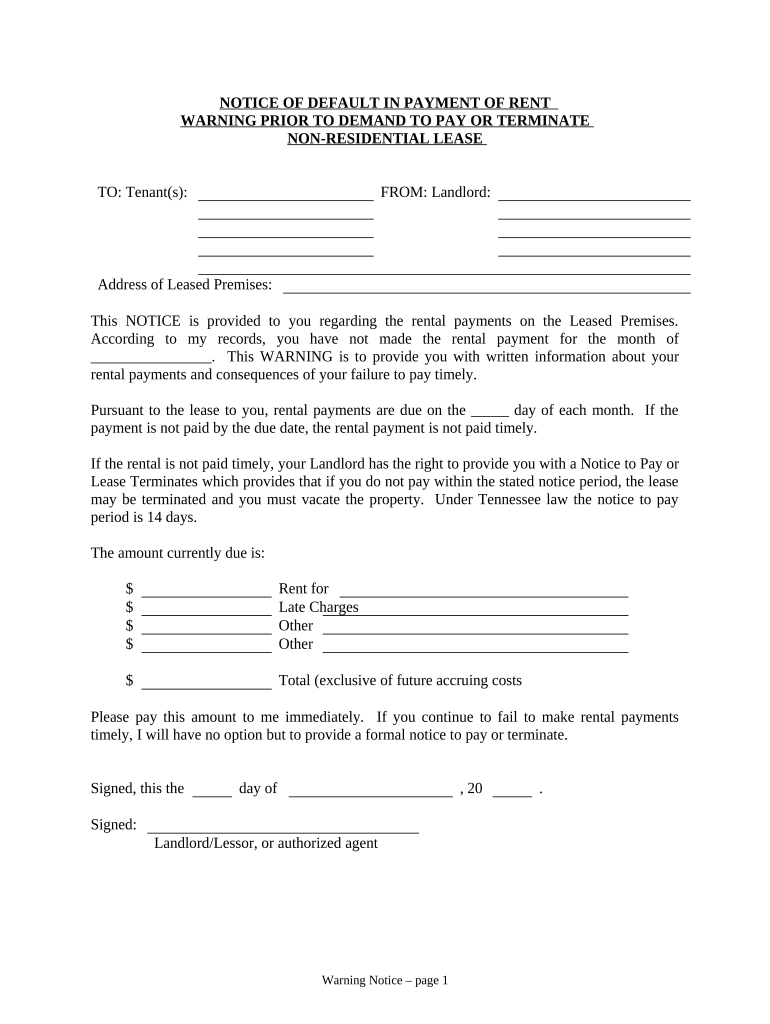
Notice of Default in Payment of Rent as Warning Prior to Demand to Pay or Terminate for Nonresidential or Commercial Property - Tennessee 2026

Get Form
Notice of Default in Payment of Rent as Warning Prior to Demand to Pay or Terminate for Nonresidential or Commercial Property - Tennessee Preview on Page 1

Here's how it works

01. Edit your form online
Type text, add images, blackout confidential details, add comments, highlights and more.
02. Sign it in a few clicks
Draw your signature, type it, upload its image, or use your mobile device as a signature pad.
03. Share your form with others
Send it via email, link, or fax. You can also download it, export it or print it out.

How to use or fill out Notice of Default in Payment of Rent as Warning Prior to Demand to Pay or Terminate for Nonresidential or Commercial Property - Tennessee

Form edit decoration
9.5
Ease of Setup
DocHub User Ratings on G2
9.0
Ease of Use
DocHub User Ratings on G2
  1. Click ‘Get Form’ to open it in the editor.
  2. Begin by entering the tenant's name(s) in the designated 'TO' field. This ensures that the notice is directed appropriately.
  3. In the 'FROM' section, input your name as the landlord along with your contact information for clarity.
  4. Fill in the 'Address of Leased Premises' where the tenant resides. This is crucial for legal documentation.
  5. Specify the month for which rent has not been paid in the blank space provided. This highlights the specific payment issue.
  6. Indicate the due date for rental payments according to your lease agreement. This establishes a timeline for payment expectations.
  7. List all amounts due, including rent, late charges, and any other fees in their respective fields. Ensure accuracy to avoid disputes.
  8. Sign and date the notice at the bottom, confirming its authenticity and your intent to communicate formally with the tenant.
  9. Complete the 'Proof of Delivery' section by selecting how you delivered this notice (e.g., hand delivery, mail).

Start using our platform today to streamline your document editing and ensure timely communication with tenants!

be ready to get more

Complete this form in 5 minutes or less

Get form

Got questions?

We have answers to the most popular questions from our customers. If you can't find an answer to your question, please contact us.
Contact us
Defaulting on a lease means failing to fulfill your responsibilities as outlined in the agreement. This could involve missed rent payments or violating other terms, like subletting without permission. Defaulting on a lease often leads to legal consequences, including eviction.
The landlord can also pursue damages against the tenant as compensation for financial losses which were a result of the tenants default. Damages may include unpaid rent, repair costs, and other expenses incurred because of the tenants actions. The tenant also has rights and defenses in the event of a default.
Tennessee law requires different notices based on the reason for eviction: 3-day notice to quit For serious issues like drug-related activity, violence, or health and safety threats. No cure is allowed; tenants must vacate within three days. 14-day notice to pay or quit For nonpayment of rent.
How Long Does an Eviction Stay On Your Record? Record TypeHow Long It Lasts Eviction filing (court record) Up to 7 years (varies by state) Credit report entry 7 years under the Fair Credit Reporting Act Rental history databases Indefinitely, unless removed Aug 26, 2025
Notice for Other Lease Violations: 30 days to quit. If a tenant violates any other lease provisions, the landlord may send this notice giving the tenant 30 days to vacate the unit. The landlord is not obligated to give the tenant an opportunity to correct the bdocHub (TN Code 66-7-109(b)).
be ready to get more

Complete this form in 5 minutes or less

Get form

People also ask

Written notice should be given to the tenant three months before the lease term expires or before the landlord would like the tenant to vacate the property. It should state any final rental payments due and the conditions against which any deposit paid at the start of the tenancy will be returned.

Related links