Letter from Tenant to Landlord containing Notice to landlord to withdraw improper rent increase during lease - South Dakota 2026

Get Form
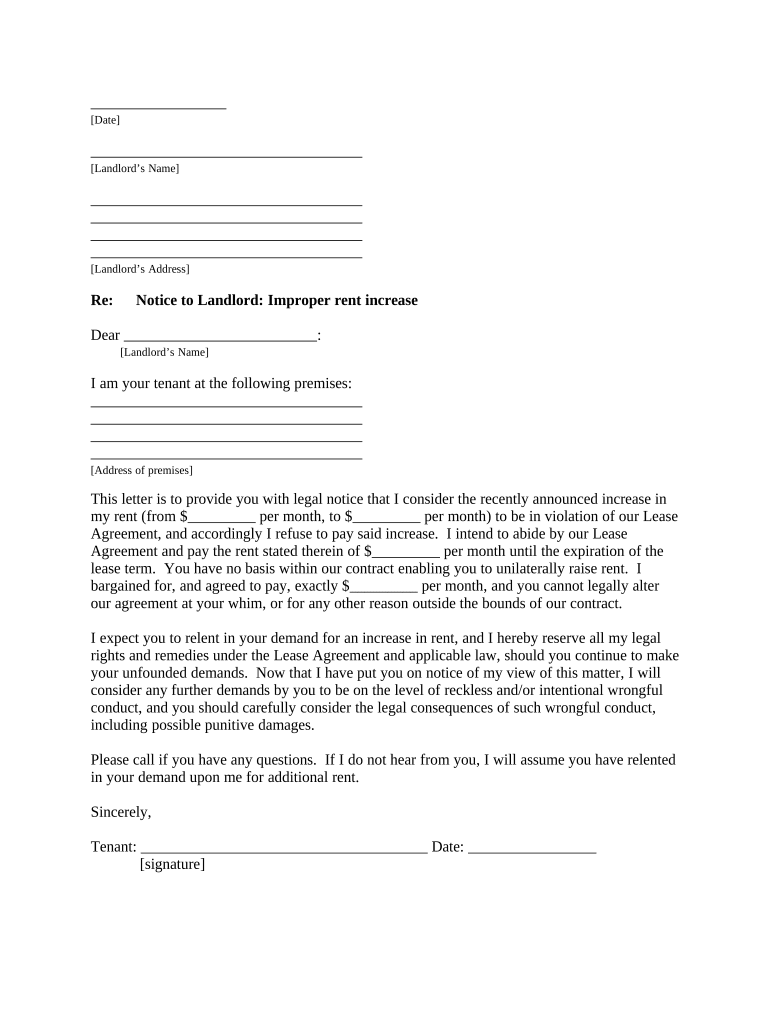
Letter from Tenant to Landlord containing Notice to landlord to withdraw improper rent increase during lease - South Dakota Preview on Page 1

Here's how it works

01. Edit your form online
Type text, add images, blackout confidential details, add comments, highlights and more.
02. Sign it in a few clicks
Draw your signature, type it, upload its image, or use your mobile device as a signature pad.
03. Share your form with others
Send it via email, link, or fax. You can also download it, export it or print it out.

How to use or fill out Letter from Tenant to Landlord containing Notice to landlord to withdraw improper rent increase during lease - South Dakota with our platform

Form edit decoration
9.5
Ease of Setup
DocHub User Ratings on G2
9.0
Ease of Use
DocHub User Ratings on G2
  1. Click ‘Get Form’ to open it in the editor.
  2. Begin by entering the date at the top of the letter. This sets a clear timeline for your notice.
  3. Fill in the landlord’s name and address in the designated fields. Accurate information ensures proper delivery.
  4. In the greeting, address your landlord directly using their name for a personal touch.
  5. Provide your address as the tenant in the specified section, confirming your residency.
  6. Clearly state the current rent amount and the proposed increase in the respective fields. This highlights your concern regarding the improper increase.
  7. Reiterate your commitment to pay only the agreed-upon rent until lease expiration, emphasizing your legal rights.
  8. Sign and date at the bottom of the letter, ensuring you have a record of communication.
  9. Complete the Proof of Delivery section by selecting how you delivered this notice and signing it again if necessary.

Start using our platform today to easily fill out and manage your important documents for free!

be ready to get more

Complete this form in 5 minutes or less

Get form

Got questions?

We have answers to the most popular questions from our customers. If you can't find an answer to your question, please contact us.
Contact us
AB 1482: Limits annual rent increases to no more than 5% + local CPI or 10% whichever is lower.
There are no statewide caps or maximum allowable amounts for rent increases in South Dakota. Landlords have full discretion to raise rents by any amount, as frequently as they choose.
STATE OF CALIFORNIA: Limits annual rent increases to no more than 5% + local CPI or 10% whichever is lower. Provides Just Cause protections to tenants.
For periodic tenancies, the maximum allowable increase is once every 12 months. The Act outlines that landlords must provide at least 60 days notice for rent increases in these cases. However, it is important to note that there is no specific percentage cap for periodic tenancies.
South Dakota does not have any statewide rent control laws limiting how much landlords can raise rents each year. Cities and counties in South Dakota are allowed to implement their own rent control ordinances if desired, but very few have chosen to do so to date.
be ready to get more

Complete this form in 5 minutes or less

Get form

People also ask

What to include in a rent increase letter Date of the rent increase letter. Name and information of the tenant and landlord. Property address and unit number (if applicable). Reference to the expiration date of the existing lease. Current rent amount. Amount of rent increase. Date the rent increase will go into effect.
Usually, unless rent control applies, the only way to contest a rent increase is to argue that the landlord raised the rent to discriminate against you or to retaliate against you for exercising a legal right. If you plan to make this argument, you should know what you need to prove to succeed.
A tenant has the right to possession and quiet enjoyment of the property he or she is renting - that is, to be free from unreasonable interference by the landlord or other persons. The landlord has the right to make a reasonable inspection, but only with a prior 24-hour notice to the tenant and at a reasonable time.

Related links