

Renunciation And Disclaimer of Joint Tenant or Tenancy Interest - South Dakota 2026

Get Form
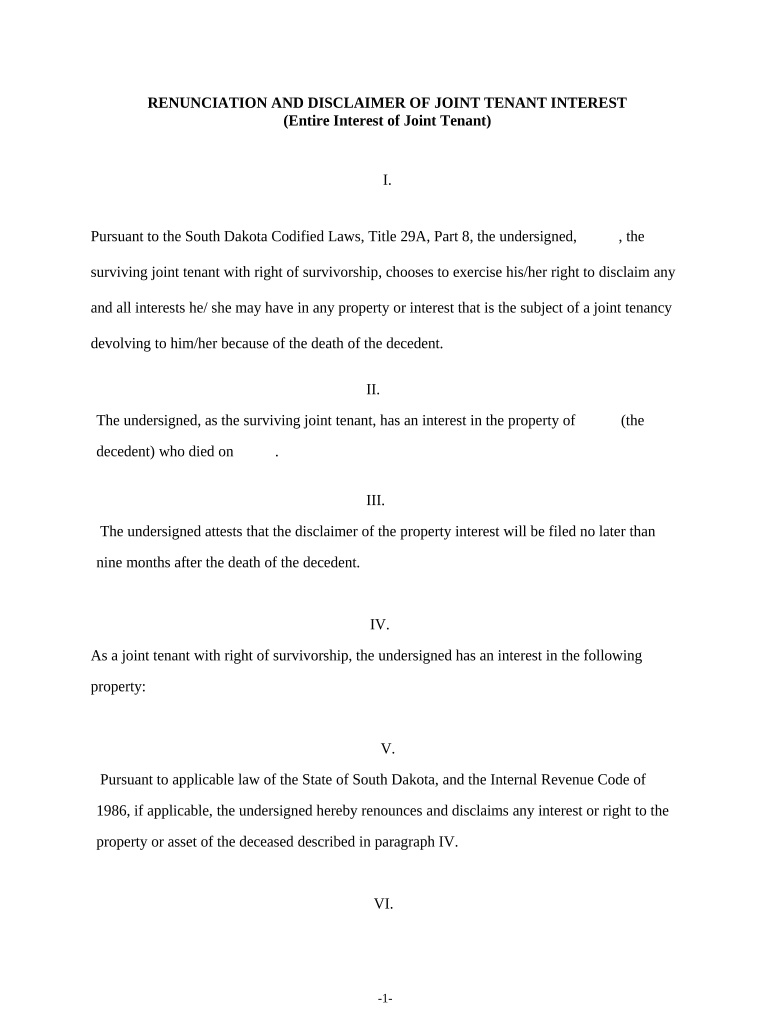
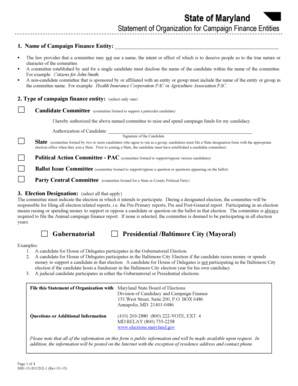
Renunciation And Disclaimer of Joint Tenant or Tenancy Interest - South Dakota Preview on Page 1

Here's how it works

01. Edit your form online
Type text, add images, blackout confidential details, add comments, highlights and more.
02. Sign it in a few clicks
Draw your signature, type it, upload its image, or use your mobile device as a signature pad.
03. Share your form with others
Send it via email, link, or fax. You can also download it, export it or print it out.

How to use or fill out Renunciation And Disclaimer of Joint Tenant or Tenancy Interest - South Dakota with our platform

Form edit decoration
9.5
Ease of Setup
DocHub User Ratings on G2
9.0
Ease of Use
DocHub User Ratings on G2
  1. Click ‘Get Form’ to open the Renunciation And Disclaimer of Joint Tenant or Tenancy Interest in the editor.
  2. Begin by filling in your name as the surviving joint tenant in Section I. This identifies you as the individual exercising the right to disclaim any interest.
  3. In Section II, provide the name of the decedent and their date of death. This information is crucial for establishing the context of your disclaimer.
  4. Section III requires you to attest that your disclaimer will be filed within nine months after the decedent's death. Ensure this is accurate to comply with legal requirements.
  5. In Section IV, list the property interests you are renouncing. Be specific about each asset involved in the joint tenancy.
  6. Review Section V where you formally renounce any rights to the property described in Section IV, ensuring compliance with South Dakota law.
  7. Complete Sections VI and VII by signing and dating the document, then prepare it for delivery to the personal representative or executor as indicated.

Start using our platform today for free to streamline your document editing and signing process!

be ready to get more

Complete this form in 5 minutes or less

Get form

Got questions?

We have answers to the most popular questions from our customers. If you can't find an answer to your question, please contact us.
Contact us
Thus, a surviving joint tenant may disclaim the one-half survivorship interest in property that the joint tenant held either in joint tenancy with right of survivorship or in tenancy by the entirety, within 9 months of the death of the first joint tenant to die.
Normally when property is purchased jointly there is a survivorship clause, meaning that on the death of one of the joint owners, their share in the property automatically passes to the survivor(s).
What Are the Steps to Contest a Will or Trust in South Dakota? Consult an Estate Attorney. File a Petition/Lawsuit with the Court. Serve Required Notice. Seek Pursue Discovery. Participate in the Process Mediation. Trial. Appeal the Decision.
Surviving spouses, children, parents, then siblings are the designated order. The exact distribution will depend on the decedents will. If they did not have one, then their spouse will inherit everything. If they were unmarried, then their parents or siblings will become the sole inheritors (S.D.
At the time the disclaimer needs to be executed, the surviving spouse will also know the exact value of the couples assets. The surviving spouse may serve as sole trustee of this trust and may have certain powers to distribute assets even though the surviving spouse is a beneficiary.
be ready to get more

Complete this form in 5 minutes or less

Get form

People also ask

You need not disclaim the entirety of a bequest. You may disclaim just a percentage, or one or more specific items. For example, if a parent has left you a brokerage account, and a home in need of expensive repairs, you may decide you want the brokerage account, but not the home.
What does Disclaimer mean? The right of a trustee in bankruptcy, Liquidator or the Crown to disclaim onerous property (often a leasehold interest). The effect is to bring any ongoing liabilities (of the bankrupt, company or the Crown) in relation to the property to an end.

Related links