
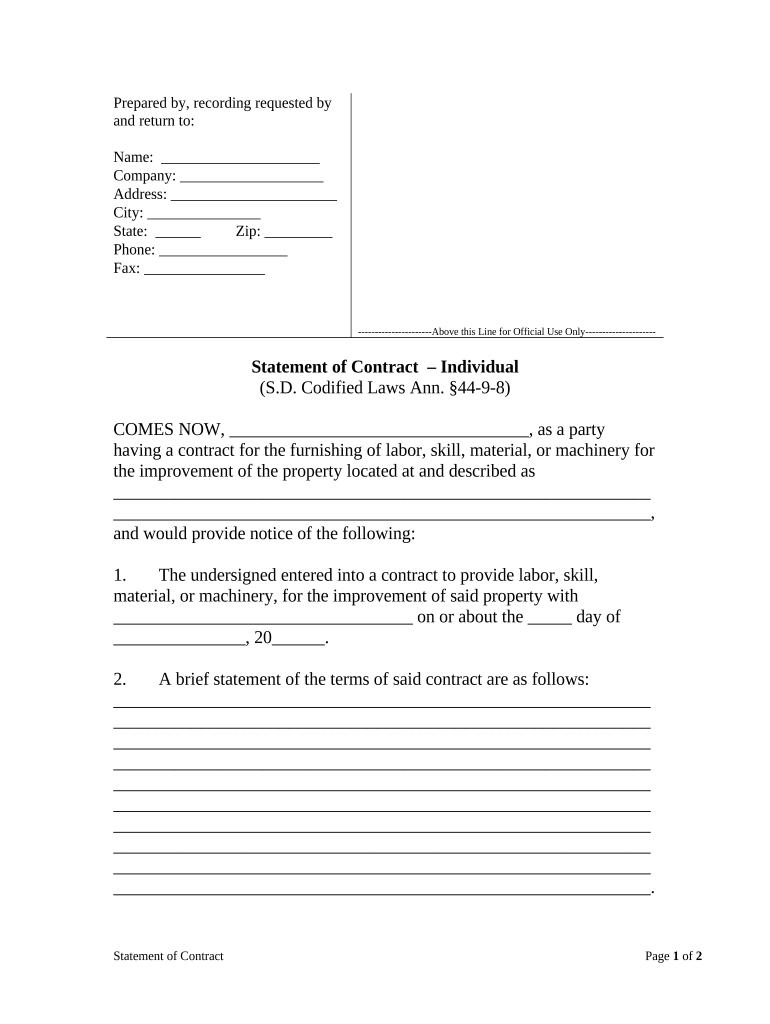







Definition and Meaning of South Dakota Form
The South Dakota form, particularly the Statement of Contract, is a legal document used to outline agreements for providing labor, materials, or machinery for property improvement within the state. This document serves a dual purpose as both a contract and a notice of lien, which safeguards contractors or suppliers who provide services or products for property enhancement.
The form is critical for formalizing terms regarding the scope of work, payment schedules, responsibilities of each party involved, and other relevant conditions. Its usage ensures clarity and legal protection for all parties involved in property improvement projects, thereby preventing potential disputes.
How to Use the South Dakota Form
Utilizing the South Dakota form involves several practical steps, designed to ensure legal compliance and protect all parties involved:
- Identify Parties: Clearly list the names and contact information of all parties entering the agreement.
- Define Scope of Work: Specify the nature of services or goods provided, and include detailed descriptions when necessary.
- Establish Payment Terms: Outline how and when payments will be made, including any installment plans or penalties for late payment.
- Include Legal Provisions: Add terms such as arbitration agreements, warranty conditions, or any contingency plans in case of unforeseen issues.
- Signatures and Notarization: The form must be signed by all parties and may require notarization to validate authenticity.
This structured approach ensures that the form is used to its fullest capacity, protecting both providers and recipients of services.
Steps to Complete the South Dakota Form
Completing a South Dakota form requires attention to detail and adherence to state-specific legal requirements:
- Gather Information: Collect all necessary details, including property address, contractor license numbers, and proof of insurance if applicable.
- Fill Out the Form: Use an editable document tool, such as DocHub, to enter information directly into form fields. This provides options for annotations and corrections easily.
- Review and Edit: Double-check all entries for accuracy and completeness. Utilize document editing features to make corrections as needed.
- Seek Legal Advice: Before finalizing, consulting with a legal professional is advised to ensure compliance with South Dakota laws and regulations.
- Finalize and Distribute: Once reviewed, distribute copies to all parties involved. Keep an electronic copy for your records using a secure document management platform.
By following these detailed steps, users can effectively complete the South Dakota form with confidence in its accuracy and legal validity.
Key Elements of the South Dakota Form
The South Dakota form is comprised of several key components, each critical to the document’s effectiveness:
- Party Information: Details of the involved parties, ensuring each is clearly identified.
- Scope of Agreement: Comprehensive description of the work or materials provided.
- Contract Terms: Includes payment schedules, delivery dates, and specific obligations of each party.
- Lien Notice: A declaration that the form serves as a notice of lien under South Dakota law.
- Signatures and Notarization: Legal validation through the signing of all parties and possibly notarization for authenticity.
Each element must be carefully considered and completed to establish a strong legal document.
State-Specific Rules for the South Dakota Form
The South Dakota form must comply with certain state-specific regulations, critical for its validity. These include:
- Lien Laws: South Dakota mandates the inclusion of a notice of lien, ensuring contractors and suppliers can claim unpaid dues legally.
- Contractor Licensing: Service providers must be licensed appropriately as per state laws.
- Disclosure Requirements: All contract terms must be disclosed upfront, with no undisclosed clauses affecting the agreement.
- Notary Public: Depending on the agreement type, notarization may be required to further authenticate the document.
Understanding and adhering to these regulations ensures the form’s effectiveness and legal standing.
Legal Use of the South Dakota Form
Utilizing the South Dakota form within the legal framework involves:
- Contract Formation: Legally binding agreements resonate throughout projects, reducing disputes through clearly articulated terms.
- Lien Rights: Incorporating a notice of lien enforces the right to claim payments legally, safeguarding interests of service providers.
- Enforcement: Should disagreements arise, the form serves as a legal basis for dispute resolution, including court filings or arbitration.
These legal uses cement the form’s importance for transactions related to property improvements within the state.
Examples of Using the South Dakota Form
Practical applications of the South Dakota form include varying project types:
- Residential Renovations: A homeowner contracts a company for kitchen remodeling, using the form to outline project timelines, materials, and payment terms.
- Commercial Building: A business hires a contractor for new office space build-out, delineating each party's responsibilities.
- Landscaping Projects: A supplier provides materials for landscape design, utilizing the form to ensure payment upon completion.
These examples highlight the versatility and necessity of the form in contracting environments.
Important Terms Related to the South Dakota Form
Several terms associated with the South Dakota form are crucial for understanding its use:
- Lien: A legal claim on property as security for debt compensation.
- Notarization: The formal process of certifying a document’s legality and authenticity by a notary public.
- Scope of Work: Detailed descriptions defining the work or materials involved in the contract.
Familiarity with these terms enhances comprehension and application of the form, ensuring effective use.




