Apartment Rules and Regulations - District of Columbia 2026

Get Form
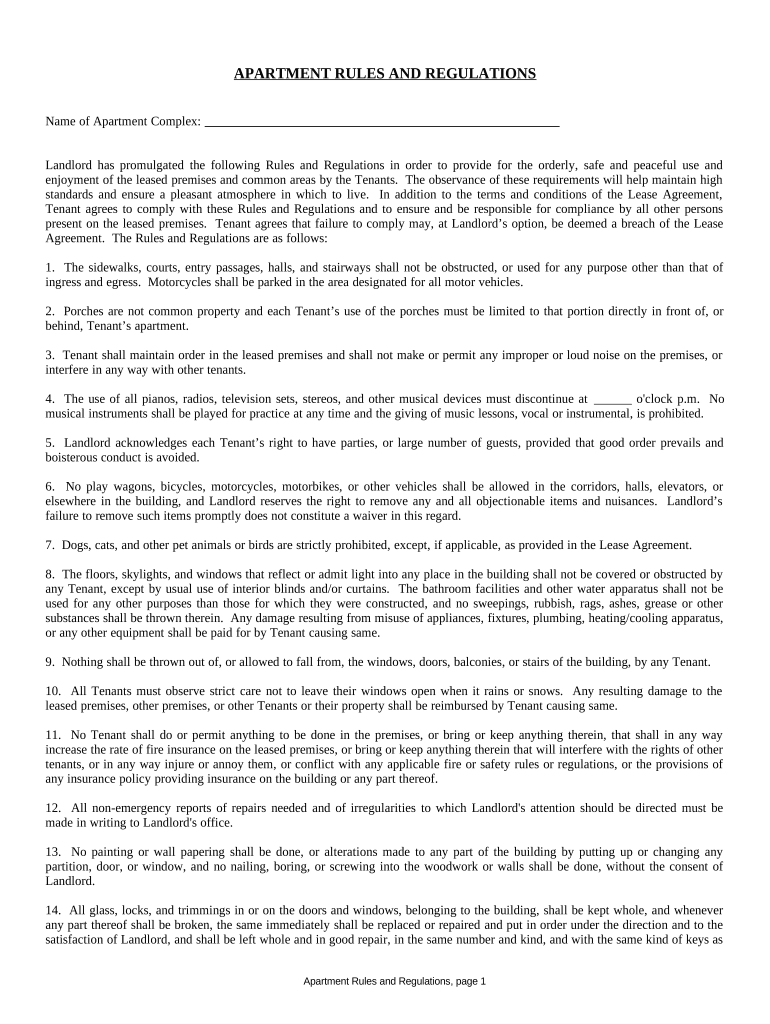
Apartment Rules and Regulations - District of Columbia Preview on Page 1

Here's how it works

01. Edit your form online
Type text, add images, blackout confidential details, add comments, highlights and more.
02. Sign it in a few clicks
Draw your signature, type it, upload its image, or use your mobile device as a signature pad.
03. Share your form with others
Send it via email, link, or fax. You can also download it, export it or print it out.

How to use or fill out Apartment Rules and Regulations - District of Columbia

Form edit decoration
9.5
Ease of Setup
DocHub User Ratings on G2
9.0
Ease of Use
DocHub User Ratings on G2
  1. Click ‘Get Form’ to open it in the editor.
  2. Begin by entering the name of your apartment complex in the designated field at the top of the form.
  3. Review each rule carefully. For any sections that require your input, such as signing or dating, ensure you fill them out accurately.
  4. In sections where specific times or conditions are mentioned (e.g., noise restrictions), make sure to provide the required details clearly.
  5. For any special stipulations or additional rules, read through them thoroughly and acknowledge your understanding by signing where indicated.
  6. Once completed, save your document. You can easily share it with your landlord or keep a copy for your records using our platform.

Start using our editor today to streamline filling out your Apartment Rules and Regulations!

be ready to get more

Complete this form in 5 minutes or less

Get form

Got questions?

We have answers to the most popular questions from our customers. If you can't find an answer to your question, please contact us.
Contact us
All rental units must be registered with the RAD either as subject to rent control or exempt from rent control. For any unit that is not registered with RAD, rent control automatically applies. The most common exemptions from rent control are for rental units that are: Federally or District-subsidized.
The most common exemptions from rent control are for rental units that are: Federally or District-subsidized. Built after 1975. Owned by a natural person (i.e., not a corporation) who owns no more than four rental units in the District.
HUD recommends a stan- dard of two persons per bedroom.
In D.C., for example, the number of rent-controlled units have declined by 14 percent from 85,000 units in 1984 to about 72,878 in 2020.
Operating in DC is different than in many other cities. Local housing laws tend to be very tenant-friendly, and the city enforces them aggressively. Some key DC landlord-tenant rules to remember: Rent increases must follow strict timelines and can only occur once every 12 months (for rent-controlled units).

Security and compliance

At DocHub, your data security is our priority. We follow HIPAA, SOC2, GDPR, and other standards, so you can work on your documents with confidence.

Learn more
ccpa2
pci-dss
gdpr-compliance
hipaa
soc-compliance

People also ask

Exemptions depend on local or state laws. Sometimes, rent control only applies to city buildings built before a set year. Luxury condominiums and homes might also not have rent protections.
In the District of Columbia, landlords are required by law to keep all housing unitsincluding apartments and shared common areasin a safe, habitable, and livable condition.

Related links