Marital Legal Separation and Property Settlement Agreement Adult Children - District of Columbia 2026

Get Form
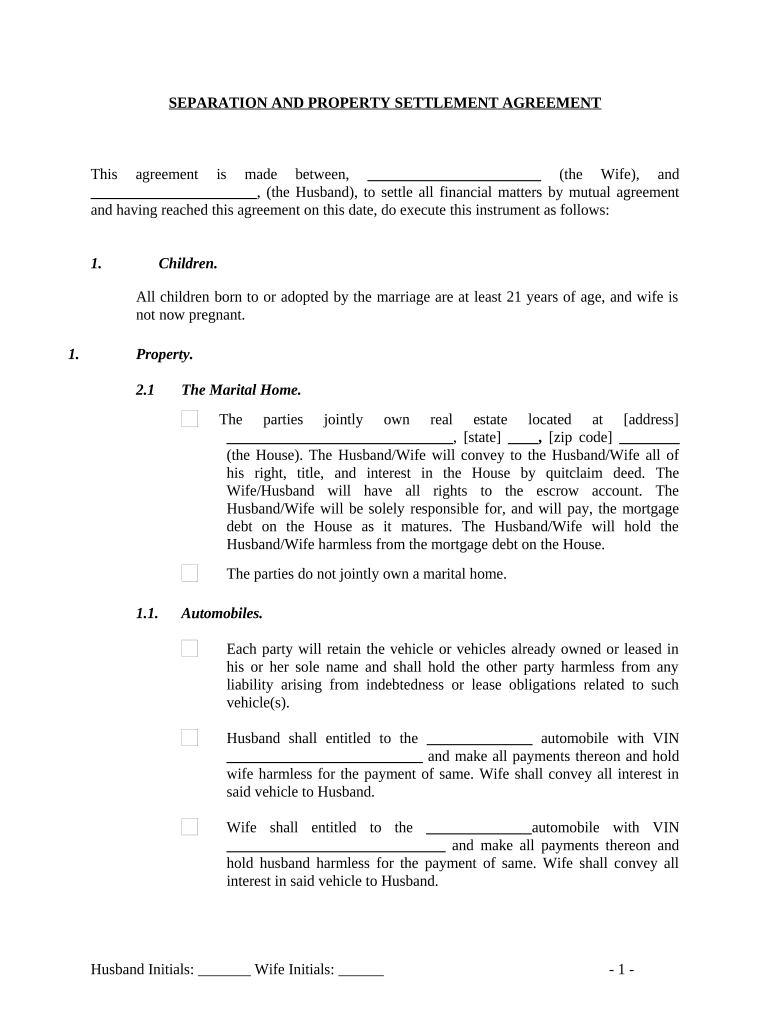
Marital Legal Separation and Property Settlement Agreement Adult Children - District of Columbia Preview on Page 1

Here's how it works

01. Edit your form online
Type text, add images, blackout confidential details, add comments, highlights and more.
02. Sign it in a few clicks
Draw your signature, type it, upload its image, or use your mobile device as a signature pad.
03. Share your form with others
Send it via email, link, or fax. You can also download it, export it or print it out.

How to use or fill out Marital Legal Separation and Property Settlement Agreement Adult Children - District of Columbia

Form edit decoration
9.5
Ease of Setup
DocHub User Ratings on G2
9.0
Ease of Use
DocHub User Ratings on G2
  1. Click ‘Get Form’ to open it in the editor.
  2. Begin by filling in the names of both parties at the top of the document. Ensure that you accurately represent 'Wife' and 'Husband' as per your agreement.
  3. In the 'Children' section, confirm that all children are at least 21 years old and indicate if there are any additional details regarding pregnancy.
  4. Proceed to the 'Property' section. Fill in the address of the marital home and specify who will retain ownership. Include details about vehicles, ensuring each party's responsibilities for payments are clear.
  5. Complete the 'Bank Accounts' section by listing joint accounts and indicating who will retain which account. Make sure to note any necessary actions like closing accounts.
  6. In 'Marital Obligations', outline any debts each party is responsible for, ensuring clarity on who holds liability.
  7. Fill out the 'Alimony' section, confirming both parties waive rights to alimony.
  8. Finalize with the 'Miscellaneous' section, detailing tax responsibilities and execution requirements. Don’t forget to sign and date at the end.

Start using our platform today to easily complete your Marital Legal Separation Agreement online for free!

be ready to get more

Complete this form in 5 minutes or less

Get form

Got questions?

We have answers to the most popular questions from our customers. If you can't find an answer to your question, please contact us.
Contact us
In the District of Columbia, all assets acquired during the marriage are considered marital property. This means that each spouse is entitled to half of the total value of these assets.
As we have noted, since an MSA is a court-approved legal document, if one of the parties violates the terms you can be held in contempt. The violator can face penalties like fines, community service, and even jail time if the court considers the breach severe enough.
Marital settlement agreements, also known as divorce settlement agreements , marital termination agreements , separation agreements, or stipulations of settlements, are written contracts between divorcing spouses of their responsibilities and rights after divorce .
A marital separation agreement, also known as a property settlement agreement, is a written contract dividing your property, spelling out your rights, and settling problems such as alimony and custody.
A settlement agreement differs from a separation agreement as it sets the terms for the divorce, not the separation. A settlement agreement should address all central issues of the divorce. This can include things like division of marital assets and debts, child custody, and child support, as well as spousal support.
be ready to get more

Complete this form in 5 minutes or less

Get form

People also ask

That is, assets and property acquired during the marriage will be equally distributed 50/50 among that parties. District of Columbia is not one of those jurisdictions. The DC legal paradigm is the equitable distribution of propertymodel.
If the parties enter into an agreement on the fulfillment of obligations after receiving the court/the arbitration decision, no further notification of the court/the arbitration court is required. A settlement agreement is a written agreement of the parties in civil proceedings that terminates civil proceedings.

Related links