Letter from Tenant to Landlord about Sexual Harassment - District of Columbia 2026

Get Form
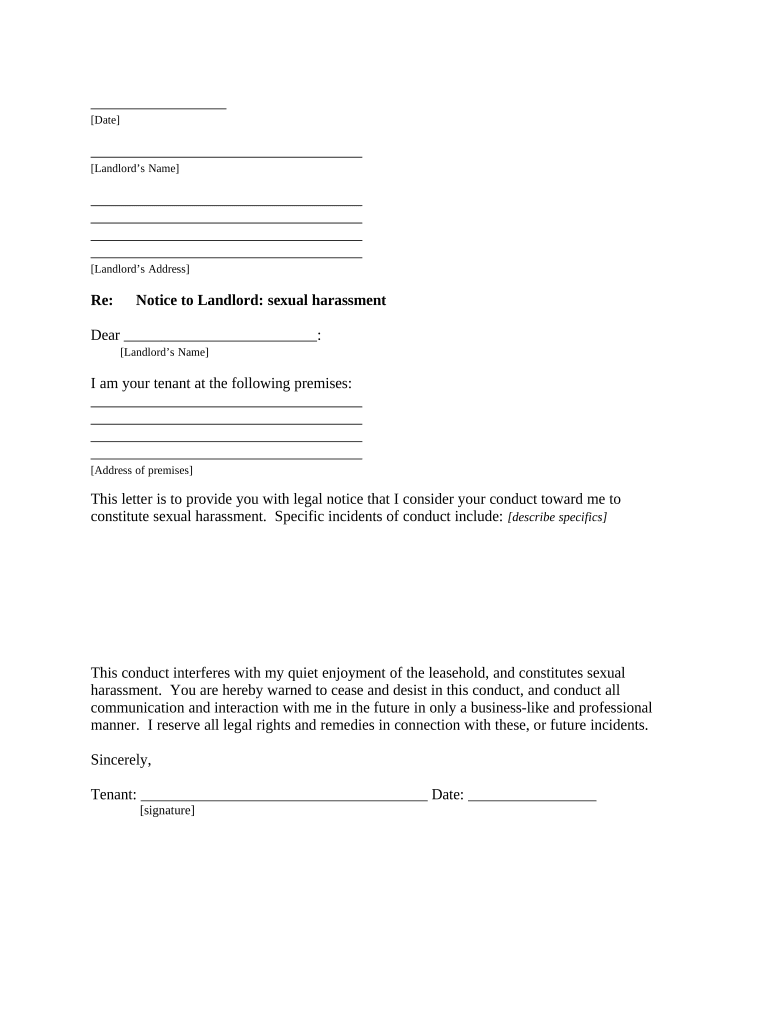
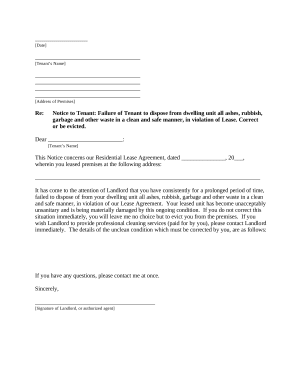
Letter from Tenant to Landlord about Sexual Harassment - District of Columbia Preview on Page 1

Here's how it works

01. Edit your form online
Type text, add images, blackout confidential details, add comments, highlights and more.
02. Sign it in a few clicks
Draw your signature, type it, upload its image, or use your mobile device as a signature pad.
03. Share your form with others
Send it via email, link, or fax. You can also download it, export it or print it out.

How to use or fill out Letter from Tenant to Landlord about Sexual Harassment - District of Columbia

Form edit decoration
9.5
Ease of Setup
DocHub User Ratings on G2
9.0
Ease of Use
DocHub User Ratings on G2
  1. Click ‘Get Form’ to open it in the editor.
  2. Begin by entering the date at the top of the letter. This is important for record-keeping purposes.
  3. Fill in the landlord’s name and address in the designated fields. Ensure accuracy to facilitate proper communication.
  4. In the body of the letter, clearly state your concerns regarding sexual harassment. Use specific incidents to illustrate your points, ensuring you describe them thoroughly.
  5. Indicate that this conduct interferes with your quiet enjoyment of the leasehold and assert your rights. This section is crucial for establishing the seriousness of your complaint.
  6. Sign and date the letter at the bottom, ensuring that you provide a clear signature for authenticity.
  7. Complete the Proof of Delivery section by selecting how you will deliver this notice to your landlord, and sign it accordingly.

Start using our platform today to easily fill out and send your Letter from Tenant to Landlord about Sexual Harassment for free!

be ready to get more

Complete this form in 5 minutes or less

Get form

Got questions?

We have answers to the most popular questions from our customers. If you can't find an answer to your question, please contact us.
Contact us
Data and Statistics Table StateAverage Payout for HarassmentCommon Claims California $15,000 Emotional distress, punitive damages New York $20,000 Negligence, invasion of privacy Texas $10,000 Intimidation, poor living conditions Mar 24, 2025
In general, a landlord cannot evict a tenant solely for having a ``bad attitude. Eviction laws typically require specific justifiable reasons, such as: Non-payment of Rent: Failing to pay rent on time. Lease Violations: BdocHubing terms of the lease agreement (eg, unauthorized pets, noise complaints).
Landlords can sue tenants for any damages caused by harassment. This might include compensation for physical damage to the property, legal fees, or other losses incurred due to the tenants actions. Courts may issue orders restraining the tenant from continuing their harassing behavior.
Tenant harassment, in this context, refers to any act or behavior by a tenant that is intended to intimidate, threaten, or cause distress to a property manager or landlord. This can take various forms such as verbal abuse, assault, property damage, or even stalking.
0:26 3:49 They cannot simply force someone out without a court order or make the property unlivable to push aMoreThey cannot simply force someone out without a court order or make the property unlivable to push a tenant. Out this ensures that tenants have a fair chance to defend their rights.

Security and compliance

At DocHub, your data security is our priority. We follow HIPAA, SOC2, GDPR, and other standards, so you can work on your documents with confidence.

Learn more
ccpa2
pci-dss
gdpr-compliance
hipaa
soc-compliance

People also ask

Engaging in such behavior not only violates the tenants rights but also exposes you to potential legal consequences. Threatening the tenant. Getting rid of the tenants items. Changing the propertys locks. Request the tenant stop or change their behavior. Begin eviction proceedings. Notify the police.
Yes, landlords can sue tenants for emotional distress, but only under strict legal conditions. Emotional distress lawsuits are based on either intentional or negligent behavior by the tenant. Landlords must show outrageous conduct, severe emotional harm, and strong evidence to win.

Related links