Type text, add images, blackout confidential details, add comments, highlights and more.
02. Sign it in a few clicks
Draw your signature, type it, upload its image, or use your mobile device as a signature pad.
03. Share your form with others
Send it via email, link, or fax. You can also download it, export it or print it out.
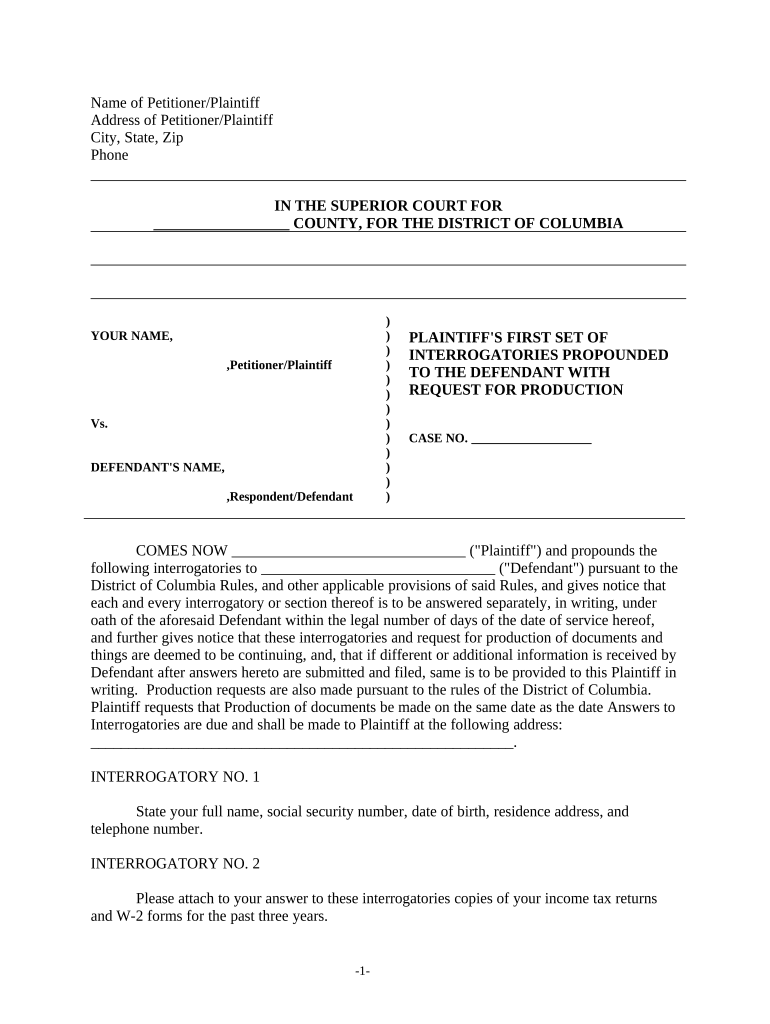
How to use or fill out Discovery Interrogatories from Plaintiff to Defendant with Production Requests - District of Columbia
Ease of Setup
DocHub User Ratings on G2
Ease of Use
DocHub User Ratings on G2
Click ‘Get Form’ to open it in the editor.
Begin by entering the name and address of the Petitioner/Plaintiff at the top of the form. Ensure all details are accurate for proper identification.
In the section labeled 'INTERROGATORY NO. 1', provide your full name, social security number, date of birth, residence address, and telephone number as requested.
Continue through each interrogatory, ensuring you answer each question thoroughly. For example, when addressing income-related questions, attach necessary documents like tax returns and paycheck stubs as specified.
Review your answers for completeness and accuracy before finalizing. Make sure to sign where indicated to affirm that your responses are true and correct.
Once completed, utilize our platform's features to save or print your document for submission.
Start using our editor today for free to streamline your document completion process!
Fill out Discovery Interrogatories from Plaintiff to Defendant with Production Requests - District of Columbia online It's free
Example of interrogatories to DefendantWhat happens after interrogatories are answeredSample interrogatories Civil casesSample interrogatories and request for production of documentsHow to avoid answering interrogatoriesFRCP 33Sample interrogatory questions to PlaintiffHow many interrogatories are allowed
Security and compliance
At DocHub, your data security is our priority. We follow HIPAA, SOC2, GDPR, and other standards, so you can work on your documents with confidence.
If you object only to a portion of an Interrogatory or a Request for Production, you must specify the part to which you object and answer or produce DocumentsRead more
Cookie consent notice
This site uses cookies to enhance site navigation and personalize your experience.
By using this site you agree to our use of cookies as described in our Privacy Notice.
You can modify your selections by visiting our Cookie and Advertising Notice.