Estate Planning Questionnaire and Worksheets - Connecticut 2026

Get Form
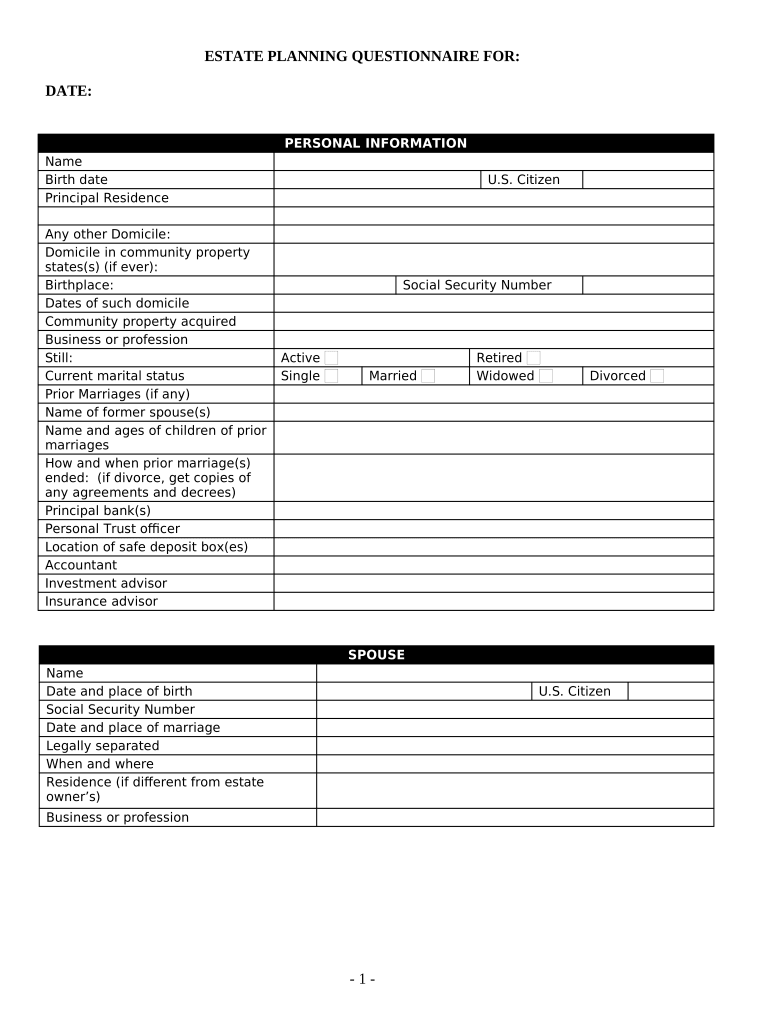
Estate Planning Questionnaire and Worksheets - Connecticut Preview on Page 1

Here's how it works

01. Edit your form online
Type text, add images, blackout confidential details, add comments, highlights and more.
02. Sign it in a few clicks
Draw your signature, type it, upload its image, or use your mobile device as a signature pad.
03. Share your form with others
Send it via email, link, or fax. You can also download it, export it or print it out.

How to use or fill out Estate Planning Questionnaire and Worksheets - Connecticut

Form edit decoration
9.5
Ease of Setup
DocHub User Ratings on G2
9.0
Ease of Use
DocHub User Ratings on G2
  1. Click ‘Get Form’ to open it in the editor.
  2. Begin with the 'Personal Information' section. Fill in your name, birth date, principal residence, and any other domicile details. Ensure you provide accurate information regarding your marital status and prior marriages.
  3. Move on to the 'Children and Grandchildren' section. Clearly designate relationships and include details for adopted children or stepchildren.
  4. In the 'Who Will Benefit Under Will' section, list beneficiaries along with their addresses and ages. Specify their relationship to you.
  5. Complete the 'Fiduciaries' section by providing names and addresses of executors, trustees, and guardians.
  6. Fill out the 'Financial Information' sections meticulously. Include details about real estate, stocks, bonds, cash accounts, life insurance policies, and any liabilities.
  7. Finally, review all entries for accuracy before saving or sharing your completed questionnaire using our platform's features.

Start filling out your Estate Planning Questionnaire today for free using our platform!

be ready to get more

Complete this form in 5 minutes or less

Get form

Got questions?

We have answers to the most popular questions from our customers. If you can't find an answer to your question, please contact us.
Contact us

Yes, you can use DocHub for signing any business and personal paperwork, including your Estate Planning Questionnaire and Worksheets - Connecticut. All eSignatures you generate with our service are legally binding and court-admissible, as DocHub complies with standards required by ESIGN and UETA. Save your accomplished paperwork with a detailed Audit Trail if needed.

When you edit your Estate Planning Questionnaire and Worksheets - Connecticut with DocHub, you will not need to look for other applications or solutions to eSign it. An electronic signature is a component of DocHub’s extensive editing toolset, which allows you to apply changes in your form without switching between platforms. Simply complete your form, double-check the correctness of the information and put your electronic signature at the end to make it submission-ready quickly.

An estate plan is a collection of documents and includes a will, guardianship designations, healthcare power of attorney, beneficiary designations, durable power of attorney, and a personal letter of intent, outlining your wishes, should you die or become incapacitated.
Estate planning goals and objectives that you might consider include: Provide financial security for your family. Ensure that your property is preserved and passed on to your beneficiaries. Avoid disputes among family members, business owners or with third parties (such as the IRS)
There are six important components to an estate plan. THE WILL. The first and well-known component of an estate plan is a will. TRUSTS. POWER OF ATTORNEY. HEALTH CARE DIRECTIVE. BENEFICIARY DESIGNATIONS. REGULAR REVIEW AND REVISION.

Security and compliance

At DocHub, your data security is our priority. We follow HIPAA, SOC2, GDPR, and other standards, so you can work on your documents with confidence.

Learn more
ccpa2
pci-dss
gdpr-compliance
hipaa
soc-compliance

People also ask

A will or trust should be one of the main components of every estate plan, even if you dont have substantial assets. Wills ensure property is distributed according to an individuals wishes (if drafted according to state laws). Some trusts help limit estate taxes or legal challenges.
Here, our estate planning attorneys lay out the 5 main components of estate planning: Wills and Trusts. Durable Power of Attorney. Medical or Healthcare Power of Attorney. Living Wills and Advance Directives for Medical Decisions. Beneficiary Designations.
There are six important components to an estate plan. THE WILL. The first and well-known component of an estate plan is a will. TRUSTS. POWER OF ATTORNEY. HEALTH CARE DIRECTIVE. BENEFICIARY DESIGNATIONS. REGULAR REVIEW AND REVISION.
Estate Planning Checklist: The 5 Essential Documents Last Will and Testament. This legal document is the foundation for a successful estate plan. Living Trust. Durable Power of Attorney (POA) Healthcare Power of Attorney (POA) Living Will.
Here, our estate planning attorneys lay out the 5 main components of estate planning: Wills and Trusts. Durable Power of Attorney. Medical or Healthcare Power of Attorney. Living Wills and Advance Directives for Medical Decisions. Beneficiary Designations.

Related links