Mutual Wills containing Last Will and Testaments for Unmarried Persons living together with No Children - Connecticut 2026

Get Form
Mutual Wills containing Last Will and Testaments for Unmarried Persons living together with No Children - Connecticut Preview on Page 1

Here's how it works

01. Edit your form online
Type text, add images, blackout confidential details, add comments, highlights and more.
02. Sign it in a few clicks
Draw your signature, type it, upload its image, or use your mobile device as a signature pad.
03. Share your form with others
Send it via email, link, or fax. You can also download it, export it or print it out.

How to use or fill out Mutual Wills containing Last Will and Testaments for Unmarried Persons living together with No Children - Connecticut

Form edit decoration
9.5
Ease of Setup
DocHub User Ratings on G2
9.0
Ease of Use
DocHub User Ratings on G2
  1. Click ‘Get Form’ to open it in the editor.
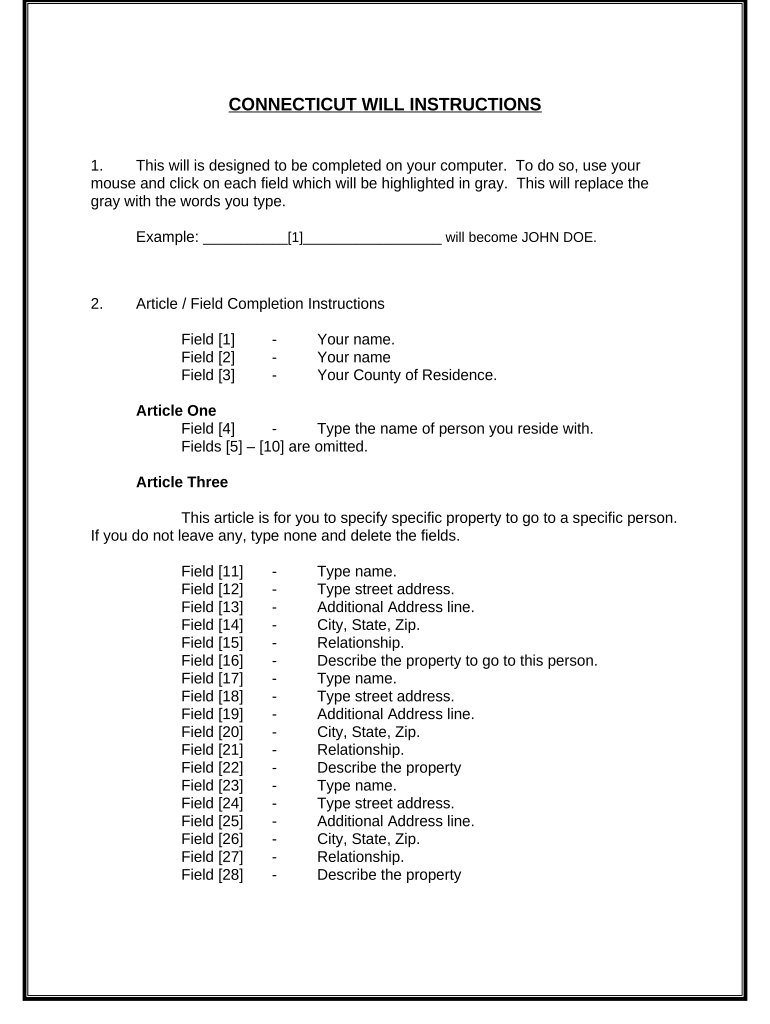
  2. Begin by entering your name in Field [1] and your county of residence in Field [3].
  3. In Article One, specify the name of the person you reside with in Field [4].
  4. For Article Three, list any specific property you wish to bequeath. If none, type 'none' and delete the fields.
  5. In Article Four, indicate the name of the person receiving your homestead in Field [29], checking the box if heirs are selected.
  6. Article Five requires you to designate a recipient for all remaining property. Fill out Field [31] accordingly.
  7. Designate your Personal Representative in Article Six by filling out Fields [34] and [35].
  8. Complete any optional provisions in Article Eleven as desired, ensuring to initial where applicable.
  9. Review all entries for accuracy before printing. Ensure signatures are obtained from two witnesses.

Start using our platform today to easily complete your Mutual Wills for free!

be ready to get more

Complete this form in 5 minutes or less

Get form

Got questions?

We have answers to the most popular questions from our customers. If you can't find an answer to your question, please contact us.
Contact us
Basic Requirements for a Valid Will in California The Testator Must Be at Least 18 Years Old. The person creating the will (testator) must be at least 18 years old and of sound mind at the time of execution. The Will Must Be in Writing. The Will Must Be Signed by the Testator. The Will Must Be Witnessed by Two Individuals.
You dont have to be legally married to be legally protected Make a Cohabitation Agreement to establish separate and shared property while you live together. Create a Last Will and Testament to ensure your partner receives a portion of your estate after you pass away.
Age: The testator must be at least 18 years old. Capacity: The testator must be of sound mind. Signature: The will must be signed by the testator. Witnesses: At least two witnesses must sign a Connecticut last will and testament in the presence of the testator in order for it to be valid.
Pitfalls of mutual wills First, they heavily restrict a surviving spouses choices. As they cannot validly revoke the mutual will, they are stuck with it for the rest of their life. They cannot add or remove any beneficiaries, which means they cannot accommodate relationships that change over time.
A will or codicil shall not be valid to pass any property unless it is in writing, subscribed by the testator and attested by two witnesses, each of them subscribing in the testators presence; but any will executed ing to the laws of the state or country where it was executed may be admitted to probate in this

Security and compliance

At DocHub, your data security is our priority. We follow HIPAA, SOC2, GDPR, and other standards, so you can work on your documents with confidence.

Learn more
ccpa2
pci-dss
gdpr-compliance
hipaa
soc-compliance

People also ask

Connecticut Inheritance Law for Spouses If you die intestate in Connecticut, what your spouse inherits depends on whether or not you have living parents or descendants. If you dont, your spouse inherits everything.
If the decedents solely-owned assets include no real property and are valued at less than $40,000 which meets Connecticuts small estates limit then the assets and property of the estate can be settled without full probate, under a much shorter and easier process.
No. Connecticut does not require a will to be notarized to be valid. However, if the testator and witnesses sign the will in the presence of a notary who then notarizes the will, it is considered a self-proved will and there is no need to prove the will during probate, thereby speeding up the probate process.

Related links