






Definition and Meaning of a Colorado Quit Claim Deed
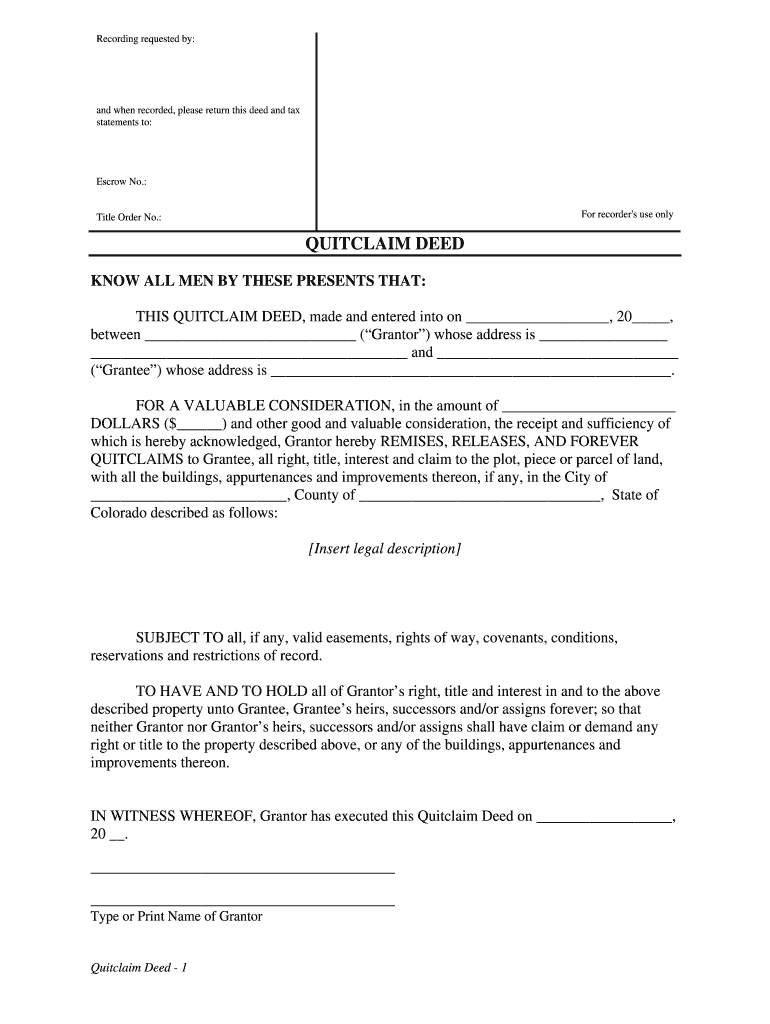
A Colorado quit claim deed is a legal document used to transfer ownership of property from one party, known as the grantor, to another party, the grantee. It involves no warranties or guarantees about the property title. This means the grantor transfers their interest in the property without ensuring the title is free from claims by others. Understanding this relinquishment of rights is crucial, as it affects the grantee's protection regarding the property title. This type of deed is often used among family members, divorces, or simple property transfers where the parties involved have an established trust.
Important Terms Related to Colorado Quit Claim Deed
- Grantor: The person or entity transferring their interest in the property.
- Grantee: The recipient of the property interest being transferred.
- Title: Legal term for one's interest in or ownership of a property.
- Consideration: Something of value exchanged for the property, which can be money, services, or other items.
- Warranty: Assurance that the property title is clear of defects or claims.
Understanding these terms is vital for effectively navigating a quit claim deed process, ensuring all parties are aware of their roles and the nature of the property transfer.
Key Elements of the Colorado Quit Claim Deed
The Colorado quit claim deed must include several elements to be recognized legally:
- Identifying Information: Full names and contact details of both grantor and grantee.
- Property Description: Accurate legal description of the property, often referencing lot numbers, block numbers, and subdivision details.
- Consideration Clause: Statement noting the consideration, if any, given for the transfer. It might state monetary value or indicate it is a gift.
- Granting Clause: Specific language indicating the transfer, typically stating that the grantor "conveys and quitclaims."
- Signature and Notarization: The grantor's signature, witnessed by a notary public, to authenticate the document.
These elements ensure the document's validity and enforceability when recorded.
How to Obtain a Colorado Quit Claim Deed
Obtaining a Colorado quit claim deed involves several steps:
- Determine Your Need: Decide if the situation warrants a quit claim deed, considering the legal implications and lack of warranty.
- Prepare the Deed: Obtain a deed form, which can be purchased online or drafted by an attorney to meet specific needs.
- Complete the Form: Fill in the necessary information, ensuring accuracy in the names, addresses, and legal property description.
- Notarize the Document: Have the grantor sign the deed in front of a notary public to verify authenticity.
These steps ensure the deed is legally prepared for recording.
Steps to Complete the Colorado Quit Claim Deed
To correctly execute the Colorado quit claim deed, follow this process:
- Collect Required Details: Gather all needed information about the grantor, grantee, and property.
- Fill Out Form: Accurately complete the form with the collected information.
- Review and Confirm: Double-check entries to prevent errors that could complicate the process or invalidate the deed.
- Sign Before a Notary: Ensure the grantor signs the document before an authorized notary.
- Record the Deed: File the notarized deed with the county recorder's office where the property is located, making the transfer official.
These steps protect both grantor and grantee, ensuring a lawful and recognized property transfer.
Legal Use of the Colorado Quit Claim Deed
The quit claim deed is legally used in scenarios where property title assurance is not required. Common uses include:
- Family Transfers: Simplifying property reallocation among family members.
- Divorce Settlements: Transferring ownership as part of divorce agreements.
- Clear Title Clouds: Correcting defects or disputes in title records without title warranty.
Its use is not recommended where full title warranty is essential, such as in standard real estate transactions.
State-Specific Rules for the Colorado Quit Claim Deed
Colorado has specific guidelines that govern quit claim deeds:
- Homestead Laws: These laws protect homeowners from losing their residence due to creditor claims, affecting quit claims where the homestead is involved.
- Recording Fees: Vary by county for filing the deed; ensure you verify current fees for accurate budget planning.
- Multiple Properties: Separate deeds may be required for different properties within different counties.
Compliance with these rules is crucial to ensure the deed's validity and prevent legal disputes.
Examples of Using the Colorado Quit Claim Deed
Understanding real-world applications aids in appreciating this deed's utility. Examples include:
- Adding a Spouse to Title: Simplifying the inclusion process for household members.
- Transferring Property to an LLC: Facilitating property control within a business entity without warranties needed.
- Family Estate Planning: Streamlining transfers related to inheritance and asset division.
These examples underscore the deed's flexibility in personal and financial planning contexts.