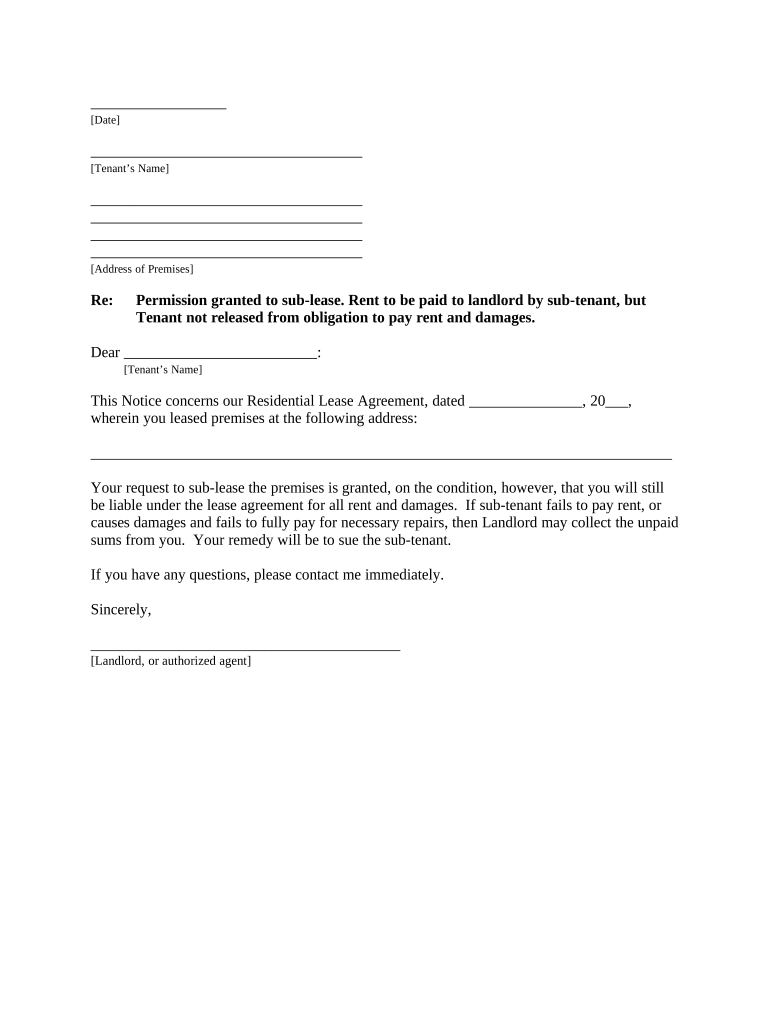
Letter from Landlord to Tenant that Sublease granted - Rent Paid by Subtenant, but Tenant Still Liable for Rent and Damages - Colorado 2026

Get Form
Letter from Landlord to Tenant that Sublease granted - Rent Paid by Subtenant, but Tenant Still Liable for Rent and Damages - Colorado Preview on Page 1

Here's how it works

01. Edit your form online
Type text, add images, blackout confidential details, add comments, highlights and more.
02. Sign it in a few clicks
Draw your signature, type it, upload its image, or use your mobile device as a signature pad.
03. Share your form with others
Send it via email, link, or fax. You can also download it, export it or print it out.

How to use or fill out Letter from Landlord to Tenant that Sublease granted - Rent Paid by Subtenant, but Tenant Still Liable for Rent and Damages - Colorado with our platform

Form edit decoration
9.5
Ease of Setup
DocHub User Ratings on G2
9.0
Ease of Use
DocHub User Ratings on G2
  1. Click ‘Get Form’ to open it in the editor.
  2. Begin by entering the date at the top of the document. This is essential for record-keeping.
  3. Fill in the Tenant’s Name and Address of Premises in the designated fields to personalize the letter.
  4. In the body of the letter, specify the date of the original Residential Lease Agreement. This provides context for your communication.
  5. Clearly state that permission is granted for sub-leasing, while emphasizing that the tenant remains liable for all rent and damages.
  6. Include a reminder about potential consequences if the sub-tenant fails to pay rent or causes damages.
  7. Conclude with a signature line for the Landlord or authorized agent, along with a space for the date signed.
  8. Finally, select how this notice was delivered to ensure proper documentation. Check one of the options provided.

Start using our platform today to easily complete and manage your rental documents online, for free!

be ready to get more

Complete this form in 5 minutes or less

Get form

Got questions?

We have answers to the most popular questions from our customers. If you can't find an answer to your question, please contact us.
Contact us
Colorado offers a balanced but landlord-friendly market, where eviction process in Colorado are not excessively difficult and landlords retain control over rental pricing. Though Colorado has some tenant protections, the state still favors landlords in key areas, such as security deposit handling and lease enforcement.
Under Colorado case law, unless the lease prohibits subleasing, a landlord may not unreasonably withhold permission to sublet. An assignment is legal transfer to a third party of a tenants right to possession of a rental property for a specific time frame.
Not only does the new law require landlords and property owners to provide a tenant with a valid reason for filing for an eviction, but the law also prohibits landlords and property owners from refusing to renew a tenants lease or use a lease holdover as grounds for eviction.
The new law aims to prevent arbitrary displacement of renters. Prior to the enactment of HB24‑1098, a landlord could decline to renew a lease without providing a tenant with a reason. Under the new law, a landlord must either offer a tenant a renewal or demonstrate cause to justify nonrenewal.
A substantial violation means any act that endangers the person or willfully and substantially endangers the property of the landlord, any joint tenant, or any other person living on or near the property, or occurs on or near the premises, and constitutes a violent or drug-related felony.

Security and compliance

At DocHub, your data security is our priority. We follow HIPAA, SOC2, GDPR, and other standards, so you can work on your documents with confidence.

Learn more
ccpa2
pci-dss
gdpr-compliance
hipaa
soc-compliance
be ready to get more

Complete this form in 5 minutes or less

Get form

People also ask

Landlords cannot retaliate against tenants for exercising their legal rights, such as reporting unsafe living conditions or requesting necessary repairs. Retaliatory actions, including raising rent, refusing to renew a lease, or attempting to evict a tenant in response to a complaint, are prohibited under Colorado law.
To evict a tenant in Colorado, the landlord must file a lawsuit and get a court order. Colorado has many tenant protection laws that apply to evictions. Colorado landlords must carefully follow the rules and procedures under Colorado law.

Related links