Type text, add images, blackout confidential details, add comments, highlights and more.
02. Sign it in a few clicks
Draw your signature, type it, upload its image, or use your mobile device as a signature pad.
03. Share your form with others
Send it via email, link, or fax. You can also download it, export it or print it out.
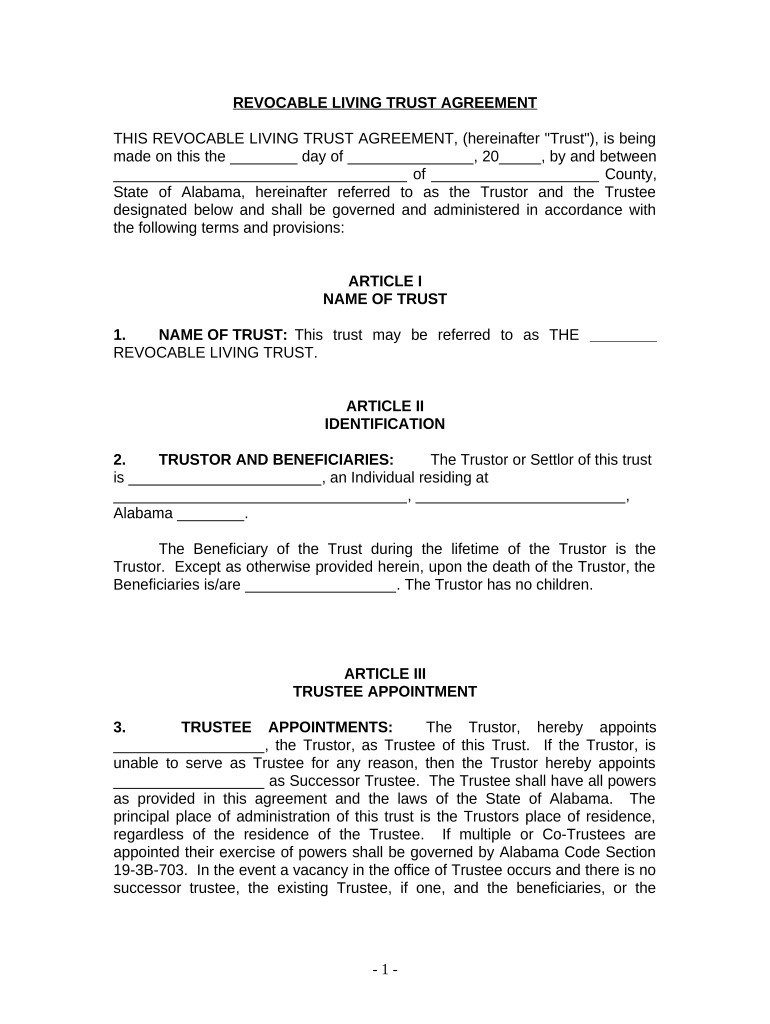
How to use or fill out Living Trust for Individual as Single, Divorced or Widow or Widower with No Children - Alabama
Ease of Setup
DocHub User Ratings on G2
Ease of Use
DocHub User Ratings on G2
Click ‘Get Form’ to open it in the editor.
Begin by entering the name of the Trustor and their county of residence in the designated fields. This identifies who is creating the trust.
In Article I, specify the name of your trust. This can be any name you choose, such as 'The [Your Name] Revocable Living Trust'.
Fill out Article II by providing your personal details as the Trustor and listing any beneficiaries if applicable. Since this form is for individuals without children, ensure that this section reflects that accurately.
Proceed to Article III to appoint yourself as Trustee. If you wish to designate a Successor Trustee, include their information here.
In Article IV, list all assets you wish to include in the trust on Exhibit A. This may include real estate, bank accounts, etc.
Review Articles V through XII carefully to understand your rights and responsibilities as Trustee and how distributions will be handled after your passing.
Start using our platform today to create your Living Trust effortlessly and for free!
Fill out Living Trust for Individual as Single, Divorced or Widow or Widower with No Children - Alabama online It's free
Best living trust for individual as single divorced or widow or widower with no children alabamaWhat is a living trustHow to make a living trust without a lawyerAlabama trust Filing requirementsLiving trust AlabamaAlabama revocable living trust formHow to set up a trust in AlabamaAlabama Family Trust
Security and compliance
At DocHub, your data security is our priority. We follow HIPAA, SOC2, GDPR, and other standards, so you can work on your documents with confidence.
If a widow and no children or descendants of a deceased child survive, all to the widow. If there is one child or descendants of a deceased child, the widowRead more
Aug 19, 2020 This step-by-step guide helps surviving spouses in the state of Alabama through the decisions they may need to make in this difficult period.Read more
23: Agnes Callard - Courage, Meta-cognitive detachment and
Sep 23, 2024 Philosopher and University of Chicago Professor Agnes Callard sits down with Eric on this episode of The Portal. Agnes is a champion of theRead more
Cookie consent notice
This site uses cookies to enhance site navigation and personalize your experience.
By using this site you agree to our use of cookies as described in our Privacy Notice.
You can modify your selections by visiting our Cookie and Advertising Notice.