




2009 form 941-2026

Get Form
form 941 Preview on Page 1

Here's how it works

01. Edit your form 941 online
Type text, add images, blackout confidential details, add comments, highlights and more.
02. Sign it in a few clicks
Draw your signature, type it, upload its image, or use your mobile device as a signature pad.
03. Share your form with others
Send it via email, link, or fax. You can also download it, export it or print it out.

Definition and Purpose of the 2009 Form 941

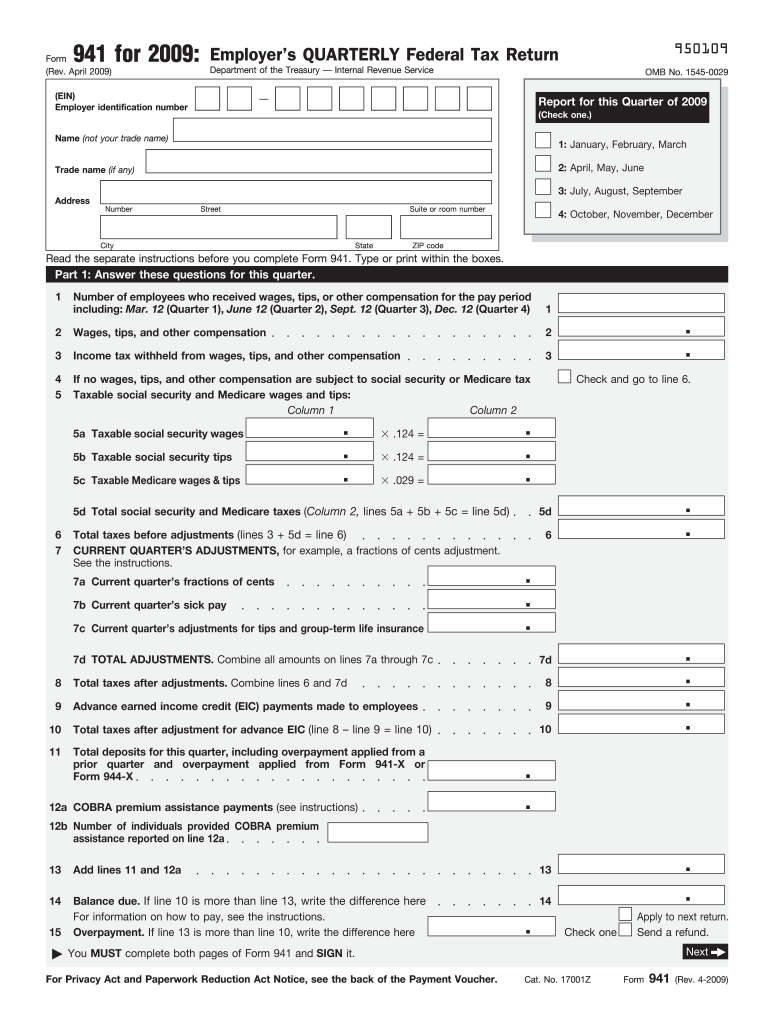
The 2009 Form 941, officially known as the Employer's Quarterly Federal Tax Return, is a crucial document for employers in the United States. It is used to report quarterly payroll taxes, including wages, tips, and other forms of compensation paid to employees. This form also captures the federal income tax withheld from employees' pay, as well as the employer and employee portions of Social Security and Medicare taxes. The accurate completion of this form is essential for compliance with federal tax laws, as it informs the IRS about an employer's tax liabilities.

Key Components of the 2009 Form 941

  • Employer Identification: Employers must provide their legal name, trade name (if different), address, and Employer Identification Number (EIN). This information is vital for the IRS to match the form with the correct employer account.
  • Wages and Taxes: The form includes sections for reporting total wages paid, tips received, and other compensation. Employers must also calculate and report the federal income tax withheld and the respective Social Security and Medicare taxes.
  • Tax Credits: Employers can report any eligible tax credits that reduce their overall tax liabilities, such as the Credit for Qualified Sick and Family Leave Wages.

Steps to Complete the 2009 Form 941

Completing the 2009 Form 941 requires careful attention to detail to ensure accurate reporting of taxes owed.

  1. Gather Necessary Information: Collect payroll records, including total wages, the number of employees, tips, and any tax liabilities from the previous quarter.
  2. Enter Employer Information: Fill in the employer's legal name, EIN, and address at the top of the form.
  3. Report Employee Wages: In the designated sections, report the total wages, tips, and other compensation paid during the quarter.
  4. Calculate Taxes: Based on reported wages, calculate federal income tax withheld, as well as the total Social Security and Medicare taxes owed. Ensure accurate calculations to avoid penalties.
  5. Tax Payments: If applicable, report any tax payments made since the last filing. This ensures that the IRS has an accurate record of payments.
  6. Review and Sign: Verify all entries for accuracy. Then, sign and date the form before submission.

By meticulously following these steps, employers can accurately report their payroll tax obligations, minimizing the risk of errors.

How to Obtain the 2009 Form 941

Employers can access the 2009 Form 941 from various sources to ensure they are using the correct version.

  • IRS Website: The easiest way to obtain Form 941 is by downloading it directly from the IRS official website. The form is available as a PDF, allowing for printing and manual completion.
  • Tax Preparation Software: Many tax preparation software programs, including TurboTax and QuickBooks, automatically include Form 941 as part of their tax filing features, streamlining the process for users.
  • Professional Tax Preparers: Employers can also request the form from professional tax preparers or certified public accountants (CPAs) who can assist with compliance and filing.

Filing Deadlines for the 2009 Form 941

Filing deadlines for the 2009 Form 941 are critical to maintain compliance with federal tax regulations. Employers must submit the form by the last day of the month following the end of each quarter:

  • Quarter 1: January 1 - March 31, due by April 30, 2009
  • Quarter 2: April 1 - June 30, due by July 31, 2009
  • Quarter 3: July 1 - September 30, due by October 31, 2009
  • Quarter 4: October 1 - December 31, due by January 31, 2010

Failure to file by these deadlines can result in penalties.

Important Terms Related to the 2009 Form 941

Understanding key terms associated with the 2009 Form 941 aids in the accurate completion and comprehension of the form:

  • FICA: Refers to the Federal Insurance Contributions Act, which mandates the collection of Social Security and Medicare taxes.
  • Withholding Tax: The portion of an employee's wages that an employer officially deducts for federal income tax.
  • Payroll Tax: Taxes imposed on employers and employees, calculated as a percentage of the salaries that employers pay their staff. This includes Social Security and Medicare taxes.

Each of these terms is integral to proper reporting and compliance, ensuring that employers and their employees understand their tax obligations.

Legal Use of the 2009 Form 941

The 2009 Form 941 serves a legal purpose in establishing an employer's compliance with IRS reporting and payment obligations. Under U.S. tax law, employers are required to:

  • Accurately report wages, tips, and other compensations to the IRS.
  • Pay federal taxes associated with employee wages, including income tax withholding and FICA taxes.
  • Retain completed copies of Form 941 for at least four years after the date of filing for recordkeeping and possible audits.

Employers who fail to meet these legal requirements may face significant penalties, including fines and increased scrutiny from tax authorities.

Through understanding and adhering to the guidelines of the 2009 Form 941, employers can ensure their compliance with federal tax regulations.

See more 2009 form 941 versions

We've got more versions of the 2009 form 941 form. Select the right 2009 form 941 version from the list and start editing it straight away!
Versions Form popularity Fillable & printable
2024 4.8 Satisfied (58 Votes)
2023 4.2 Satisfied (60 Votes)
2022 4.8 Satisfied (92 Votes)
2022 4.4 Satisfied (44 Votes)
2021 4.3 Satisfied (182 Votes)
2021 4.3 Satisfied (151 Votes)
2020 4.4 Satisfied (186 Votes)
2020 4.3 Satisfied (183 Votes)
2020 4.1 Satisfied (43 Votes)
2019 4.1 Satisfied (40 Votes)
2018 4.4 Satisfied (178 Votes)
2017 4.1 Satisfied (60 Votes)
2016 4.4 Satisfied (389 Votes)
2015 4.3 Satisfied (39 Votes)
2014 4.3 Satisfied (28 Votes)
be ready to get more

Complete this form in 5 minutes or less

Get form

Got questions?

We have answers to the most popular questions from our customers. If you can't find an answer to your question, please contact us.
Contact us
Multi-Member LLC (Partnership): If your LLC has two or more members, it will be treated as a partnership, and you must file Form 941. LLC as Corporation: If your LLC is registered as either S-Corp or C-Corp, you must file a 941 to report the taxes withheld from your employee paychecks.
When it comes to IRS Form 941 and the W-2, the most important point to remember is that both involve reporting employee wages. Form 941 provides the IRS with a quarterly snapshot of employment taxes, while the W-2 serves as an individual employees record of earnings and tax withholdings for the entire year.
Employers use Form 941 to: Report federal income, social security, and Medicare taxes withheld from employees paychecks, and. Report the employers share of social security and Medicare taxes.
If both an employer and a section 3504 authorized agent (or CPEO or other third-party payer) paid wages to an employee during a quarter, both the employer and the section 3504 authorized agent (or CPEO or other third-party payer, if applicable) should file Form 941 reporting the wages each entity paid to the employee
Generally, you must file Form 941, Employers Quarterly Federal Tax Return or Form 944, Employers Annual Federal Tax Return to report wages youve paid and tips your employees have reported to you, as well as employment taxes (federal income tax withheld, Social Security and Medicare taxes withheld, and your share of
be ready to get more

Complete this form in 5 minutes or less

Get form

People also ask

Your business will incur a penalty of 5% of the total tax amount due. You will continue to be charged an additional 5% each month the return is not submitted to the IRS for up to 5 months. The penalty will max up to 25% of the unpaid taxes.
Youre required to deposit 100% of your tax liability on or before the deposit due date. Penalties may apply for depositing late, depositing less than the required amount, or for mailing payments directly to the IRS instead of depositing the amounts. The IRS may waive penalties in certain cases.

Related links