Marital Legal Separation and Property Settlement Agreement for persons with No Children, No Joint Property or Debts where Divorce Action Filed - Delaware 2026

Get Form
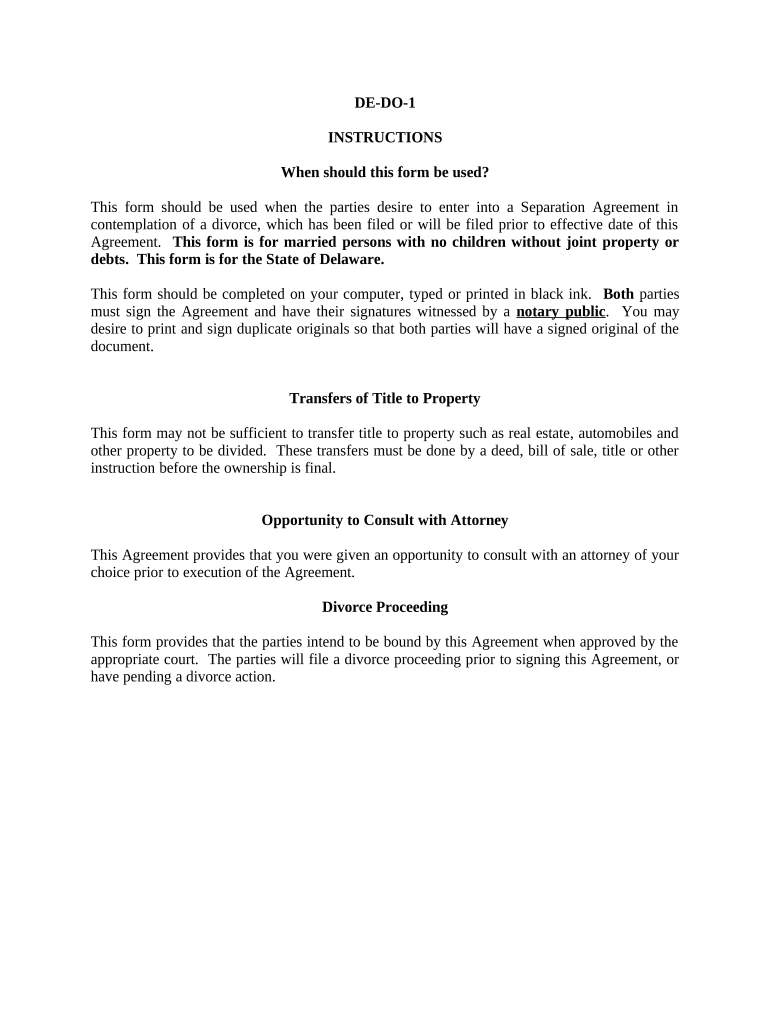
delaware separation agreement Preview on Page 1

Here's how it works

01. Edit your delaware separation agreement online
Type text, add images, blackout confidential details, add comments, highlights and more.
02. Sign it in a few clicks
Draw your signature, type it, upload its image, or use your mobile device as a signature pad.
03. Share your form with others
Send legal separation delaware via email, link, or fax. You can also download it, export it or print it out.

How to use or fill out Marital Legal Separation and Property Settlement Agreement for persons with No Children, No Joint Property or Debts where Divorce Action Filed - Delaware

Form edit decoration
9.5
Ease of Setup
DocHub User Ratings on G2
9.0
Ease of Use
DocHub User Ratings on G2
  1. Click ‘Get Form’ to open it in the editor.
  2. Begin by entering the full legal names of both parties in the designated fields at the top of the form.
  3. Fill in the date of marriage and the county where it took place, followed by the date of separation and relevant county details.
  4. In Section 1, confirm that both parties agree to live separately without interference. Initial each section as required.
  5. Complete Section 2 by disclosing financial statuses, ensuring all assets and liabilities are accurately represented.
  6. In Section 3, specify ownership of personal property and any agreements regarding household furnishings. Ensure clarity on who retains what items.
  7. Proceed through Sections 4 to 11, confirming mutual waivers, debts, and future earnings as outlined in each section.
  8. Finalize by signing and dating the document. Ensure both parties have their signatures witnessed by a notary public.

Start using our platform today to easily complete your Marital Legal Separation Agreement for free!

be ready to get more

Complete this form in 5 minutes or less

Get form

Got questions?

We have answers to the most popular questions from our customers. If you can't find an answer to your question, please contact us.
Contact us
A settlement agreement differs from a separation agreement as it sets the terms for the divorce, not the separation. A settlement agreement should address all central issues of the divorce. This can include things like division of marital assets and debts, child custody, and child support, as well as spousal support.
Assets that may be protected from equitable distribution during a divorce are typically belong to one of two types: premarital property that has been kept from being commingled or transitioned and gifts or inheritances.
If you have been married for 20 years or longer, there is no limit to how long you can receive alimony. However, under Delaware law if you were married for less than 20 years, you cannot collect alimony for more than 50% of the length of the marriage.
5 Years: Alimony is awarded for approximately half of the period of your marriage if you have been married for less than five years. 10-20 years: You should expect to pay alimony for 60 to 70% of the length of your marriage on average.
There is no minimum marriage length to qualify for alimony, but the easier it is for the lower-earning spouse to become self-sufficient, the less support they may receive.

Security and compliance

At DocHub, your data security is our priority. We follow HIPAA, SOC2, GDPR, and other standards, so you can work on your documents with confidence.

Learn more
ccpa2
pci-dss
gdpr-compliance
hipaa
soc-compliance

People also ask

Separation in Delaware There is no separate legal separation provision in our state. However, spouses wishing to live apart but not necessarily divorce can negotiate a Separation Agreement in Delaware. Generally, in this case, spouses are in agreement regarding the ending of the marriage.
Qualifying for Alimony in Delaware dependency on the other spouse and that the paying spouse doesnt make court-ordered payments to anyone else. a lack of property, including marital, to meet reasonable needs during and after the divorce.

Related links