Agreement for Payment of Unpaid Rent - Delaware 2026

Get Form
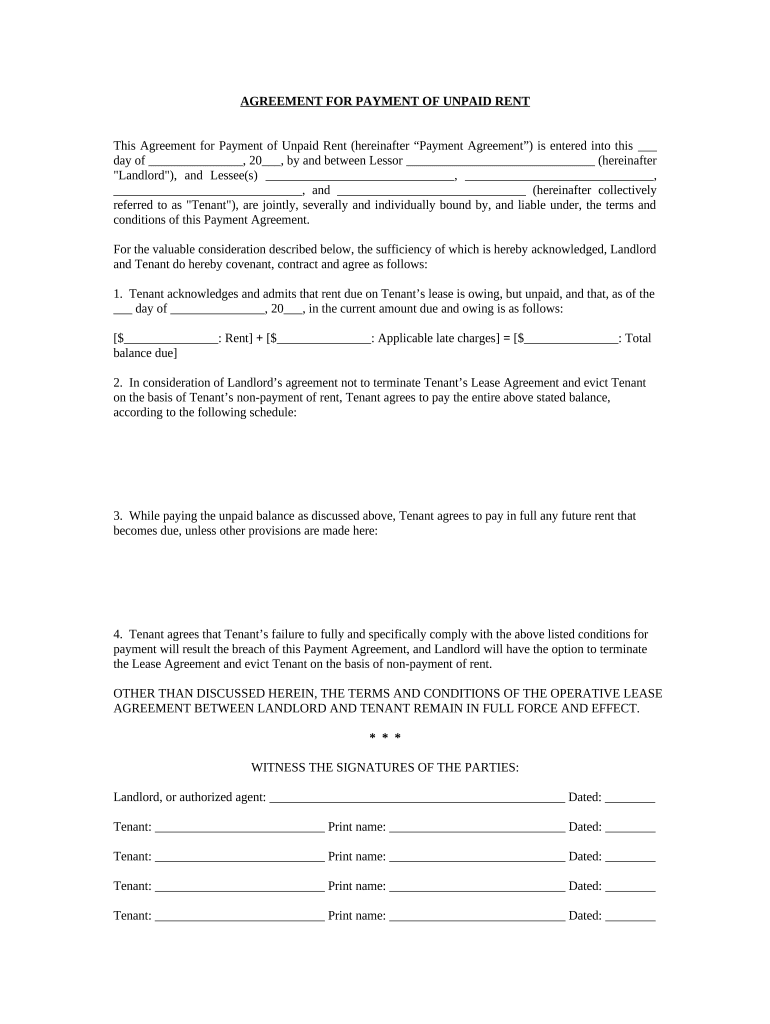
Agreement for Payment of Unpaid Rent - Delaware Preview on Page 1

Here's how it works

01. Edit your form online
Type text, add images, blackout confidential details, add comments, highlights and more.
02. Sign it in a few clicks
Draw your signature, type it, upload its image, or use your mobile device as a signature pad.
03. Share your form with others
Send it via email, link, or fax. You can also download it, export it or print it out.

How to use or fill out Agreement for Payment of Unpaid Rent - Delaware with our platform

Form edit decoration
9.5
Ease of Setup
DocHub User Ratings on G2
9.0
Ease of Use
DocHub User Ratings on G2
  1. Click ‘Get Form’ to open the Agreement for Payment of Unpaid Rent in the editor.
  2. Begin by entering the date at the top of the form, where it states 'this ___ day of ______, 20___'.
  3. Fill in the name of the Landlord in the designated space after 'by and between Lessor'.
  4. List all Tenant names in the section provided, ensuring each name is clearly written.
  5. In Section 1, input the total rent due and any applicable late charges. Calculate and enter the total balance due.
  6. Outline a payment schedule in Section 2, detailing how and when payments will be made.
  7. Confirm that you will pay future rent as stated in Section 3, unless otherwise agreed upon.
  8. Review Section 4 regarding compliance with payment conditions to avoid lease termination.
  9. Finally, ensure all parties sign and date at the bottom of the document to finalize the agreement.

Start using our platform today to easily complete your Agreement for Payment of Unpaid Rent online for free!

be ready to get more

Complete this form in 5 minutes or less

Get form

Got questions?

We have answers to the most popular questions from our customers. If you can't find an answer to your question, please contact us.
Contact us
For late rental payments, landlords issue a 5-Day Notice to Pay. If the tenant doesnt pay within this period, eviction proceedings can start. For month-to-month tenancy, a 60-day notice is required to end the lease agreement. The Delaware Landlord-Tenant Code requires landlords to follow certain procedures.
5 Things You Should Never Say When Renting an Apartment I hate my current landlord Every potential landlord is going to ask why youre moving. Let me ask you one more question I cant wait to get a puppy My partner works right up the street I move all the time
The initial notice period takes about 5 to 60 days from the Notice to Vacate/Quit issuance. This depends on the reason for the eviction lawsuit and the rent or lease agreement.
(a) Except as is otherwise provided in this part, whenever either party to a rental agreement rightfully elects to terminate, the duties of each party under the rental agreement shall cease and all parties shall thereupon discharge any remaining obligations as soon as is practicable.
Delaware Eviction Time Estimates ActionDuration Eviction hearing No designated time Issuance/service of writ of possession 10+ days Time to quit after writ is posted 24 hours Total 1-3 months3 more rows Jul 14, 2025

Security and compliance

At DocHub, your data security is our priority. We follow HIPAA, SOC2, GDPR, and other standards, so you can work on your documents with confidence.

Learn more
ccpa2
pci-dss
gdpr-compliance
hipaa
soc-compliance

People also ask

5513. Landlord remedies relating to bdocHub of rules and covenants. (a) If the tenant bdocHubes any rule or covenant which is material to the rental agreement, the landlord shall notify the tenant of such bdocHub in writing, and shall allow at least 7 days after such notice for remedy or correction of the bdocHub.
5514. Security deposit. (a) (1) A landlord may require the payment of security deposit. (2) No landlord may require a security deposit in excess of 1 months rent where the rental agreement is for 1 year or more.
Payment deadlines for damages after moving out depend on lease terms and local laws. Typically, landlords must provide an itemized list of damages and related costs within a specified period, often 14 to 30 days after tenancy ends. Tenants usually have a set time to pay or dispute charges.

Related links